





.jpg)
To track smart money on Solana, monitor selected wallets through RPC, WebSockets, or Yellowstone gRPC, then enrich raw transactions with labels, token metadata, DEX context, liquidity data, and risk filters.
The business problem is not just wallet discovery. Manual tracking misses entries, sends late alerts, and creates false confidence during volatility. A production-grade setup treats wallet monitoring as a data pipeline: ingestion, parsing, enrichment, scoring, alerting, and observability.
For trading teams, DeFi builders, analytics platforms, and MEV researchers, the target outcome is simple: fresher wallet events, fewer false signals, and less dependency on fragile public dashboards.
TL;DR
- Smart-money tracking on Solana works best as a real-time data pipeline, not a copy-trading shortcut.
- Start with a qualified wallet list, monitor activity through RPC, WebSockets, or Yellowstone gRPC, then parse transactions, resolve Address Lookup Tables, enrich events with token and liquidity context, and score alerts before they reach traders or internal systems.
| Method | Best for | Latency profile | Cost profile | Main limitation |
|---|---|---|---|---|
HTTP polling withgetSignaturesForAddress
|
Backfills, history, low-frequency alerts | Slow to medium | Lower | Weak fit for real-time detection |
| WebSocket subscriptions | Live account, log, slot, and signature events | Medium to fast | Medium | Reconnects, noisy streams, subscription limits |
| Yellowstone gRPC / Geyser streaming | High-volume monitoring, trading systems, analytics pipelines | Fast | Higher | More parser and filtering work |
- Use HTTP RPC for historical backfills, WebSockets for live dashboards, and Yellowstone gRPC for high-volume monitoring where event freshness matters. The main risks are noisy alerts, missed accounts in versioned transactions, stale data, weak wallet labels, and RPC limits during market volatility.
- For production use, measure slot lag, stream reconnects, parser failures, queue depth, and p95 alert latency.
What “smart money” means on Solana
Smart money wallet refers to the successful track record of strategic investments made by insiders who influence market trends. It does not typically mean “large wallet.” A whale address with poor entries is still noise. Useful smart-money categories include:
- Profitable DEX traders
- Early liquidity providers
- Successful token deployers
- MEV and searcher wallets
- Market makers
- Wallets that rotate early into new narratives
- Wallets linked to repeated profitable exits
Treat every label as probabilistic. A wallet that bought early once is not a strategy. A useful label needs transaction history, entry timing, exit behavior, position size, token selection, and failure rate.
.jpg)
Copy-trading without context is dangerous. A wallet transfer, swap, LP add, claim, bridge movement, or token account cleanup has a different meaning. A monitoring system should classify behavior before it sends alerts.
The data you need to track wallets
A Solana wallet tracker needs more than signatures. The minimum useful data model includes:
- Watched wallet address
- Wallet label and confidence score
- Transaction signature
- Slot and block time
- Commitment level
- Parsed instructions
- Token account changes
- SPL token transfers
- DEX swap route
- Liquidity pool address
- Token mint
- Token metadata
- Priority fee data
- Failed transaction status
- Historical wallet performance
Versioned transactions add another requirement: correct Address Lookup Table resolution. If the parser ignores lookup tables, it risks missing accounts touched by the transaction. That breaks wallet attribution, DEX route detection, and token movement analysis.
For production systems, store raw events before enrichment. Raw storage gives the team replay capability after parser bugs, RPC incidents, or schema changes.
Three ways to monitor smart money wallets
.jpg)
HTTP polling works for historical analysis. For example, a system scans known profitable wallets, fetches recent signatures, retrieves transactions, and calculates PnL over time. This is useful for wallet discovery and backtesting.
WebSockets fit live dashboards and alerting. Solana WebSocket methods support subscriptions for accounts, programs, logs, signatures, slots, and blocks. For wallet tracking, logsSubscribe with mentions is useful, but one subscription supports one mentioned address. Large watchlists need connection planning. On RPC Fast, concurrent WebSocket subscriptions are capped per plan: 1 on the free Start plan, 10 on Focus, 20 on Stream, and 50 on Aperture.
Yellowstone gRPC fits systems where delivery delay matters. It streams Solana data through the Geyser interface and supports slots, blocks, transactions, and account updates. For HFT, MEV, and real-time analytics, this is usually the stronger base layer. On RPC Fast, Yellowstone gRPC starts on the Stream plan with up to 10 concurrent streams and goes to 25 on Aperture, and its server-side filters accept up to 10 pubkeys and 2 data slices each, with block filters disabled.

Yellowstone gRPC
Structured transaction and account streams tuned for execution systems.
Lower overhead than JSON RPC. Stable p95 under burst load.

Ordered transaction feeds

Account + slot streams

Fine-grained filters
Reference architecture for wallet monitoring
A reliable Solana smart-money tracker has seven layers.
.jpg)
1. Watchlist service
Stores wallet addresses, labels, confidence scores, risk tags, and data sources.
2. Data ingestion
Uses RPC for backfills and WebSocket or gRPC for live updates. Historical reads and real-time streams should not share the same queue.
3. Transaction parser
Decodes instructions, resolves Address Lookup Tables, maps program IDs, detects DEX swaps, and separates transfers from trades.
4. Enrichment layer
Adds token metadata, pool liquidity, price, wallet history, token age, and routing context.
5. Scoring engine
Ranks events by wallet quality, trade size, token liquidity, first interaction, prior performance, and cluster behavior.
6. Alerting layer
Sends filtered events to Slack, Telegram, webhooks, dashboards, or internal trading systems.
7. Observability
Tracks stream lag, slot delay, reconnects, parse failures, dropped events, queue depth, and p95 alert latency.
This structure keeps trading logic separate from raw data transport. That separation reduces incident impact when RPC behavior, parser code, or alert rules change.
Practical alert rules that reduce noise
Bad wallet trackers alert on everything. Useful systems rank events.
Practical alert rules:
- Alert only above a defined USD size;
- Suppress known spam tokens;
- Require minimum pool liquidity;
- Mark first wallet interaction with a token;
- Separate buys, sells, LP events, transfers, and claims;
- Score wallets by historical behavior;
- Track exits, not only entries;
- Flag coordinated buys from related wallets;
- Ignore dust movements and cleanup transactions;
- Downgrade alerts from wallets with recent losses.
Example:
A wallet buys a new token for $400 in a thin pool. Another wallet buys $25,000 into a pool with deep liquidity, then three historically profitable wallets follow within two minutes. The second event deserves higher priority. The value is not the buy alone. The value comes from size, liquidity, timing, and cluster behavior.
.png)
Latency, reliability, and RPC infrastructure
Smart-money tracking is latency-sensitive when alerts feed execution. During volatile markets, weak infrastructure creates three failure modes:
- Late event delivery
- Stale transaction context
- Missed or duplicated alerts
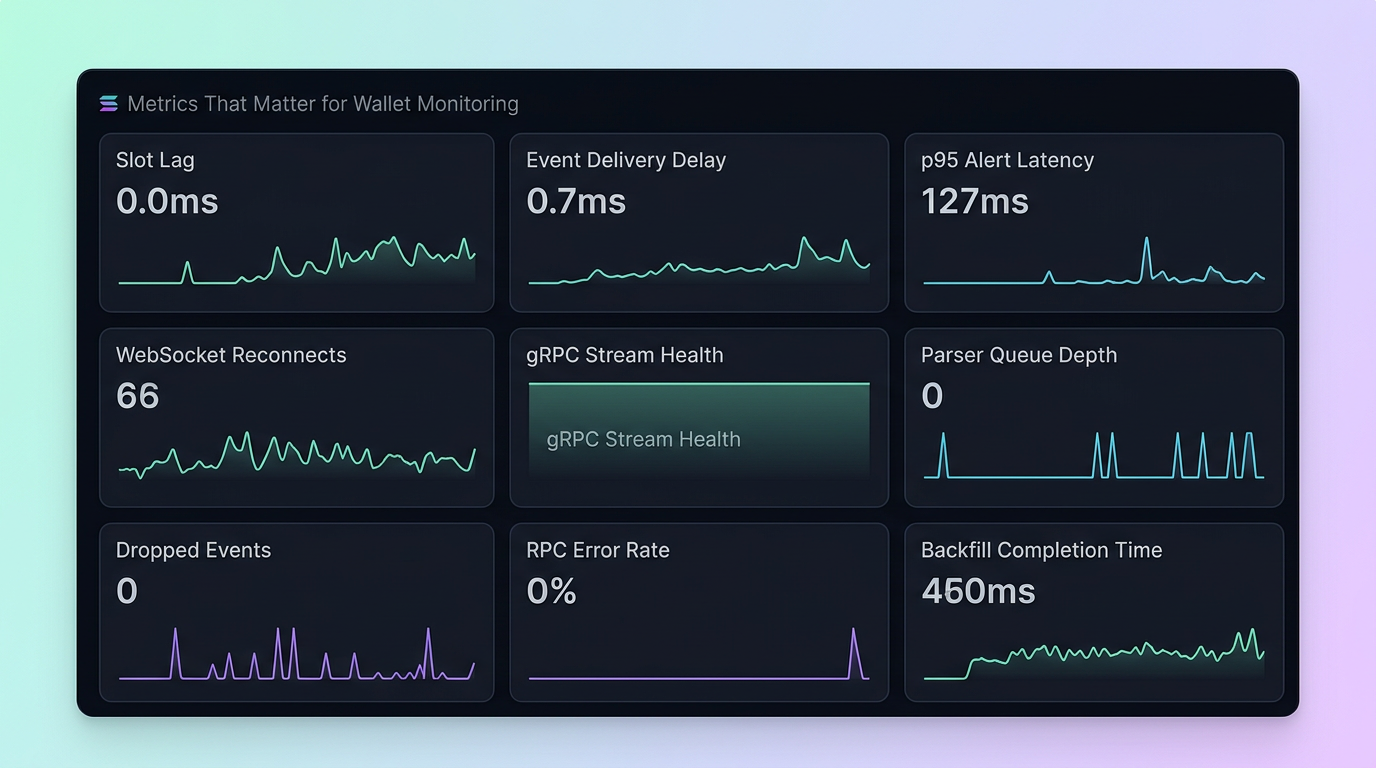
The core metrics to monitor:
- Slot lag
- Event delivery delay
- WebSocket reconnect frequency
- Missed subscription count
- Parser queue depth
- p95 alert latency
- RPC error rate
- Backfill completion time
Commitment level also matters. processed gives earlier visibility with rollback risk. confirmed gives stronger reliability with slightly later data. finalized is safer for accounting and analytics, but too slow for execution-sensitive alerts.
Aperture TxStream narrows that tradeoff on the Aperture plan: it attaches a predicted execution result to each transaction while it is still in flight, before it lands, with roughly 95% accuracy against actual execution and about +791 µs added to median delivery. On the Stream plan, TxStream is available without execution simulation.
For many dashboards, shared RPC and WebSockets are enough. For trading systems, dedicated Solana RPC or Yellowstone gRPC provides more control over stream quality, concurrency, and filtering.
RPC Fast supports Solana RPC, WebSocket access, Yellowstone gRPC, Shredstream gRPC, and dedicated node infrastructure for workloads that depend on real-time chain data. Monitoring can start on the free Start plan at $0 with no card, move up through paid SaaS plans as watchlists and stream counts grow, and scale to dedicated bare-metal Solana nodes from $2,200/month with the server, setup and maintenance included, delivered within 72 hours.
Common mistakes in smart money tracking
The most common mistake is treating wallet monitoring as a list of addresses. The address is only the input.
Avoid these failures:
- Treating every whale as smart money;
- Ignoring failed transactions;
- Tracking buys but not exits;
- Parsing token transfers as swaps;
- Missing Address Lookup Table accounts;
- Relying only on finalized data for trading alerts;
- Sending alerts without liquidity filters;
- Copying wallets without wallet-level backtesting;
- Using one RPC endpoint without failover;
- Storing enriched events but not raw events;
- Ignoring parser error rates.
A monitoring system is only as accurate as its parser. If it misclassifies an LP add as a buy, the alert feed becomes a liability.
Shared RPC vs gRPC vs Dedicated nodes
| Setup | Use when | Avoid when |
|---|---|---|
| Shared RPC | Research, dashboards, light backfills, low-frequency alerts | Execution depends on low latency |
| WebSocket-heavy RPC | Live wallet alerts, dashboards, event-driven apps | Watchlists become large or streams become noisy |
| Yellowstone gRPC | Real-time transaction monitoring, analytics, trading infrastructure | The team lacks parser and stream-filtering capacity |
| Dedicated Solana nodes | HFT, MEV, high-throughput analytics, private plugins, custom regions | Traffic is small or budget does not justify operations |
There is no universal best choice.
A research dashboard usually starts with RPC polling and WebSockets. A trading desk needs lower stream delay, better observability, and tighter control over node placement. A data company needs replay, deduplication, schema stability, and parser accuracy.
The correct architecture follows the business risk. If a late signal loses money, invest in streaming and node quality. If the product is exploratory analytics, start simpler and optimize after measuring bottlenecks.
Implementation checklist for smart money tracking
Use this checklist before shipping a wallet monitoring system:
- Define wallet selection criteria
- Backfill wallet history
- Label wallets by behavior, not social lists
- Choose RPC, WebSocket, or gRPC ingestion
- Decode versioned transactions
- Resolve Address Lookup Tables
- Enrich token, pool, and price context
- Score alerts by size, liquidity, and wallet quality
- Measure p95 alert latency
- Track stream reconnects and parser failures
- Store raw events for replay
- Test during high-volume market periods
- Add failover for RPC and streaming endpoints
A system that works during quiet hours is not production-ready. Test it during token launches, NFT mints, and meme coin volatility. Those events expose rate limits, slow queues, reconnect loops, and parser edge cases.
Power up your tracking with our expertise
Smart-money tracking on Solana works when wallet activity becomes structured data. The stack needs historical RPC reads, real-time streams, accurate transaction parsing, enrichment, scoring, and observability.
Remember that your goal is faster, cleaner signal detection with enough context to reduce bad alerts.
Questions about wallet monitoring infrastructure? RPC Fast engineers answer in the chat
Join the RPC Fast Solana chat.jpg)


.jpg)


