
SOLANA RPC COMMUNITY
Built for Solana builders.Run by operators.
Join builders running HFT bots, DEX tools, and AI agents on Solana.
Join Discord

Special offers

Live support

No spam

SOLANA RPC COMMUNITY
Built for Solana builders.Run by operators.
Join builders running HFT bots, DEX tools, and AI agents on Solana.
Join DiscordSpecial offers
Live support
No spam


blockchains available
deployment zones
managed
From
+ infrastructure
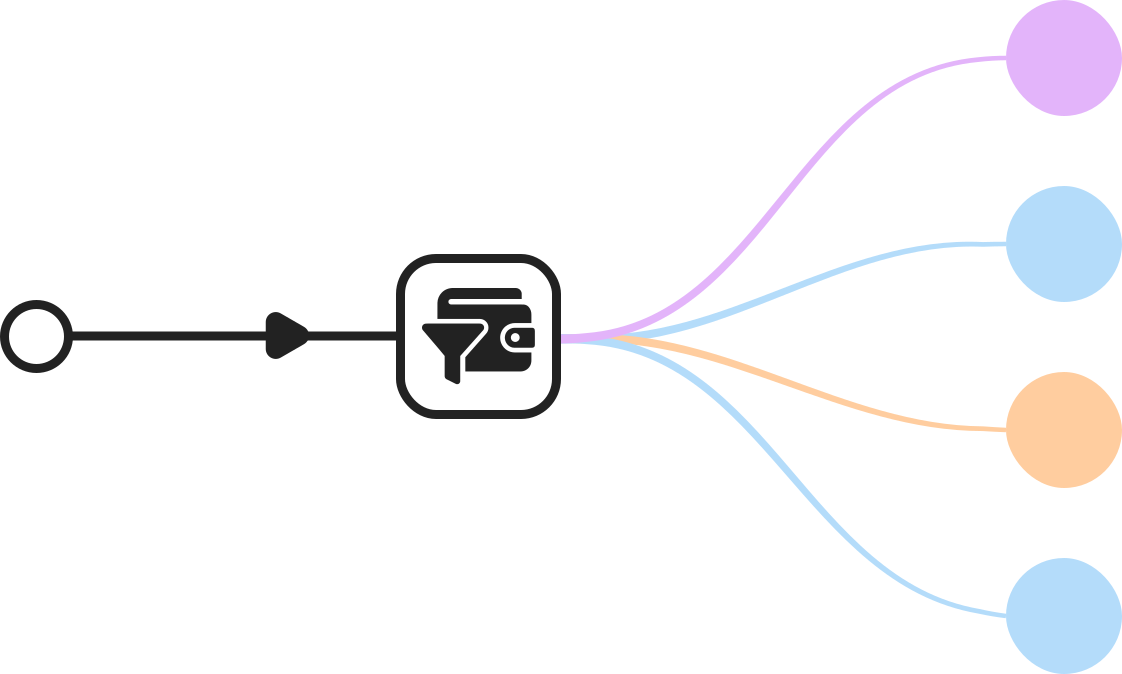
RPC Fast manages the infrastructure layer around the blockchain clients as well: routing, health, scaling, monitoring, recovery, security, and workload-specific tooling.

Health-aware load balancing

Private, isolated infrastructure

Custom data and performance stack

Geo-distributed deployment

Automated recovery and scaling

Managed by blockchain DevOps engineers

Blockchain analytics & trading data • Solana • Hybrid OVHcloud architecture
Learn moreTwo-node setup with limited resilience
Load balancing existed, but without advanced monitoring or caching.
Infrastructure lacked automation
Node deployment and lifecycle operations required more manual work.
High Solana resource pressure
Nodes still failed under Solana v1.18 even with 1 TB RAM configurations.
Cloud economics did not fit the workload
~80 TB monthly bandwidth per node plus high RAM requirements made hyperscaler infrastructure expensive.
Hybrid bare-metal + cloud cluster
Solana nodes run on OVHcloud bare metal while Kubernetes control, monitoring, and supporting services use public cloud.
Geo-distributed, redundant infrastructure
Multiple locations, private networking, load balancing, and additional live nodes improve availability.
Automated node lifecycle
Kubernetes, Helm, and GitHub Actions standardize deployment and infrastructure operations.
Production observability
Prometheus/VictoriaMetrics, Grafana Loki, and Promtail provide monitoring, alerts, and centralized logs.

Result: a cost-efficient Solana cluster designed for high availability, low latency, automated operations, and blockchain analytics/trading workloads.


Shortest path
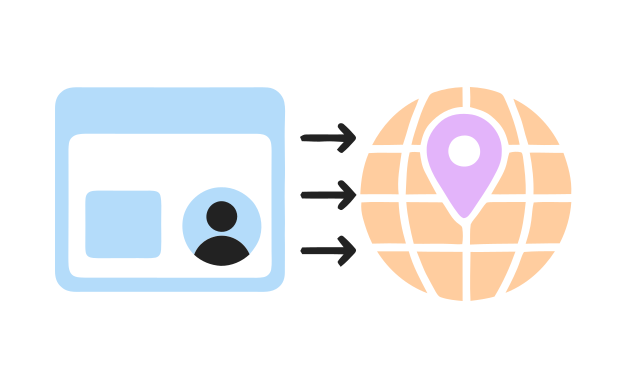
Multi-region entry
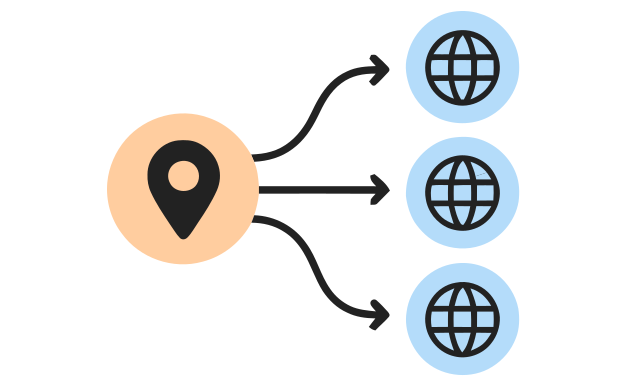
Healthy-node selection
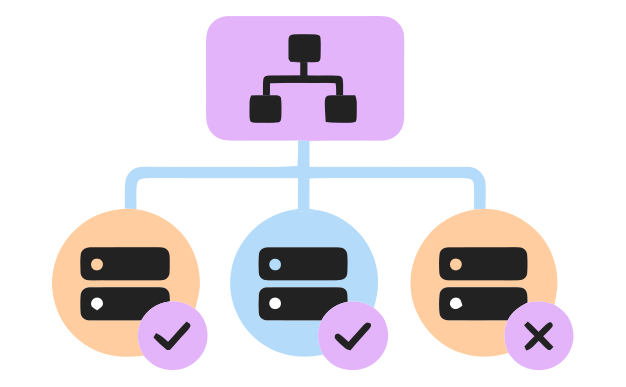
Isolated capacity
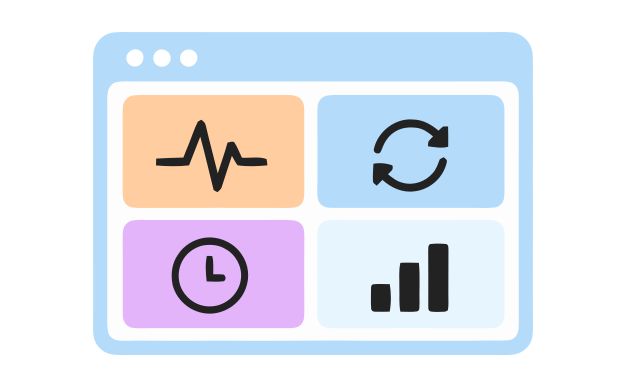
Watches the cluster
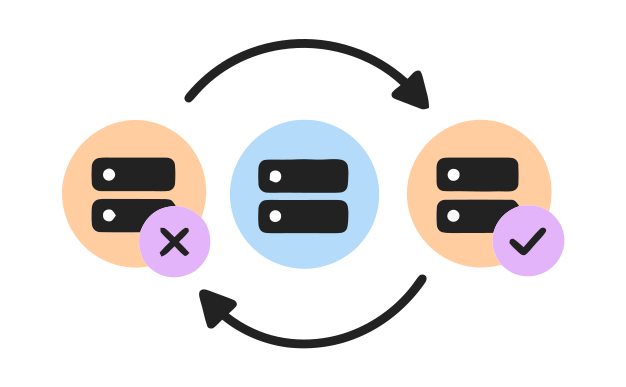
Failover, scale, restore


Nearest region

Healthy node

Isolated capacity

Automated failover

Managed recovery












.svg)


The DevOps engineers' work is organized in such a way that their response takes minimal time.

See on Clutch
-min.avif)

Dysnix team has changed a lot of things in the course of the project and it works much better now.
See on Clutch
HIGH-AVAILABILITY IS REAL
Ready for a node failure to become a non-event?
Run 2+ dedicated blockchain nodes with geo-distribution, health-aware routing, automated failover, and RPC Fast engineers managing the infrastructure behind them.
Design Your Cluster
Frequently Asked Questions: Basic Knowledge to Remind
Dedicated means that you host the software yourself, on your own servers. This is in contrast to using a SaaS (Software-as-a-Service), where the software is hosted by the provider. Self-hosting can give you more control over your data and how the software is used, but it also requires more technical expertise to set up and maintain.
Self-hosting refers to hosting the software on your own servers, as opposed to using a Software-as-a-Service provider. While self-hosting grants greater control over your data and usage of the software, it also necessitates a higher level of technical proficiency for setup and maintenance.
Our team is ready to set up and maintain a dedicated blockchain infrastructure on your own servers within your private network with an SLA. Our infrastructure engineers have over 7 years of battle-tested experience in DevOps, blockchain, and expertise in custom infrastructure solution of any complexity.
When deciding between SaaS and self-hosting, control and cost are key factors. SaaS offers limited customization, but may be more expensive for frequent requests. Self-hosting allows for more customization but requires an up-front investment in hardware and software. When it comes to data control, it's significant to consider who has access to your data and how secure it is. With SaaS, you are essentially entrusting your data to a third-party provider and relying on them to maintain its security. With self-hosting, you have complete control over your data and can implement security measures tailored to your specific needs.
A dedicated node is a single computer set up to participate in a blockchain network as a full or archive node. It stores the entire blockchain data and can be used to get that data via JSON RPC interface. On the other hand, a dedicated cluster is a group of blockchain nodes working together for a more robust and scalable Web3 infrastructure. A dedicated cluster offers advanced features such as load balancing, high availability, scalability and adjustable performance compared to a single dedicated node. The choice between a dedicated node and a dedicated cluster depends on the organization's specific needs and resources.
Sign up for a dashboard with Google, GitHub, or email to access the RPC Fast Blockchain API in a SaaS format. Our mission is to make our services user-friendly and accessible. Our team is proud to offer you the fastest Blockchain API available. Get started by interacting with it today.


-min.avif)

-min%25201.avif)


