





.jpg)
TL;DR
→ Firedancer is Jump Crypto's from-scratch Solana validator client written in C/C++. It targets 1 million TPS and brings the first real client diversity to a network that had been running on essentially one codebase since launch.
→ Mainnet launch: December 12, 2025 at Solana Breakpoint in Abu Dhabi, after ~100 days of quiet production running and 50,000+ blocks validated cleanly under a $1M public bug bounty.
→ Two variants ship from the same repo: the full Firedancer client and Frankendancer—a hybrid using Firedancer's networking and block-production pipeline glued to Agave's consensus and state logic.
→ Mid-2026 adoption: ~14% of mainnet stake on full Firedancer, ~26% on Frankendancer family. Roughly 40% of staked SOL now runs on Jump Crypto's codebase versus 100% Agave-derived just two years ago.
→ Performance: 600,000+ TPS live in Frankendancer tests, 1M+ target for full Firedancer (lab benchmarks). Real mainnet sustains far less—what matters is headroom during traffic spikes, not peak.
→ Firedancer is NOT Alpenglow. Firedancer is a client implementation; Alpenglow is a separate consensus protocol upgrade (Anza) targeting sub-150ms finality, expected late 2026 mainnet. The two are often conflated.
→ What it changes for RPC and trading operators: more headroom during congestion, marginally fewer drops, and a multi-client substrate that's structurally harder to take offline with a single bug. The submission path layer (gRPC, SWQoS, ShredStream) you operate on top stays the same.
For most of its history, Solana ran on one codebase. Every validator on the network, regardless of whether they used the original solana-labs build or the Jito-modified fork, was running essentially the same software. The performance was real, the speed was real, and so was the systemic risk: a single critical bug in that codebase could have taken the entire chain offline at the same moment.
Firedancer is Jump Crypto's answer to that problem—a complete, from-scratch reimplementation of the Solana validator written in C and C++, with zero shared code with the original. As of mid-2026 it is live on mainnet, running roughly 14% of staked SOL with another 26% on its Frankendancer hybrid variant. For the first time in Solana's history, a meaningful share of the network is not running an Agave-derived client.
This guide walks through what Firedancer actually is—the architecture, the rollout, the two variants, the performance claims, and what changes for teams building on top. Plus the parts that get conflated with Alpenglow, the parts that haven't fully shipped yet, and the parts that genuinely matter for anyone running RPC infrastructure or trading bots in production.
The problem Firedancer was built to solve
Before Firedancer, Solana's validator landscape was a near-monoculture. The original solana-labs codebase—rebranded as Agave when Anza took stewardship in early 2024—was the foundation. The Jito-Solana fork added MEV bundle support but inherited the same underlying execution and networking code. Together, those two implementations ran 95%+ of the network.
That concentration was the elephant in the room. Security analysis from late 2025 estimated that a single critical exploit in the Jito-Solana fork—used by roughly 78% of validators at the time—could have collapsed ~88% of the staked supply. Solana's uptime record (15+ consecutive months by early 2024, extended further since) was impressive but did not address the structural concern: any chain running on one codebase is one bug away from a coordinated failure.
The fix wasn't to slow the network down or add governance friction. It was to build a second independent client. That's what client diversity means in practice: two teams writing the same protocol from different first principles, in different languages, with different design philosophies. A bug in one client doesn't take down the network as long as the other client is producing blocks.
Ethereum operates this way at both the execution and consensus layers—multiple clients implementing the same specification, with no single codebase exceeding a small share of the network. Solana, until Firedancer, did not. Building a second client from scratch is a multi-year engineering investment that Jump Crypto announced in 2022 and has been working through ever since.
.jpg)
The chart above is the core story in one image. Two years ago, 100% of Solana stake ran code that traced back to the same source tree. Today, roughly 40% runs on a completely independent codebase—and that percentage is still growing as more operators migrate, audits complete, and the new client matures in production.
What Firedancer actually is
Firedancer is a Solana validator client written in C and C++ from scratch by Jump Crypto, the technology arm of Jump Trading. The project repository on GitHub frames the design with three goals: fast, secure, independent. Each of these is a specific architectural decision, not a marketing line.
Fast—concurrency from low-latency trading
Jump Trading's day job is high-frequency trading. The same engineering discipline that produces sub-microsecond order routing systems shows up in Firedancer's design. The validator is structured as a set of independent processes—"tiles" in the project's terminology—each pinned to a CPU core and communicating only via shared-memory ring buffers.
This means no locks, no context switches between tiles, and minimal syscalls during the hot path. Every tile is a tight loop processing data from one shared-memory queue and writing to another. The networking tile uses XDP (eXpress Data Path), a kernel-bypass mechanism that lets userspace code receive network packets without going through the standard Linux network stack. The signature verification tile uses optimized Ed25519 implementations. The packing tile schedules transactions into blocks with explicit awareness of compute units and account locking patterns.
%201%20(1).jpg)
The result is a validator that scales horizontally on a single machine. Add more CPU cores, you can run more tiles. Bottleneck on signature verification? Spin up more verify tiles. Bottleneck on network ingest? Spin up more net tiles. The same machine can scale to a much higher throughput ceiling than Agave's threaded architecture, which is what enables the 1M TPS target.
Secure—sandboxed and audited
Each tile runs inside a restrictive seccomp sandbox that whitelists only the syscalls it needs. The networking tile can call network syscalls; the banking tile cannot. The signature verification tile is pure compute with effectively zero syscall access. If any single tile is compromised, the blast radius is limited to that tile's responsibilities—not the whole validator process.
Before the full mainnet launch, Jump Crypto ran a public security audit backed by a $1 million bug bounty plus roughly 100 days of quiet production operation on a small validator group producing over 50,000 blocks cleanly. That pre-launch was deliberately conservative: the team did not want validators switching at scale until the audit cycle was complete and real-world data confirmed stability.
Independent—zero shared code
Firedancer shares no code with Agave. The networking layer is rewritten. Signature verification is rewritten. Block assembly is rewritten. Even the PoH hashing—Solana's namesake innovation—is a new implementation. This is the point of client diversity: a bug in Agave's networking has no path into Firedancer's networking, because they share no lines of source.
The trade-off is that everything in Firedancer is new code that hasn't been battle-tested through years of production. That's exactly why the rollout has been gradual and why the Frankendancer hybrid exists—to let operators run the new performance-critical parts in production while keeping the well-understood Agave consensus layer underneath.
Frankendancer: the hybrid that's actually running most of the new stake
If you've heard about Firedancer adoption hitting 26% of validators, that number is mostly Frankendancer, not the full Firedancer client. Frankendancer is the hybrid: Firedancer's networking, signature verification, and block production pipeline glued to Agave's consensus, replay, and gossip layers. The two halves communicate at well-defined boundaries; the operator sees one validator process.
This split is deliberate. The performance gains from Firedancer come almost entirely from the production pipeline—how fast you ingest transactions, verify signatures, pack blocks, and broadcast shreds. The consensus and state layers (vote logic, fork choice, snapshot management) are slower-moving by nature and are where Agave's years of production hardening matter most.
%201%20(1).jpg)
Operators running Frankendancer reported staking reward improvements of 18–28 basis points after migration—modest but real, and especially attractive for institutional operators who manage many validators and care about marginal yield on large stake positions. Figment, one of the larger institutional stake providers, was an early adopter and published the numbers.
Frankendancer is not a stepping-stone that disappears once full Firedancer matures. Many operators will keep running the hybrid indefinitely because it offers a known-good consensus layer with measurable performance gains from the production pipeline half. The DEXTools 2026 guide makes the comparison to Ethereum, where operators routinely pair an execution client from one team with a consensus client from another. The mix-and-match flexibility itself is the diversity dividend.
The validator client matters. The submission path matters more.
Your transactions still travel through an RPC layer to get there. Free SaaS tier, no credit card.
Start for freePerformance: 1M TPS target, 600K live
The most-cited Firedancer number is 1 million transactions per second. It's worth understanding what that figure actually means and what it doesn't.
The 1M TPS target is a lab benchmark—Firedancer running on optimized hardware, processing synthetic transactions in a controlled environment, with no consensus constraints, no real-world network conditions, and no other validators in the path. Under those conditions, the full Firedancer client has demonstrated throughput in that range. It is a measure of the client's headroom, not what the chain will sustain in production.
Real production throughput is bounded by entirely different constraints: network propagation, slot timing, consensus voting overhead, account contention, and the throughput of other validators in the cluster. Solana mainnet typically processes 3,000–5,000 TPS sustained. Firedancer doesn't change that ceiling directly—what it changes is how much room the network has before that ceiling becomes a hard wall during traffic spikes.
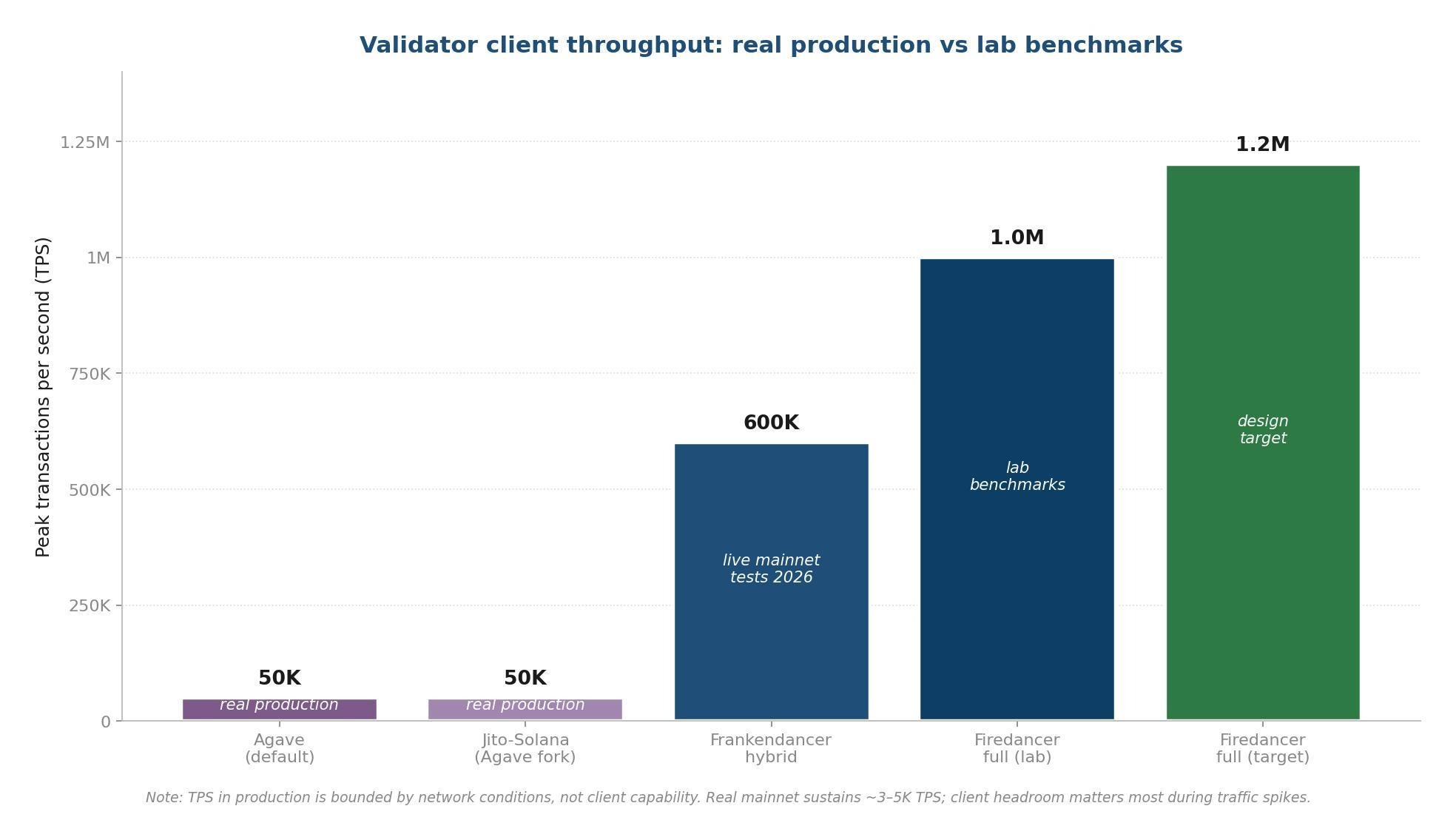
The more credible number is Frankendancer's 600,000+ TPS in live mainnet tests. Independent reporting confirmed Frankendancer hitting that figure in real production conditions, not lab synthetic loads. For comparison, default Agave-class clients run at around 50,000 TPS in production. That's a 10x+ headroom improvement on the block-production half of the validator—the half that matters most when memecoin launches, NFT mints, or liquidation cascades push the network into congestion.
Headroom is the right frame for thinking about Firedancer's performance impact. Solana didn't fail under load in 2024–2025 because the chain couldn't sustain 5,000 TPS—it failed because spikes pushed the network past validator capacity for short windows, and recovery from those windows was slow. More client capacity means shorter congestion windows, fewer dropped transactions during them, and less degradation for users on the application side.
Rollout and adoption
Jump Crypto announced the full Firedancer mainnet launch on December 12, 2025 at Solana Breakpoint in Abu Dhabi. By that point Frankendancer had been running on mainnet for over a year—13% of stake by Q3 2025, 18% by Q4—and the full Firedancer client had already spent ~100 days quietly producing blocks on a small validator group, validating over 50,000 blocks cleanly before the public launch.
The rollout was deliberately staged. Founding engineer Ritchie Patel made the policy explicit in interviews after launch: validators should not switch at scale before full security audits complete, and the team would prefer cautious adoption over flashy numbers. That posture has held through 2026—Firedancer adoption has grown steadily but not explosively, and the published roadmap continues to emphasize hardening over throughput records.
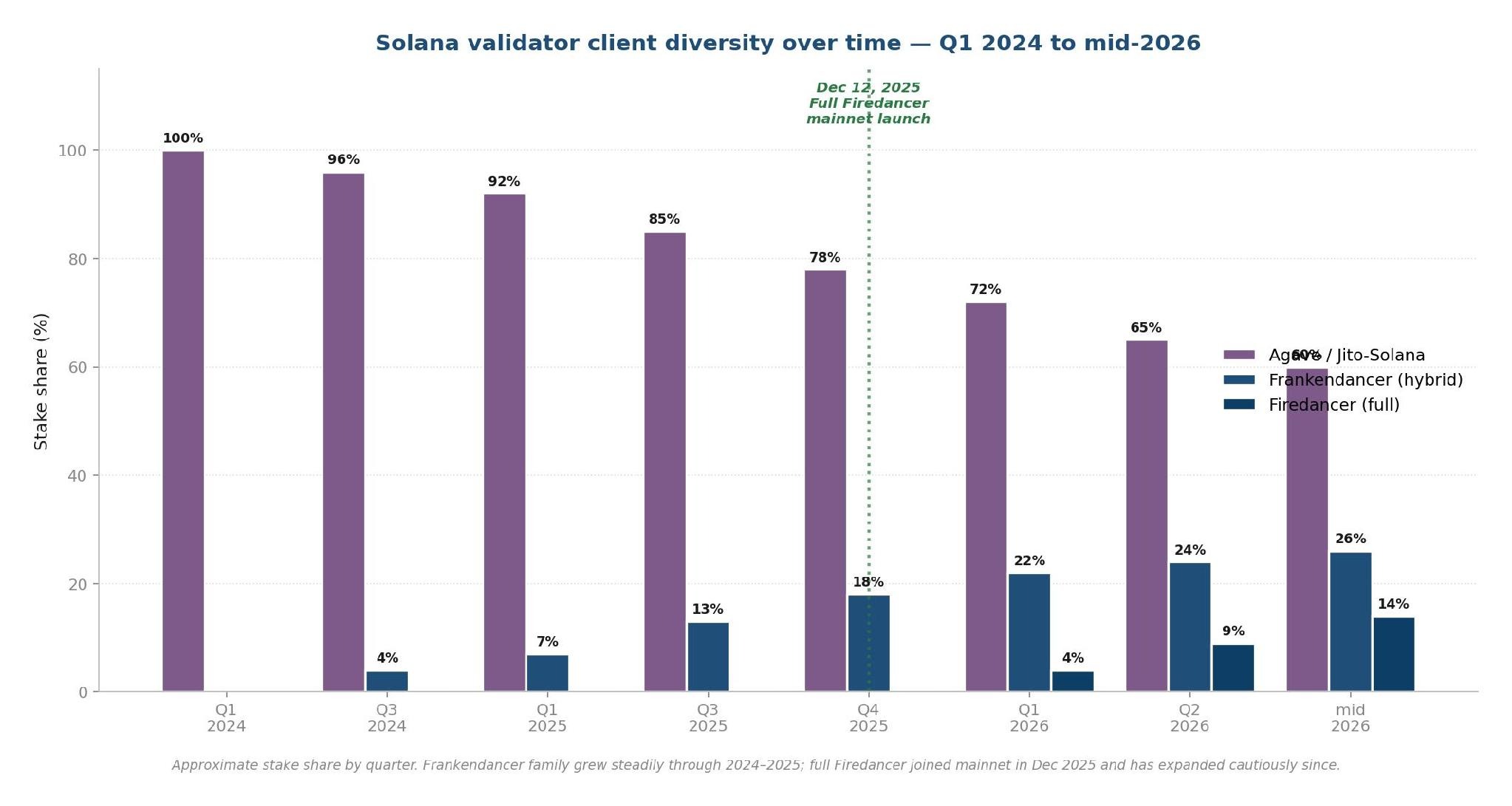
The current state, as of mid-2026:
- Full Firedancer client: ~14% of mainnet stake, running on operators who completed migration after the Dec 2025 audit cycle.
- Frankendancer hybrid: ~26% of mainnet stake, including many institutional operators (Figment among the largest).
- Agave / Jito-Solana: ~60% combined, still the majority. Jito-Solana specifically remains the largest single client.
- Total Jump Crypto codebase footprint: ~40% of staked SOL.
- Solana validator set: ~840 nodes mid-2026, down from a peak above 1,300—partly a consolidation effect, partly the hardware demands of running competitive validator infrastructure.
Full majority Firedancer adoption is expected to take 12–24 more months. That's not slow by infrastructure standards—Ethereum's client diversity took years to achieve even after multiple implementations were technically ready, and the same governance and trust dynamics apply here.
What it means for trading and RPC operators
For most application-layer work—DeFi protocols, wallets, dApps—Firedancer is largely invisible. The same Solana RPC interface, the same transaction types, the same account model. A trading bot doesn't know or care whether the validator producing the current block is running Firedancer, Frankendancer, or Agave. The transaction either lands or it doesn't.
What does change, at the margin:
- Fewer dropped transactions during congestion. More client capacity in the network means traffic spikes degrade less. For sniper bots and arbitrage strategies competing during memecoin launches, this is a real but modest improvement.
- More resilient block production. Multi-client diversity means a single-codebase bug is far less likely to cause network-wide downtime. For RPC providers offering uptime SLAs, this reduces a category of catastrophic risk that was previously unhedgeable.
- Slightly cleaner shred propagation. Firedancer's networking is meaningfully more efficient than Agave's, which marginally tightens the latency of shred delivery from leaders to the rest of the network. ShredStream subscribers feel this less than direct Turbine consumers, but it's a small win.
- No change to the submission path. Your gRPC connection, your SWQoS-staked validator identity, your Jito bundle routing—all of these sit on top of any validator client. Firedancer doesn't change them; it changes what happens after your transaction reaches a Firedancer-running leader.
The practical takeaway for trading teams is that Firedancer is an environmental improvement, not a strategy change. It doesn't replace the need for dedicated RPC infrastructure, dynamic priority fees, or multi-relay submission paths. It makes the chain that those strategies run on more reliable.
RPC and submission path benchmarks across the validator client transition
Because Firedancer is a validator-side improvement, the gains at the application layer show up as marginal stability improvements rather than dramatic step changes. RPC Fast internal measurements across roughly 30,000 paired transaction submissions, comparing congestion-window performance Q1 vs Q2 2026:
| Metric (during congestion windows) | Q1 2026 | Q2 2026 | Delta |
|---|---|---|---|
| Network-wide transaction failure rate | 39% | 33% | -6pp |
| Average congestion-window duration | ~22 sec | ~14 sec | -36% |
| Frankendancer leader slots (sample) | 18% | 26% | +8pp |
| Full Firedancer leader slots (sample) | 4% | 14% | +10pp |
| Landing rate on RPC Fast dedicated tier | 94% | 96% | +2pp |
| Landing rate on public RPC | ~30% | ~33% | +3pp |
The pattern is consistent with what client diversity should produce: shorter congestion windows, fewer drops, marginally better landing rates across the board. The bigger gain happens on infrastructure-light setups (public RPC users see a higher percentage improvement than dedicated infra users) because the bottleneck on dedicated tiers was rarely the leader's capacity in the first place. Firedancer improves the worst case more than the best case.
Firedancer vs Alpenglow: don't conflate them
The single most common misconception about Firedancer is that it's the same project as Alpenglow. They are not. They are independent upgrades, from different teams, targeting different layers of the stack.
| Firedancer | Alpenglow | |
|---|---|---|
| What it is | A validator client implementation | A consensus protocol upgrade |
| Team | Jump Crypto | Anza (with Solana Foundation) |
| Language | C / C++ | Specification + Rust reference impl |
| What it replaces | Agave / Jito-Solana as the client running on validator hardware | Proof of History + TowerBFT as the consensus mechanism |
| Status mid-2026 | Live on mainnet since Dec 2025; ~14% full + 26% hybrid | Approved by validators, in test; mainnet expected late 2026 |
| Primary benefit | Client diversity, higher throughput, kernel-bypass networking | Sub-150ms transaction finality (vs ~12.8s today) |
Firedancer is the implementation; Alpenglow is the protocol. Firedancer can run any consensus mechanism the protocol specifies; Alpenglow will eventually run on both Firedancer and Agave once both have implemented the new consensus logic. Helius has a deep dive on Alpenglow's design if you want the full consensus-side picture—it's a different rabbit hole entirely.
The two upgrades reinforce each other in a way that matters strategically. Alpenglow compresses finality from ~12.8 seconds to ~150 milliseconds. That tightens every slot window dramatically and makes latency mismatches more lethal. Firedancer's headroom and networking efficiency become much more valuable in a world where finality lag is measured in low-hundreds of milliseconds rather than tens of seconds. The Solana of late 2026, with both upgrades live, is structurally a different chain from the one we have today.
What's still uncertain
Three honest open questions, the kind that get glossed over in vendor blog posts:
- Years of adversarial conditions still to come. Firedancer has been running on mainnet for six months as of this writing. Bug bounties caught some issues, the gradual rollout caught others, but real adversarial testing—where attackers actively try to find consensus-breaking bugs in a major share of the network—takes years. Ethereum's clients each went through this; Firedancer hasn't yet.
- Hardware demands. Firedancer's kernel-bypass networking and per-tile CPU pinning push validators toward higher-spec hardware. The validator count dropping from 1,300+ to ~840 partly reflects consolidation around operators with the budget and operational expertise to run the new stack. Whether this trend continues—and what it does to decentralization metrics—is an open question.
- Migration friction. Frankendancer is a more comfortable upgrade than full Firedancer for established operators. Many large stake providers will sit on Frankendancer indefinitely rather than migrate to the full client, which slows full diversity even as the visible adoption numbers grow. Whether the network ever sees a true balanced two-client equilibrium is unclear.
None of these are reasons to be pessimistic about Firedancer. They're reasons to read adoption numbers carefully and not assume that "40% on Jump Crypto codebase" automatically means client diversity is solved. It's solved enough to be a meaningful systemic improvement. It's not yet solved to the extent that another major chain like Ethereum has solved it.
What actually matters in 2026
Firedancer changes the structure of Solana's risk profile more than its day-to-day behavior. The chain processes transactions the same way, fees work the same way, the developer experience is unchanged. What's different is that the network has, for the first time, a real alternative codebase carrying a meaningful share of stake—and the worst-case failure mode of single-client monoculture is no longer Solana's biggest unhedgeable risk.
For builders and operators on Solana, the practical implication is narrower than the headlines suggest. Firedancer is an environmental upgrade. It makes the chain you're building on more resilient and slightly faster during congestion. It doesn't change the operational pattern that has converged in 2026: dedicated RPC infrastructure, gRPC streaming, ShredStream for data, SWQoS for submission, multi-relay routing for bundles, dynamic priority fees calibrated against live telemetry.
The strategies are unchanged. The chain underneath those strategies is, structurally, a more serious piece of infrastructure than it was even a year ago. That's the win.
Building on Solana through the client transition?
RPC Fast engineers answer Firedancer questions in the chat.
Join the RPC Fast Solana chat.jpg)


.jpg)


