





Sniper bots share one goal: enter first at a sane price while avoiding traps. But every missed fill and extra 30–50 ms on Solana costs P&L. So, good bots optimize the full path from signal to confirmation, tune priority fees by slot conditions, validate liquidity and authorities, and exit fast on anomalies. Bad ones spam, ignore mempool reality, skip safety checks, and leak edge through retries.
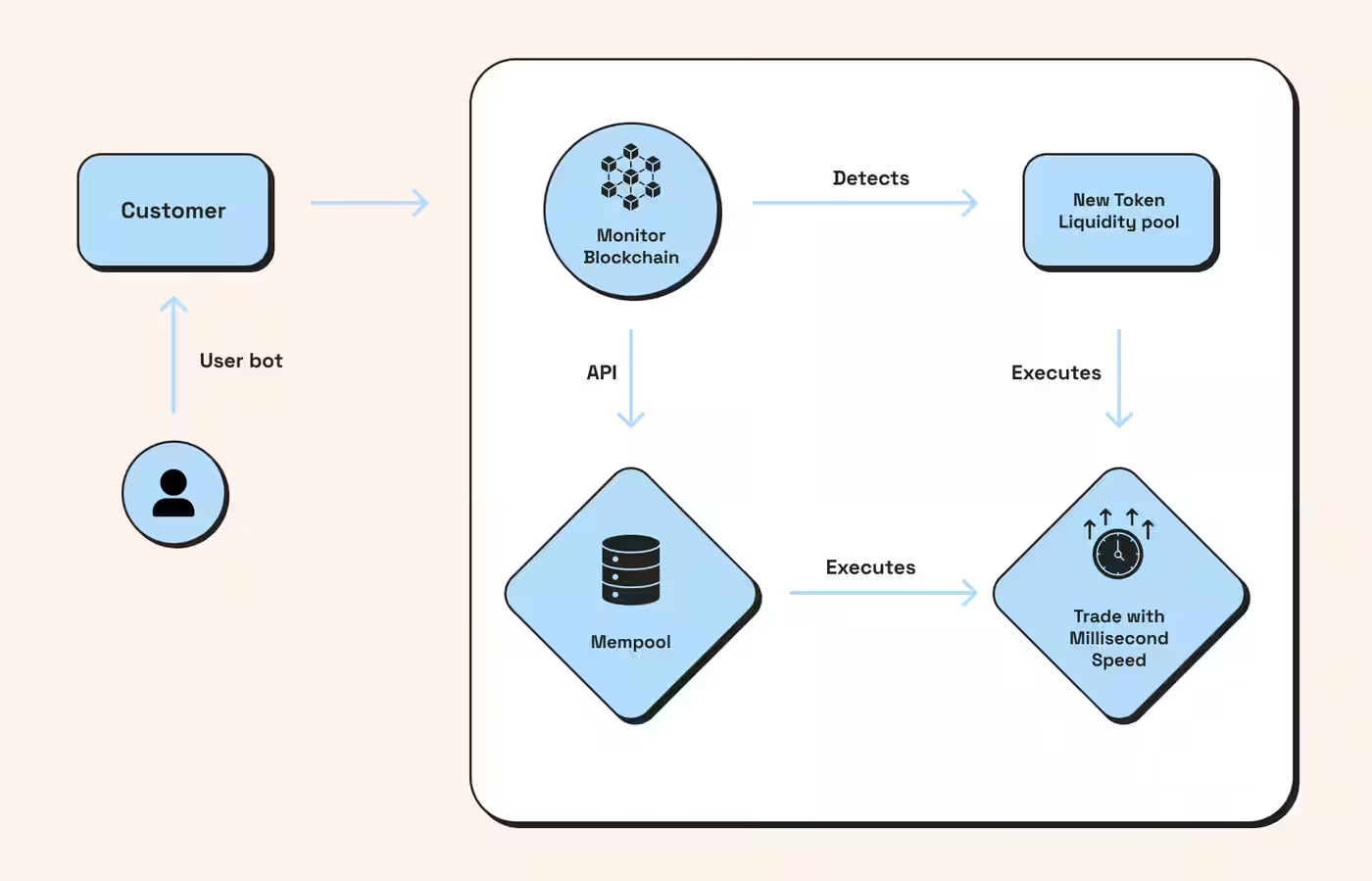
Teams use snipers to solve three problems:
- Win scarce fills during new listings;
- Reduce slippage under burst TPS;
- Avoid rugs on permissionless pairs.
The bar is sub-100 ms submit, consistent first-10 confirmations in target slots, and a measurable drop in revert rate and loss events.
This article explains the basics and advanced advice for teams looking to adapt a specific sniper bot for Solana, and now also covers the two questions that follow: why bots stop landing trades, and what it takes to build your own stack instead of renting one.
Also, instead of a name dump, we group community-endorsed sniper bots by what drives outcomes: latency path, priority fee logic, strategy control, and safety checks. Use this to match your stack to your risk, speed, and ops constraints.
Low-latency Solana infrastructure for sniper bots—shared plans to start, dedicated nodes to scale.
TL;DR
- The core edge comes from sub-100ms submission latency, consistent first-10 confirmations, dynamic priority fee tuning by slot conditions, and pre-trade safety checks (liquidity depth, mint authority, freeze authority).
- Anomalies that trigger exits include liquidity mismatches, authority risks, priority fee spikes, price deviations >5–10%, contract behavior issues (transfer taxes, pausable flags), network congestion, and abnormal MEV patterns post-fill.
- The seven most-used platforms are Axiom Trade (all-in-one terminal), Trojan Bot (fastest Telegram), Photon Sol (lightweight web), GMGN.ai (copy trading + Anti-MEV), BullX NEO (multi-chain), Banana Gun Bot (advanced routing), and BONKbot (simplest starter).
- Best practices include dedicated wallets per strategy, geographic RPC proximity, dynamic fee scaling, token safety validation, multi-endpoint failover, structured logging, circuit breakers on anomalies, and immutable audit trails for compliance.
- Demand benchmarks before funding: 7-day repro over 100 simulated launches measuring P50/P95 submission latency, confirmation rank, failure rate, realized slippage, and exit-on-anomaly time.
Solana sniper bots in 2026: what's different from 2025
Solana's fee markets, MEV infrastructure, and bot competition have evolved. Priority fees and bundle routes are more standardized, typical retail bots are faster, and professional desks treat crypto sniper bot infra as part of a broader HFT stack instead of a toy side-project.
In this update, we keep the core playbook but add 2026-level considerations: tighter latency SLOs, bundle-aware routing, more mature risk controls, and ops practices for teams that run multiple snipers across chains.
1. What is a Solana sniper bot?
A Solana sniper bot is an automated trader that monitors new token listings and on-chain signals, then submits a buy transaction in the first viable slots to capture early price movement while constraining slippage and risk. The core loop is simple but unforgiving: detect, price-check, route with priority fees, confirm early, and exit on anomaly.
An anomaly is any signal that increases loss odds or invalidates the entry thesis. Examples:
- Liquidity mismatch: sudden drop in on-chain pool depth, disabled swaps, or concentrated spoof liquidity on the target DEX pool;
- Authority risks: mutable mint authority, freeze authority present, recent ownership transfer, or blacklisted program IDs;
- Trading path issues: priority fee spikes without leader proximity, repeated preflight reverts, or rising duplicate/nonce errors;
- Price integrity: rapid >5–10 percent deviation from oracle/VWAP within a few slots, or asymmetric slippage vs. contemporaneous trades;
- Contract behavior: transfer taxes, trading pausable flags, blocked sell functions, or delayed mint updates detected during simulation;
- Network conditions: slot congestion with rising blockhash-not-found, leader schedule change increasing confirmation lag, or RPC rate limiting on submit/confirm;
- Post-fill health: abnormal MEV patterns around the fill, widening spreads with no replenishing depth, or failure to place an immediate exit order.
On Solana, slot timing, local fee markets, and RPC path latency define the edge; poorly tuned bots spam or confirm late, which increases reverts and worsens fill prices. Well-engineered bots add pre-trade liquidity and authority checks, dynamic fee curves by slot congestion, and post-trade watchdogs to avoid rugs on permissionless pairs.
For an overview of Solana transaction flow, fee markets, and priority fees that the fastest Solana sniper bot strategies depend on, see the official Solana docs.
Who needs sniper bots?
Teams that live or die by first fills use sniping bots: quant traders chasing early momentum on new listings, market makers securing inventory before spreads widen, and retail-to-pro desks automating entries during micro-spikes.
They want three outcomes: consistent first-10 confirmations in target slots, lower realized slippage during burst TPS, and fewer loss events from rugs or disabled sells.
From the infrastructure point of view (our favorite one 😉), these teams have lots in common:
- Priority-aware RPC and leader proximity: Low-variance, close-to-leader RPC with reliable QUIC, websockets, and priority fee passthrough. Multi-endpoint failover with health checks.
2. Ready-made bots: the 2026 comparison
Here is a table of Solana bot platforms, highlighting key differentiators for technical buyers.
Fees are indicative and can change quickly. Always confirm current fee schedules and any rebates/points inside each bot or on its official docs before relying on them.
Selection guide
- If you want a single, heavy-duty Solana terminal: Axiom Trade—the most all-in-one option (snipes, perps, yield, analytics) if you're fine living in a web app.
- If you want the highest-end Telegram experience: Trojan on Solana—very fast, feature-dense, designed for serious on-chain memecoin trading from your phone.
- If you prefer a lightweight web terminal first: Photon Sol—simple, clean, and fast as a browser-based front end; many traders pair it with a Telegram bot.
- If you care about smart money and automation in one place: GMGN.ai—best fit if you want new-token feeds, copy trading, and Anti-MEV in the same workflow.
- If you're trading across multiple chains as well as Solana: BullX NEO and Banana Gun Bot both give you multi-chain reach with strong Solana support.
- If you want the simplest Solana starter bot with serious infra behind it: BONKbot is still the go-to just-tap-and-trade Telegram flow for many users.
Solana sniper bot fees and costs
Most platforms charge a percentage per transaction, typically ranging from 0.5 percent to 1 percent. Some offer a lower base fee but add a fixed cost per transaction for priority routing via Jito validators. And ~0.006 SOL per transaction can accumulate rapidly on high-volume days.
In practice, base fees are tiny, but priority fees dominate. A single snipe transaction can range from a fraction of a cent to several cents worth of SOL, depending on congestion and your CU price.
Beyond platform fees, consider the implicit costs of a sniping bot:
- Priority fees: your bot's dynamic fee strategy determines how much SOL you spend to outbid others for block inclusion. Poorly tuned fees waste capital or lead to missed fills.
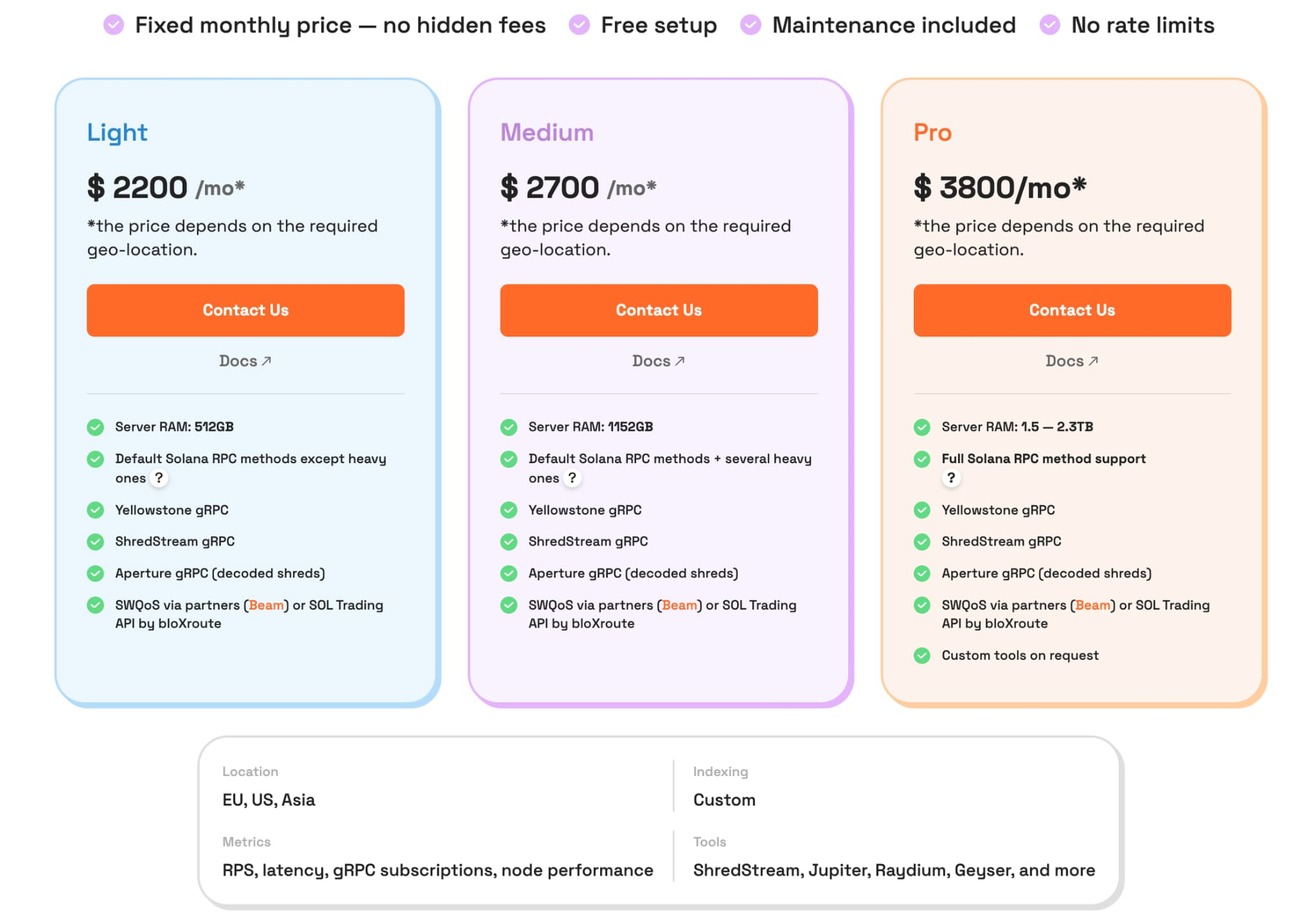
- RPC costs: dedicated or premium RPC endpoints, essential for low latency, come with a subscription cost. This is a fixed overhead for speed.
- Failed transactions: each revert still consumes network fees. A high revert rate due to flawed logic or poor RPCs adds up.
Evaluate the total cost of ownership, not just the headline percentage. A cheaper bot with higher revert rates or slower fills can be more expensive in lost opportunity and wasted fees.
3. Smaller and lesser-known sniper bots
Beyond the seven platforms above sits a long tail of smaller products, and people search for them by name: Nano Sniper Bot, Nano Sniper Bot Telegram, NexSniper, NanoSnipe, Aiwass Solana Trader, and a rotating cast of similar names.
The defining characteristic of this tier is that almost nothing about it is independently verifiable. These products typically have no audit, no named team, and no public track record beyond their own marketing and affiliate-driven promotion. Some are genuine small projects. Others are resold template code. A meaningful share are wallet drainers wearing a trading-bot interface.
Any Solana bot that asks for your private key or seed phrase, rather than connecting via a wallet protocol or generating its own segregated key, should be treated as a theft mechanism regardless of how polished it looks. This is the single most reliable filter in the entire category.
How to evaluate a bot nobody has heard of
- Key handling. Does it ever ask for a seed phrase or private key? If yes, stop.
- Team and audit. Is there a named team, a security audit, or a contract you can read?
- How you found it. A YouTube promo with a referral link and no independent coverage is information about the product.
- Fee transparency. Is the fee stated publicly, or does it only appear after you fund a wallet?
- Test with a throwaway. Fund a fresh wallet with an amount you can lose, run small trades, and try to withdraw. The withdrawal is the test.
Pump.fun snipers specifically
Bonding-curve launches behave differently from ordinary DEX pool launches: the detection signal is different and the competition profile is different again. We cover the launchpad-specific event flow separately in how to snipe Pump.fun launches in 2026.
4. Memecoin sniper bots and crypto sniper bots
Memecoin sniper bots
Most Solana sniping in practice is memecoin sniping, and the phrase describes the same software pointed at a particular kind of token. The technical stack does not change. What changes is the risk profile: extremely short opportunity windows, extremely high failure rates, and an unusually high density of deliberate traps.
The practical adaptations are consistent: hard position caps per token, mandatory pre-flight simulation of the sell path rather than only the buy, liquidity depth thresholds below which you do not participate, and automatic exits defined before entry.
Crypto sniper bots beyond Solana
The strategy transfers across chains. The infrastructure does not. On Ethereum and most EVM chains there is a public mempool, so sniping involves reading pending intentions, gas auctions and private relays. On Solana there is no mempool, so the competition happens on arrival speed and priority fees instead. Multi-chain platforms abstract this away, which is convenient and costs you the ability to tune the part that decides contested launches.
5. Why your sniper bot is not landing trades
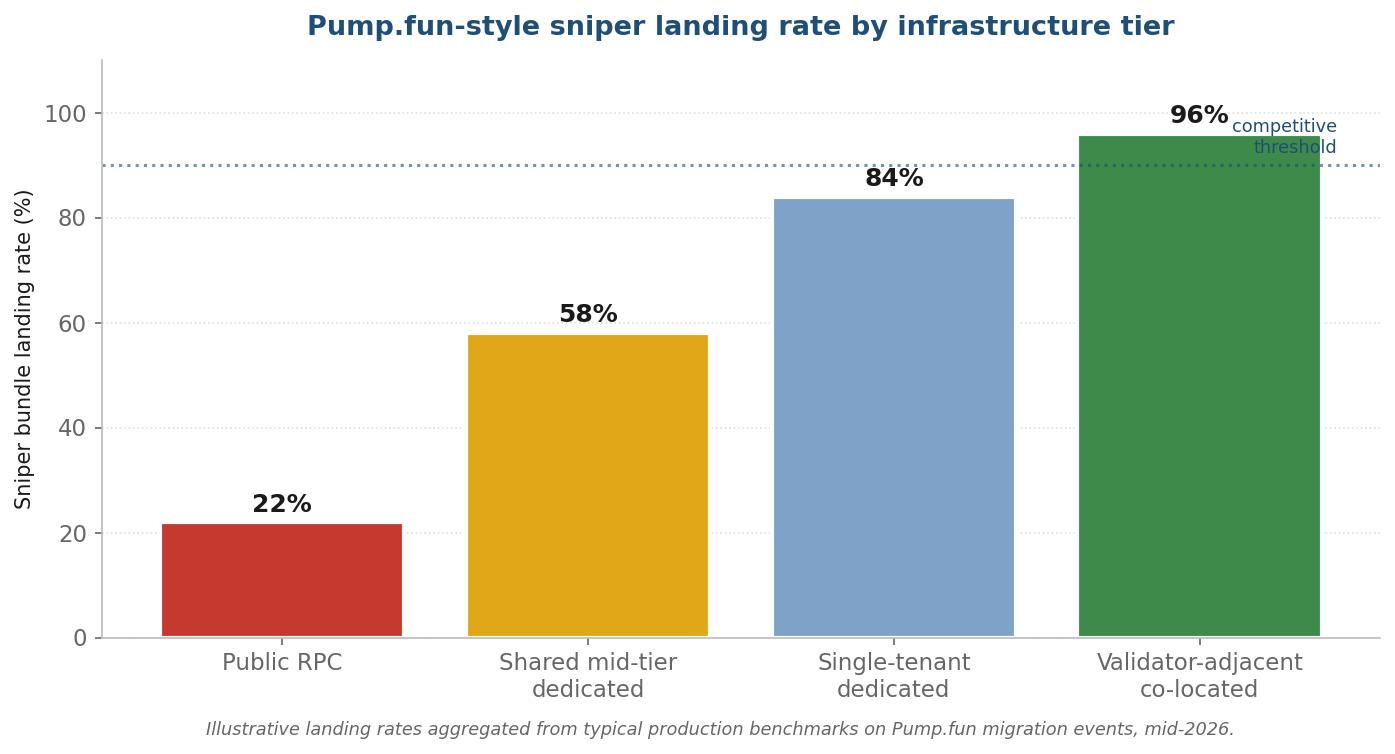
Solana processes 65,000+ TPS. Pump.fun launches hit 200+ competing bots in the first 500 milliseconds. Only 10–15% of sniper bots achieve consistent landing rates. The bottleneck isn't your logic—it's your stack.
This piece is about the four infrastructure layers that decide whether a sniper bot lands or watches the slot go by. Each layer compounds with the others. Skip one and the rest don't help.
What landing actually means
Landing means the transaction reaches the leader's TPU, gets included in the block being assembled, and ends up in the canonical chain. That is one event. Everything before it—detection, decision, build, sign, submit—is preparation. Everything after it—confirmation, settlement—is post-hoc reporting. The bot's whole job is to win the race to the leader.
Walk the path a transaction takes:
- Detection. Your bot sees the event. For a Pump.fun migration sniper, that's an account write on the bonding curve.
- Build and sign. Construct the transaction, fill in the dynamic fields (mint, amount, slippage), sign with the pre-loaded keypair.
- Submit. Send the transaction to your RPC, which forwards it to the current leader via Gulf Stream.
- Ingest at TPU. The leader's Transaction Processing Unit pulls your transaction in, sigverifies it, and queues it for execution.
- Inclusion. Banking stage runs your transaction; if it succeeds, your buy is in the slot.
There are exactly three places bots reliably lose this race: between detection and submission (slow data feed), between submission and TPU ingest (bad RPC or wrong region), and inside the TPU under load (insufficient stake-weighted priority). Each one is a layer of the stack.
.jpg)
Layer 1—Your RPC endpoint is the starting gun
If your RPC takes 200ms to respond to getLatestBlockhash during a launch, you've already lost. The bot's reaction speed is bounded by its RPC's reaction speed. Public and shared endpoints hit rate limits and queue under load exactly when high-value launches happen—which means your bot operates on degraded infrastructure precisely when it matters most.
The target for competitive sniping is sub-20 ms RPC response on hot methods—getLatestBlockhash, getAccountInfo, sendTransaction, simulateTransaction. What good looks like: p50 under 15 ms, p95 under 30 ms, p99 under 60 ms. What bad looks like: p50 above 100 ms, p95 above 300 ms, p99 effectively unbounded during congestion.
Layer 2—Why priority fees stop working
During Pump.fun launches and other contested slots, priority fees alone are not enough. A standard sendTransaction with a high priority fee competes for blockspace alongside every other transaction touching the same accounts. The fee race becomes an auction where you either win the highest position or land late.
This is what Jito bundles fundamentally fix: atomic, ordered execution at a specific slot position, paid for with a tip routed to the validator. In contested launches, validators effectively ignore unbundled high-fee transactions because bundle income outpaces priority-fee income—Jito tips alone account for more than 60% of all priority-fee volume on Solana in 2026.
The target for competitive Pump.fun sniping is >90% bundle acceptance rate across multiple regions. The path to that target:
- Submit through Jito Block Engine, not standard sendTransaction, for any launch-style strategy.
- Multi-relay parallel submission across Jito's NY, Frankfurt, Tokyo, and Amsterdam endpoints simultaneously, plus Astralane and QuickNode Lil-JIT as alternates.
- Dynamic tip calibration based on the last 50 blocks of accepted tip levels, scaled by the velocity of the bonding curve approaching completion.
- Pre-signed tip transaction included in the bundle's last position, with the SOL transfer to one of Jito's 8 tip accounts hardcoded for the hot path.
Competitive sniper teams routinely surrender 50–70% of expected profit to Jito tips during contested launches. That's the price of winning the slot. Hardcoded tips set during quiet hours are universally insufficient when the launch goes viral.
Layer 3—Geographic latency compounds everything
Physical distance from the slot leader is a constant tax on every layer above. A 100 ms cross-region penalty applies to your blockhash fetch, to your RPC submission, to your Jito bundle delivery. None of those latencies cancel. They stack.
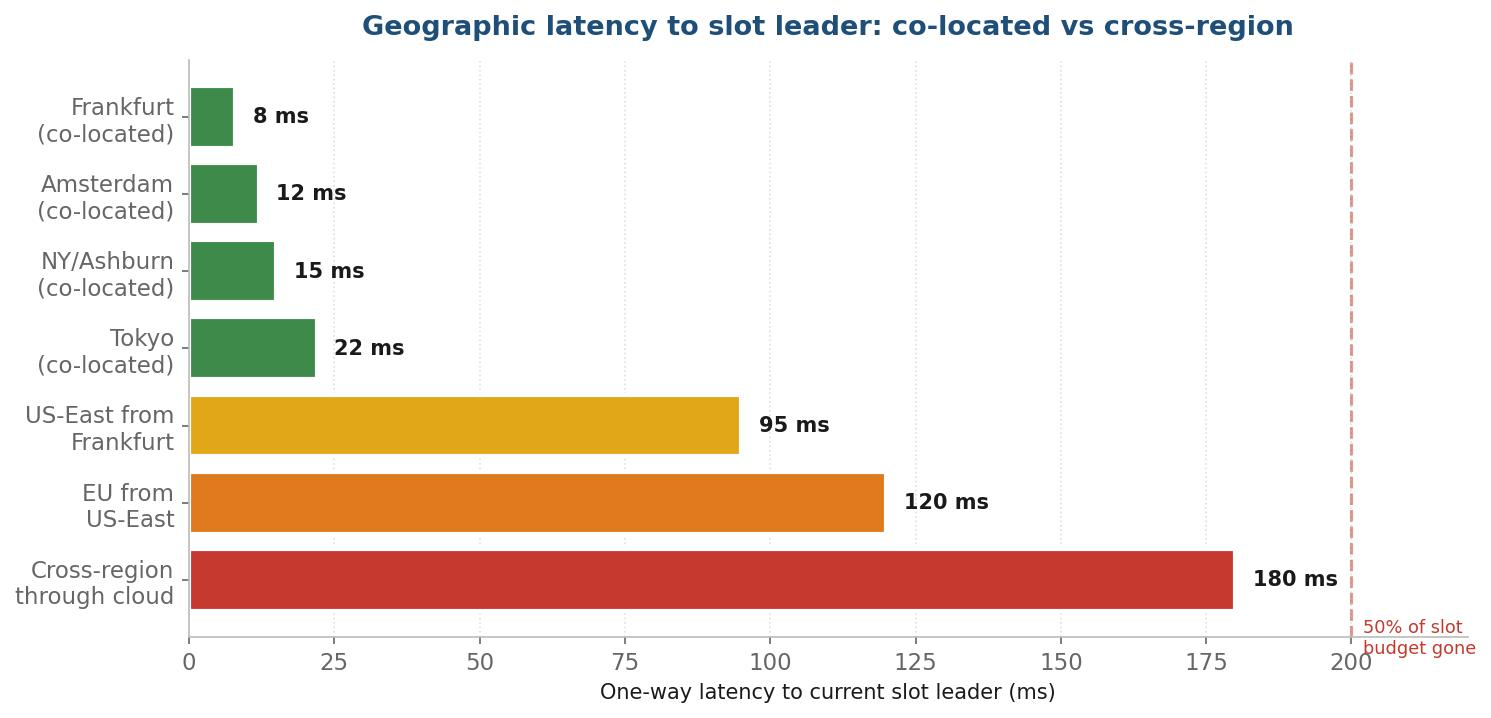
Solana's validator set concentrates in three regions: US East (Ashburn / NY), EU (Frankfurt / Amsterdam), and APAC (Tokyo / Seoul). A bot located in any one of these regions can reach a local leader in 5–20 ms. The same bot trying to reach a leader in a different continent operates with an 80–150 ms baseline before any code runs. On a 400 ms slot, that 80 ms geographic penalty alone consumes two slots of effective budget.
The fix is co-location with multiple regions, not single-region deployment. The minimum viable geographic setup:
- Frankfurt or Amsterdam for EU slot leaders, which control approximately half of network stake.
- Ashburn or NY for US East slot leaders.
- Tokyo for APAC slot leaders—lower stake share, but still meaningful.
- Automated failover between regions, so the bot uses whichever endpoint is closest to the current leader.
Layer 4—You're firing on a notification that's already late
WebSocket subscriptions have a median notification latency of 50–80 ms—by the time your bot reacts, the slot has moved. This is the most overlooked of the four layers, partly because every tutorial uses WebSockets and partly because the latency is invisible until you measure it.
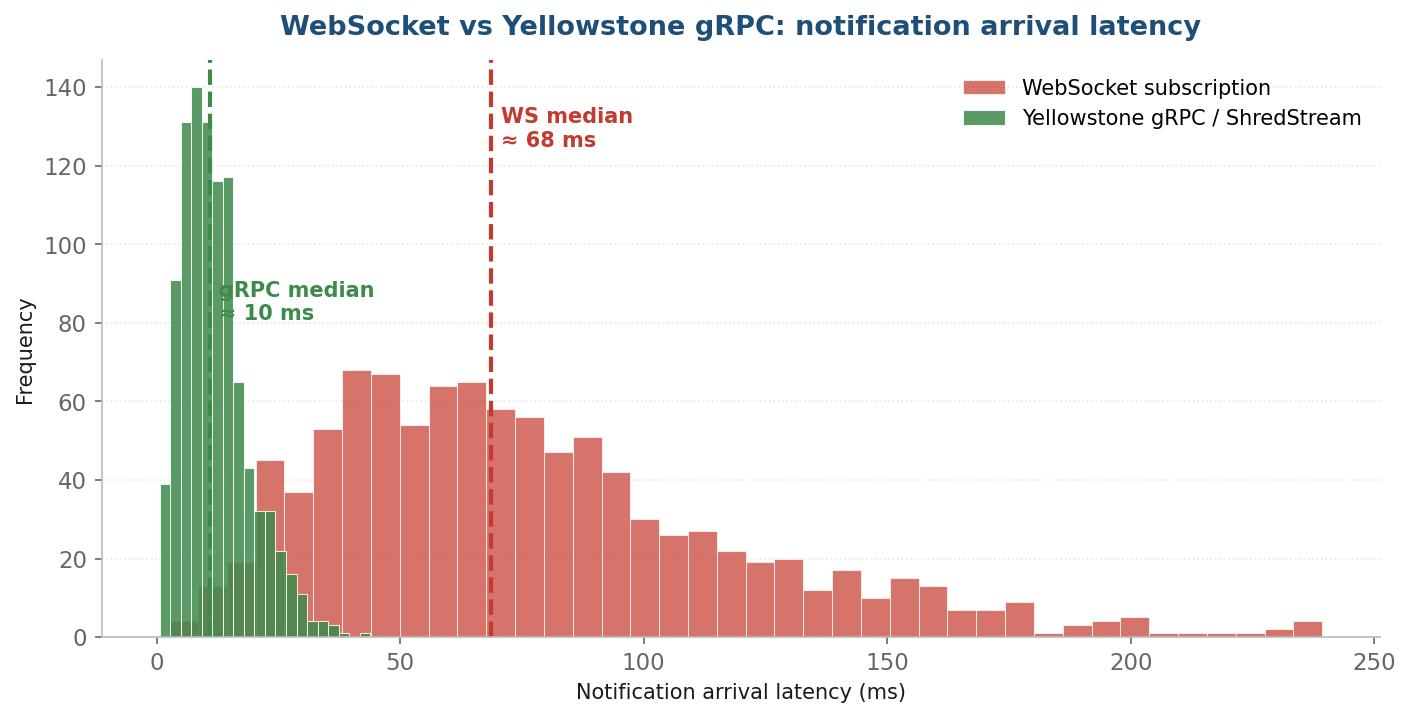
Yellowstone gRPC and Jito ShredStream are the data layers production sniper infrastructure runs on. They deliver events with median notification latency of 5–15 ms, an order of magnitude better than WebSocket. ShredStream specifically streams shreds—block fragments—from Jito-connected validators before Turbine fanout completes, giving an additional 50–200 ms of forward visibility on chain state.
A counter-intuitive insight that most sniper bot guides miss: most bots watch the wrong event. For Pump.fun migrations specifically, the migration instruction lands a slot too late—the curve has already completed and the first bots have already fired. The right event to subscribe to is the second-to-last bonding curve buy that pushes deposits to ~84.5 SOL—the slot before the migration trigger. From there, the migration is mathematically inevitable, and you can pre-fire the buy transaction.
Measuring your bot's actual landing rate
If you can't measure your landing rate, slot lag, and RPC response time live, you can't tune any of the four layers. The metrics that matter, with targets versus typical shared-node values:
A bot operating on the shared-node column isn't a worse bot—it's a bot operating on infrastructure that was never built for the workload. The fix is rarely the strategy. The fix is moving down the table toward the target column.
6. Building your own: the stack
In high-frequency trading on Solana, milliseconds are not a metaphor. Slot times average 400ms, and finality after Alpenglow lands in 150ms. A bot that arrives one slot late is buying tokens after the first wave of snipes has already moved the price. Two slots late, it is paying the price the early bots will sell into.
This is why sniper bot development has shifted from being a logic problem to being an infrastructure problem. Writing the code that recognizes a launch event and constructs the right transaction is the easy part. The hard part is getting that transaction from your bot to the slot leader's block before competing bots do the same thing.
What a Solana sniper bot actually does in 2026
The core trigger categories that drive most sniper activity today:
- Launchpad graduations—pump.fun, LetsBONK, Moonshot and other launchpads graduating tokens to Raydium/Orca pools. The largest single source of sniper opportunities on Solana.
- Liquidity pool creation—new pools opening on Raydium CPMM, Orca Whirlpool, Meteora DLMM.
- Token mint events—initial mints of new SPL or Token Extensions tokens.
- DEX listing events—first liquidity additions when a project moves from launchpad to a major DEX.
- Price discovery on memecoin launches—first 10–20 seconds where price movement is exponential and entry timing dominates returns.
Each of these categories produces opportunities where the bot that enters first captures most of the value. The fifth bot in might still profit. The fiftieth is usually buying the local top.
Why public RPCs are completely out of the race
Four specific failure modes occur on public RPCs that no amount of bot tuning can fix:
- Rate limiting under load—exactly when traffic spikes (which is exactly when sniping opportunities appear), the public endpoint throttles incoming requests.
- Slot drift—public nodes routinely lag the network tip by 3–4 slots during congestion. Your bot is reading state that is over a second old.
- Submission queuing—outbound transactions enter the public gossip layer with no priority.
- No streaming support—Yellowstone gRPC and Jito ShredStream are not available on public endpoints, forcing you to poll at intervals an order of magnitude slower than gRPC.
The competitive sniper bot pipeline
The components that actually matter
1. Dedicated RPC with Yellowstone gRPC
Yellowstone gRPC is the streaming interface that delivers account state changes the instant they hit validator memory, rather than waiting for full block propagation through the standard WebSocket layer. The performance gap between the two patterns is large enough to be the dominant factor in whether a bot lands at slot 0 or slot 3+.
2. Pre-signed transactions
Building and signing transactions in response to a trigger event is too slow. By the time the transaction is constructed and signed, the price has moved. Production sniper bots maintain pools of pre-built, pre-signed transactions that can be dispatched immediately when a trigger fires. Multiple parallel keypairs let the bot fire several transactions simultaneously with slight parameter variations, which improves the odds of at least one landing in the target slot.
3. Jito BAM submission
Standard RPC submission puts your transaction in the gossip queue with no ordering guarantee. Jito BAM lets you submit a bundle with an explicit SOL tip that gives you predictable position in the target block, with full atomic execution. Tip calibration is the entire game on BAM. For sniper bots, tips typically run between 0.0001 and 0.005 SOL depending on expected profit and competition density on that specific launch.
4. Slot synchronization
More than one slot of drift is a problem. Three or more slots is operational failure—the bot is functioning but feeding decision logic stale inputs.
5. Auto-sell and risk management
Sniping the entry is half the work. Securing exit is the other half. Production bots maintain auto-sell logic with multiple triggers: profit targets, stop losses, time-based exits, and circuit breakers that close the position if anything unexpected appears on-chain. A bot that lands perfect entries and rides every position to zero is not actually profitable.
Common failure modes that public-RPC tutorials skip
- Transaction simulation differs from execution—a transaction that simulates successfully on stale state fails on-chain when the actual pool state has shifted. Always simulate against current state, ideally within the same slot as submission.
- Multi-region submission timing—Jito Block Engines in different regions process bundles at different times relative to slot leaders. Submitting to all regions in parallel is necessary.
- Priority fee inflation under load—during congested launches, priority fees can spike 10–100x. Static tip configurations get outbid.
- Account access patterns matter—Sealevel's parallel execution depends on transactions declaring account access upfront. Bots that touch more accounts than necessary serialize behind other transactions.
- Failed transaction cost accumulation—each failed submission costs ~5000 lamports. For a bot firing thousands of attempts per day, this compounds.
The four layers of the stack
The workflow is a high-stakes relay race: detect → decide → execute → exit. Total cycle is under 150ms end-to-end for top performers, or you buy at 3-5x the floor price amid the stampede.
- Event detection (the radar). Scans the chain non-stop for triggers. Uses WebSocket subs or Geyser plugins to watch AMM logs, like Raydium's program ID for new pools or Pump.fun's curve hits. Key bits: event filters, polling every 20-50ms.
- Decision engine (the brain). Sizes up the find to skip duds. Checks on-chain (liquidity over $10K, low dev holdings) and off-chain (social buzz). Builds a quick score, greenlighting only high-odds plays.
- Execution layer (the trigger). Crafts and fires the swap. Relies on Jupiter for routes, with tight slippage (0.3-0.5%) and fees to prioritize. Bundles via Jito to shield from MEV grabs.
- Exit strategy (the parachute). Tracks and cashes out to lock gains. Feeds from DexScreener set sells at 2-3x or stops at -15%. Adds rotations and timers for safety.
Layer 1: Data ingestion and monitoring—Feeding the bot's senses
%201%20(1).jpg)
You've got the bot's basic structure down—now it's time to wire in the data that makes it alive.
This first layer focuses on pulling in real-time blockchain events and layering on extra context, so your sniper doesn't just react, but reacts smartly. Without solid ingestion, the whole setup stalls: events slip by, decisions lag, and opportunities turn into regrets.
The goal here is a steady stream of intel, processed fast enough to keep your cycle under a couple of hundred milliseconds from spot to shot.
Think of it as building a custom news ticker for the chain: start with core event streams, then add filters and enrichers to cut the noise.
Setting up the intake: Streams and subscriptions
Begin with simple subscriptions to catch on-chain triggers, like new liquidity pools or token creations. Use Solana's web3.js library to connect and listen for log updates from key programs.
Here's a starter snippet in TypeScript to subscribe and parse:
This sets up a listener that flags potential snipes without overwhelming your setup—commit to "confirmed" for stability, and add a filter for specific instruction types to avoid junk.
For quicker pulls, switch to Geyser gRPC endpoints from services like Triton One. These deliver raw updates before full confirmation, giving you an edge on timing. Limit active streams to a handful to keep resource use light, and integrate ShredStream if your provider supports it for pre-block previews.
On RPC Fast’s Aperture plan, TxStream goes a step further and attaches a predicted execution result to each transaction while it is still in flight, before it lands — around 95% accurate against actual execution, at a cost of roughly 791 µs on median delivery. That lets the decision engine drop events that are already failing instead of racing them; on the Stream plan TxStream is available for a limited time without simulation.
Once an event hits, enrich it with off-chain data. Pull from APIs like Birdeye for quick checks on social traction or holder distribution—query only when needed to stay efficient. This turns a raw log into a scored lead, helping your brain filter out the obvious traps.
Next up: The RPC backbone that turns sights into strikes.
Layer 2: RPC infrastructure—The backbone for swift execution
Data's pouring in—now you need a rock-solid connection to the network to act on it. This RPC layer is the bot's nervous system: it queries the blockchain, fetches blockhashes, and submits transactions without a hitch. Public endpoints work for testing, but in live sniping, they choke under load, adding delays that cost slots and edges. Private RPCs from outfits like Helius or your own setup cut that noise, aiming for consistent pings under 100ms and near-zero drops.
The setup here ties directly into your event detection: use the same provider for seamless handoffs, with configs tuned for Solana's quirks like leader schedules. Focus on co-location (e.g., Frankfurt hubs) and extras like priority fee estimators to prioritize your sends.
Configuring your RPC setup: Essentials and tweaks
Pick a dedicated node over shared ones—look for ShredStream support and Jito integration. Start with a TypeScript config in your bot to handle connections:
This keeps queries lean—use 'processed' commitment for speed, but simulate txns first to catch issues.
Enable auto-fee estimation via the RPC's compute budget API, setting base units around 200K for complex swaps. Add retry logic for congestion: exponential backoff up to three tries. For MEV defense, hook in Jito's client early—bundle your tx with a tip to validators.
Two ways to run RPC Fast under a sniper bot
You do not need single-tenant hardware on day one. You need to know whether your route is the bottleneck.
Shared plans start at $0 with no credit card and run up to Aperture at $499/mo — enough throughput to benchmark your current endpoint, with Beam SWQoS routing included on every plan.
Dedicated nodes start at $2,200/mo with no rate limits — bare-metal server, setup and maintenance included, no setup fee. Delivered within 72 hours.
The line falls at physical distance: single-tenant hardware pays off once your p99 is decided by how far you sit from the leader. Cheap test — run the free plan against your current endpoint for a week and compare p95 submission and confirmation rank.
Layer 3: Transaction building and execution—Turning decisions into deals
Your data's sharp and RPC's humming—now comes the moment of truth: crafting and launching trades that stick. This layer handles the heavy lifting of transaction assembly, simulation, and submission, ensuring your bot doesn't just spot gold but grabs it clean. In Solana's mempool scrum, where txns vie for inclusion, raw speed means little without smart building: unoptimized swaps fail 30% more often during rushes (Jito 2025 logs). Aim for under 100ms from build to send, using aggregators and bundlers to route efficiently and dodge MEV pitfalls.
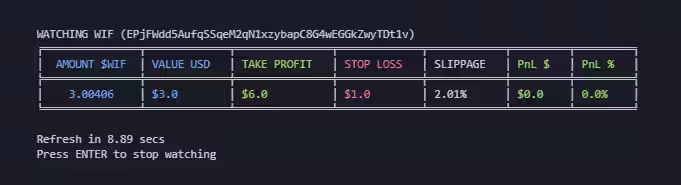
Tie this right into your RPC connection—pull recent blockhashes and simulate before firing. Providers with Jito hooks make it seamless, prioritizing bundles that land in the next slot.
Assembling and firing: Key steps and code
Use Jupiter V6 for routing across DEXes, quoting inputs like SOL amounts against target mints. Set slippage tight (0.3%) to avoid overpays, and add compute units (200K) for smooth execution.
Here's a Rust example to build and sign:
This keeps it atomic—simulate via RPC first to flag failures like low liquidity.
Layer 4: Wallet and risk management—Guarding your gains
Trades are flying—time to shield the operation with wallets that rotate seamlessly and rules that cap downsides. This layer manages funds, enforces limits, and scans for threats like rugs or sandwiches, preventing one bad call from wiping the slate. Without it, even flawless executions bleed out: unchecked positions rug 50% of snipers yearly (Dune 2025). Rotate across 5-10 keys, size bets at 1-2% of stack, and monitor in real-time.
Link to execution by injecting keys dynamically and querying balances post-trade. Tools like Solflare APIs or hardware integrations add security without slowing the flow.
Securing and sizing: Controls and practices
Spread across hot wallets (software) and cold (hardware for big holds). Use env vars for keys—never code them in. Post-trade, cycle to evade DEX flags.
Example in TypeScript for balance checks:
This keeps liquidity fresh—aim for under 1% exposure per key.
Backtesting and metrics
Pull event logs (aim for 5K-10K launches over a quarter) and feed them into your pipeline. Simulate full cycles—detection to exit—using frozen timestamps to mimic live timing. Run 50-100 iterations per dataset to average out noise.
Benchmarks to demand before funding
- Repro script: 100 simulated token launches over 7 days
- Measure: P50/P95 submission, confirmation rank, failure rate, realized slippage, exit-on-anomaly time
- Include: RPC endpoints, slot leader proximity, fee settings, machine type, region
- Share: monthly latency and P&L review with owned post-mortems
7. RPC Fast for sniper bot infrastructure
Most published sniper bot guides cover Layer 2 (priority fees) and parts of Layer 1 (use a good RPC). They leave Layer 3 (geographic positioning) and Layer 4 (notification stream) for you to figure out.
That's the gap RPC Fast fills directly, and it runs on two lines. Shared plans start at $0 with no credit card and run up to Aperture at $499/mo—enough throughput to benchmark your current endpoint before you buy hardware. Above them sit dedicated bare-metal Solana nodes, co-located with validators across Frankfurt, Amsterdam, Ashburn, and Tokyo, from $2,200/mo with server, setup and maintenance included and delivery normally within 72 hours. On a dedicated node, Yellowstone Geyser gRPC, Jito ShredStream and Aperture gRPC come included at no extra cost. Beam handles low-latency transaction delivery on every plan, free Start tier and dedicated nodes alike, routing submissions through Astralane, bloXroute, Nozomi and Falcon in fastest or MEV-protect mode. On the Aperture plan, Aperture TxStream also attaches a predicted execution result to each transaction while it is still in flight, from deshredded data—around 95% accurate against actual execution, at a cost of +791 µs to median delivery.
This isn't a sales section—it's the natural answer to Layer 1 and Layer 4. If your sniper is built on shared RPC and WebSocket subscriptions, the upgrade path to competitive landing rates is exactly this stack. The team has tuned 100+ trading bots, snipers, and AI agents in production on Solana, including production Pump.fun migration setups.
What actually changes when infrastructure is right
A recent migration with a Solana memecoin sniping operation (running on a multi-chain provider's shared tier) illustrates the gap. Before migrating to RPC Fast's dedicated infrastructure: median entry at slot 3.2 after launch events, 31% bundle acceptance rate, profit per attempted snipe near zero after fees and failed transactions.
After two weeks running on RPC Fast with Yellowstone gRPC and parallel BAM submission across US East and EU regions:
- Median entry slot: 0.8 (down from 3.2)
- Bundle acceptance rate: 91% (up from 31%)
- Failed transaction count: down 78%
- Profit per attempted snipe: 4.2x improvement on the same strategy logic
The strategy code did not change. The bot did not get smarter. The infrastructure stopped losing the latency race, and the underlying logic—which had been correct the whole time—finally had a chance to execute on the opportunities it was identifying.
Strategy gets the credit. Infrastructure gets the result.
Every sniper bot guide on the public internet eventually tells you the same things about strategy—token filtering, position sizing, rug protection, exit logic. Those things matter. But they all run downstream of the four infrastructure layers above. If Layer 1 fails, your detection is late. If Layer 2 fails, your bundle doesn't land. If Layer 3 fails, you can't reach the leader in time. If Layer 4 fails, you fired on stale data.
The bots in the top 10–15% of landing rate share one thing. They got all four layers right before they thought about the strategy. Audit the four layers. Benchmark the metrics. Fix the one that's weakest first.
Free Start plan. $0.
No credit card — benchmark against your current setup before you commit.
.jpg)


.jpg)


