





.jpg)
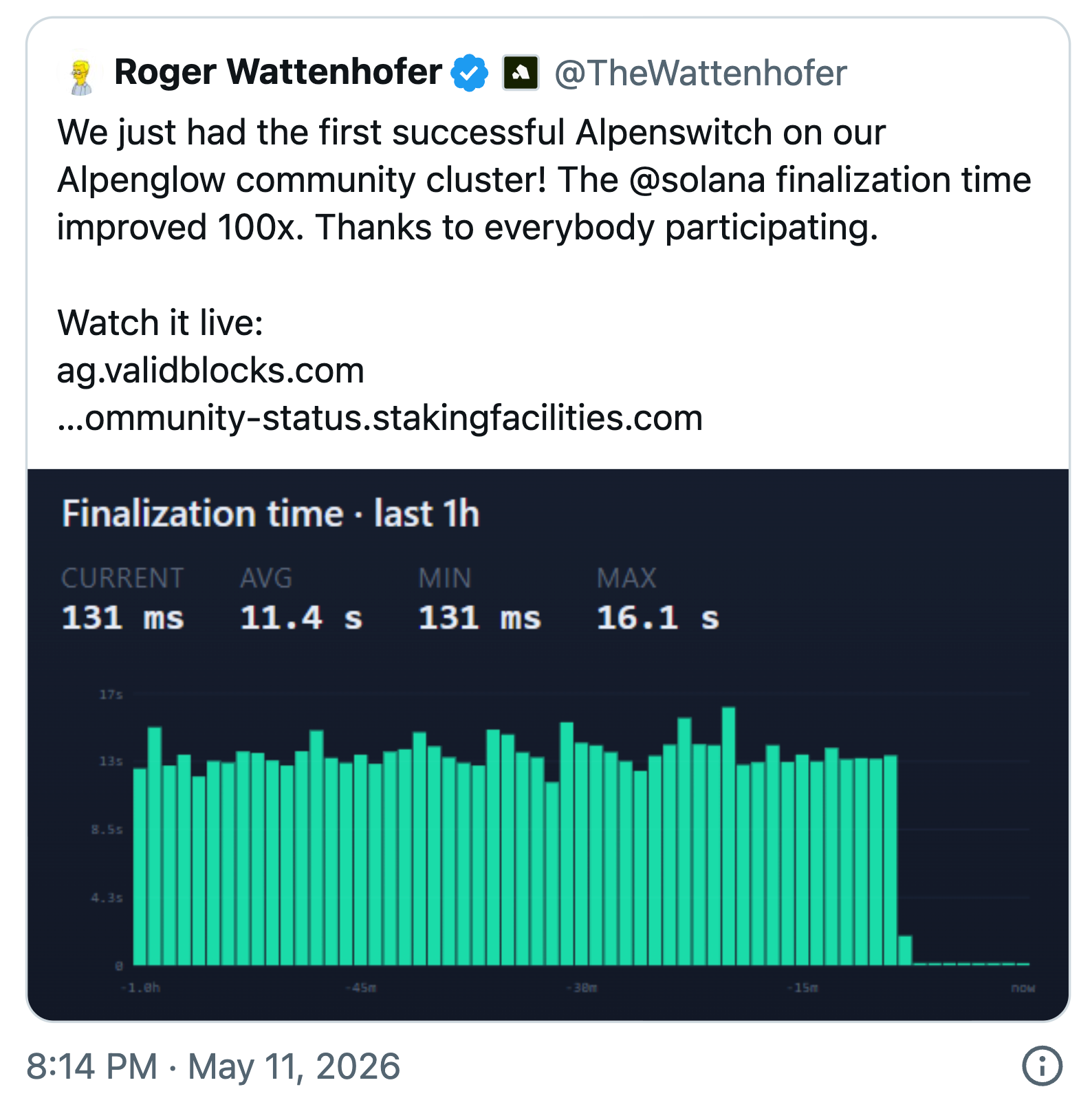
Solana transactions currently finalize in 12.8 seconds, but after Alpenglow, this time decreases to 100–150 milliseconds.
That is not a configuration tweak. This update fully replaces Solana's original consensus mechanisms—Proof of History and TowerBFT—with a new, ground-up architecture. The upgrade received 98.27% validator approval in September 2025, began community cluster testing in May 2026, and aims for mainnet deployment in late 2026 through Agave 4.1.
This text describes the specific changes Alpenglow makes at the protocol level, why those changes are important for traders and developers, and their implications for infrastructure providers such as RPC Fast.
TL;DR
Alpenglow is not an incremental improvement. It is a ground-up replacement of Solana's consensus layer that:
- Cuts finality from 12.8 seconds to 100–150ms;
- Frees 75% of block space currently consumed by vote transactions;
- Eliminates the three-tier commitment level system for developers;
- Compresses the MEV window and flattens priority fee markets for traders;
- Reduces the minimum profitable validator stake by ~90%.
The governance vote was approved almost unanimously. The community test cluster is now active, and the mainnet is scheduled for late 2026.
The teams that understand what 150ms means—and build infrastructure around it before their competitors do—are the ones that will define what Solana looks like on the other side of this upgrade.
What Alpenglow replaces—and why the old system hit a ceiling
To understand Alpenglow, you need to know what it replaces and why those systems could not simply be optimized further.
Proof of History (PoH) was the original cryptographic clock for Solana—a continuous SHA-256 hash chain that timestamped every event on the network. It was clever engineering in 2020. By 2025, it had become a source of computational overhead that every validator had to verify on every operation, with no way to remove it without redesigning the protocol.
TowerBFT was Solana's consensus mechanism. It required validators to vote in 32 sequential rounds, with each round doubling the lockout period of the previous one. The 12.8-second finality was not a bug—it was the mathematical consequence of that 32-round structure. No amount of hardware improvement could change it.
There was a third problem: validators cast their votes as on-chain transactions. At peak load, even if the number of validators decreased again, those vote transactions consumed roughly 75% of Solana's block space, leaving only a quarter of the network's capacity for actual user activity.
Alpenglow removes all three constraints at once.
Votor and Rotor explained
The entire system is based on two new protocols, each replacing a component of the previous stack. The research was initiated at Professor Wattenhofer's distributed systems lab at ETH Zurich. Anza, the team responsible for the Agave validator client, is leading the implementation, while Jump Crypto's Firedancer team is working together to ensure multi-client compatibility.
- Alpenglow Whitepaper (Anza)
- SIMD-0326 Proposal (GitHub)
- Alpenglow community cluster announcement (May 2026)
How Votor gets blocks finalized
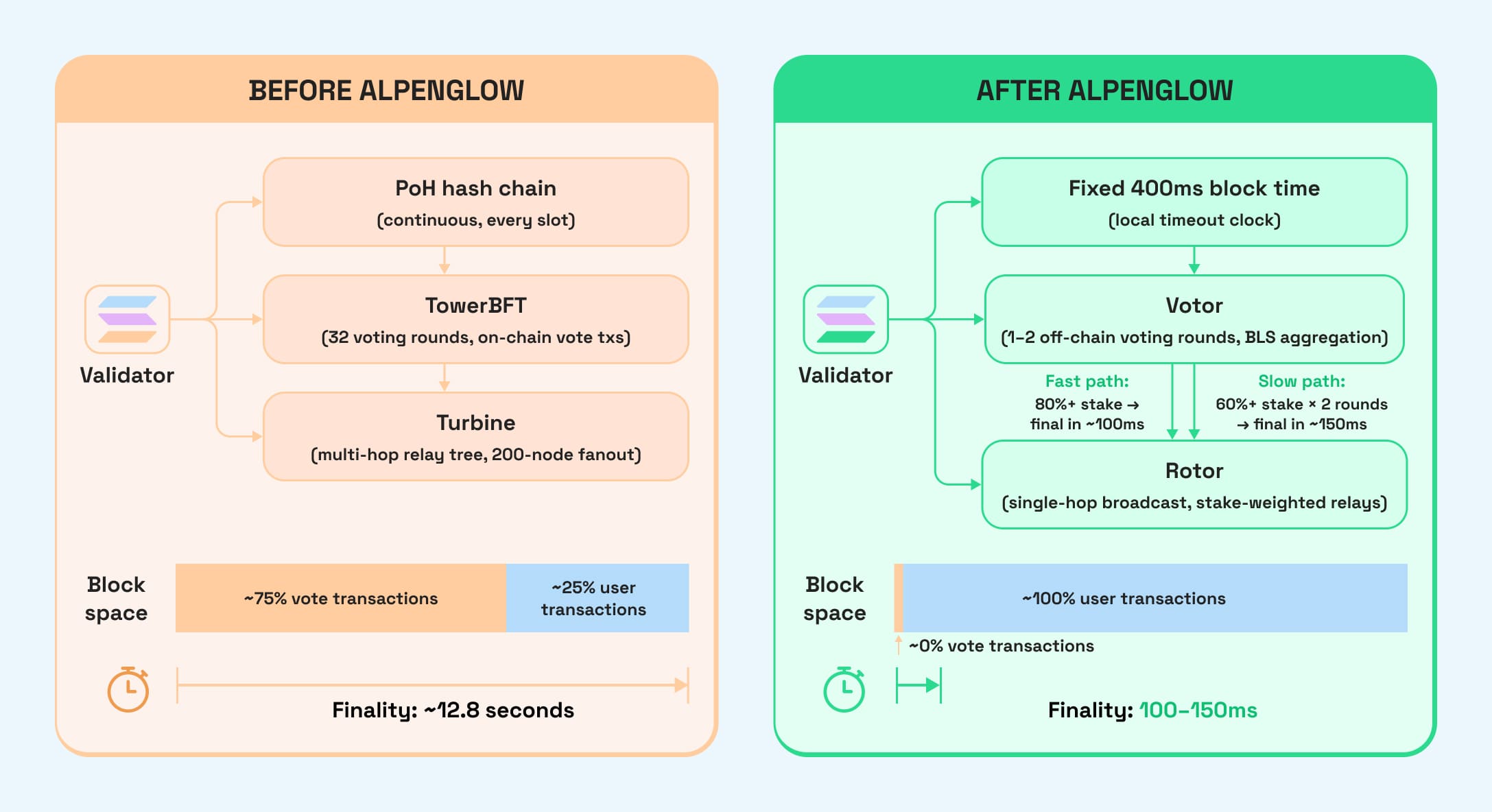
Votor replaces TowerBFT. Instead of 32 sequential voting rounds, it uses one or two parallel rounds:
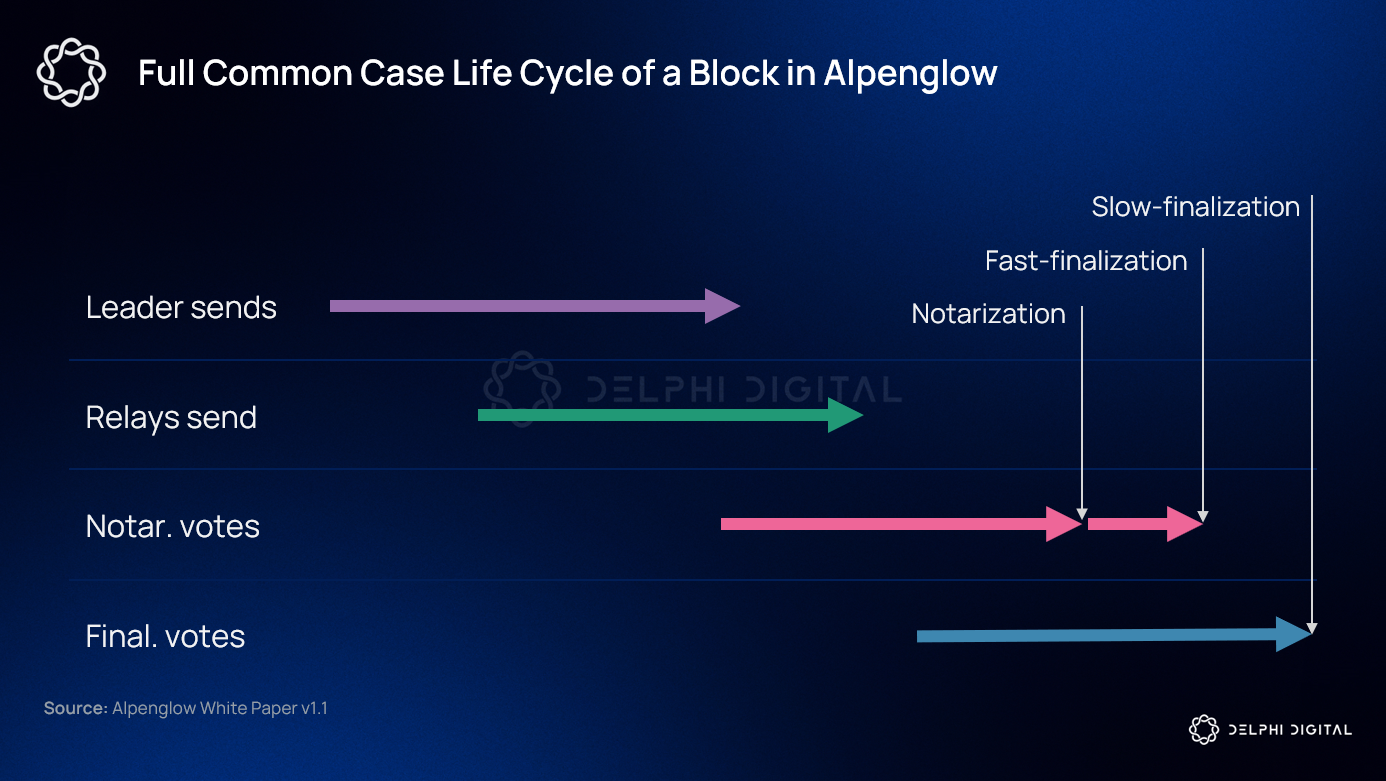
- Fast path (~100ms): If 80%+ of validator stake approves in the first round, the block is final. Done.
- Slow path (~150ms): If 60–80% approve in round one, a second round runs. If 60%+ approve again, it is final.
Both paths operate concurrently, with the first to finish winning.
Importantly, validators no longer submit votes through on-chain transactions. Instead, they send lightweight UDP messages directly to each other. These votes are combined using BLS signature compression, which consolidates thousands of individual signatures into a single, compact proof—approximately 1,000 bytes. Only this aggregated proof is submitted on-chain, replacing the roughly 500 KB of vote data recorded per slot.
As a result, vote transactions are completely eliminated from the block, freeing up 75% of the block space they previously occupied.
How block data spreads with Rotor
Rotor replaces Turbine, the current block propagation layer. Turbine used a relay tree with 200-node fanout, causing latency and failure points. Rotor uses single-hop broadcast: the producer sends data to stake-weighted relay nodes, which then push it to all validators simultaneously.

Note: Rotor will ship separately from the core Votor consensus changes, but both are part of the Alpenglow architecture.
Numbers from the Alpenglow whitepaper show that transmitting 1,500 shreds takes approximately 18ms on a 1 Gb/s bandwidth. To reach 80% of the total stake, only about 150 relay nodes are needed, which can be achieved in roughly 2ms.
%201.jpg)
No more PoH
Alpenglow retires the continuous hash chain entirely. Validators now use a fixed 400ms block time with local timeouts:
- Block arrives before timeout → approve it (NotarVote)
- Timeout expires with no block → skip it (SkipVote)
Clock drift is tolerated proportionally: 5% drift requires only a 5% timeout extension.
Architecture metamorphosis
Performance: The numbers side by side
Simulation results show 65% of stake finalizes within 50ms of raw network latency. With a ~70ms longest one-way network hop, fast-path finality lands around 120–150ms in practice.
The security model: What changes, what holds
Alpenglow introduces a "20+20" fault tolerance framework that differs from classical BFT:
The math behind the safety guarantee: conflicting forks cannot both reach quorum because 80% + 60% = 140% > 100%. For liveness, the network still finalizes through the slow path even if 20% of the stake goes offline.
The trade-off is real—pure Byzantine tolerance drops from 33% to 20%. But real-world failures are mixed: some nodes are malicious, some are simply offline. The combined 40% tolerance handles that scenario better than traditional BFT's uniform 33% ceiling.
One commitment level: Dev dream comes true?
Today, we have three commitment levels on Solana:
processed—fastest, no confirmation guarantee;confirmed—approx. 500ms, probabilistic;finalized—approx. 12.8s, deterministic.
Every developer makes a trade-off per feature: accept rollback risk and show the user a fast result, or wait 12.8 seconds and be certain. Exchange deposit crediting, bridge confirmations, and liquidation engines all wait for finalized because even a small rollback risk is unacceptable. Everything else uses confirmed and hopes for the best.
Alpenglow simplifies to one level with 100–150ms deterministic finality per transaction. No trade-offs, no retries for disappeared transactions.
That single change unlocks patterns that were previously impractical:
- On-chain order books with tighter spreads—market makers know their quote state is final in 150ms.
- Perpetual exchanges with lower latency costs on JIT auctions.
- Cross-chain bridges that eliminate the Solana-side finality bottleneck.
- Exchange deposit crediting that goes from a 13-second wait to instant.
- Point-of-sale payments where customers expect the same responsiveness as a card tap.
What this means for traders
For traders—whether running bots or executing manually—Alpenglow changes the competitive landscape in three concrete ways:
1. The MEV window narrows
Under TowerBFT, slot leaders could delay block production to sell better ordering to searchers. Alpenglow penalizes leaders who miss timeout thresholds, reducing their probability of winning future slots. The sandwich attack window compresses as finality tightens.
2. Priority fee markets flatten
When every transaction finalizes in 150ms, the urgency gradient that drives fee spikes becomes less extreme. The value of being first is still real—but the premium for it decreases.
3. Latency becomes the primary differentiator
At 12.8-second finality, being 30ms faster than a competitor was a meaningful edge but not decisive. At 150ms finality, 30ms is 20% of the entire confirmation window. Infrastructure latency—the gap between chain tip and your node—becomes the dominant variable in competitive execution.
Validator economics: What changes
Alpenglow also restructures the economics of running a validator:
- Vote fees disappear. Currently ~1 SOL/day per validator. Alpenglow moves all voting off-chain.
- New cost: Validator Admission Ticket (VAT). ~0.8–1.6 SOL per epoch, burned to reduce inflation.
- Validator cap: 2,000 (highest stake selected).
- Barrier to entry drops ~90%. Minimum profitable stake falls from ~4,850 SOL to ~450 SOL.
- HSM support. Identity keys can now live in hardware security modules, since they no longer sign high-frequency vote transactions.
Where Alpenglow stands right now
As of May 2026, Alpenglow is not yet on production clusters. The community test cluster phase is being treated as a serious proving ground—a flaw reaching production could affect transaction processing, state consistency, or network liveness.
Other expected components
SIMD-0326 covers the Votor consensus changes. Three components from the full Alpenglow whitepaper are deferred to separate proposals:
- Rotor (block propagation)—separate SIMD, part of the broader Alpenglow vision
- Smart sampling—bandwidth optimization layer
- Lazy/Asynchronous execution—decouples execution from consensus for further throughput gains
Firedancer, Jump Crypto's independent validator client written in C/C++, also benefits directly from Alpenglow. The simpler consensus protocol means less complexity to reimplement in a second codebase—a practical win for multi-client diversity and network resilience.
What Alpenglow means for RPC Fast users
A 150ms finality window only delivers its full value if the infrastructure layer is calibrated to operate inside it. That is where the pressure lands on RPC providers—and where RPC Fast is actively preparing.
Three infrastructure gaps have become visible as Alpenglow testing progresses:
- Node lag. RPC nodes running on commodity hardware cannot keep up with validator throughput, creating a widening gap between chain tip and node tip. At 12.8-second finality, a 2–3 slot lag was tolerable. At 150ms, it is a structural bottleneck.
- Polling cycles. WebSocket subscriptions built around 400ms polling cycles now miss multiple full consensus rounds between updates.
- Submission paths. Transaction submission paths that were "fast enough" at 12-second finality become a visible source of latency overhead when the confirmation window is 150ms.
These are not problems that more of the same infrastructure solves. They require purpose-built nodes, gRPC streaming instead of WebSocket polling, and direct submission paths that bypass the standard gossip queue.
RPC Fast is tracking Alpenglow's development closely and evolving both SaaS endpoints and dedicated node configurations to match the new consensus architecture.
The same engineering approach that powers Aperture gRPC—intercepting data at the shred level, 30–40ms ahead of standard Yellowstone streams—is the foundation for staying ahead of the curve as Alpenglow reshapes what "fast" means on Solana.
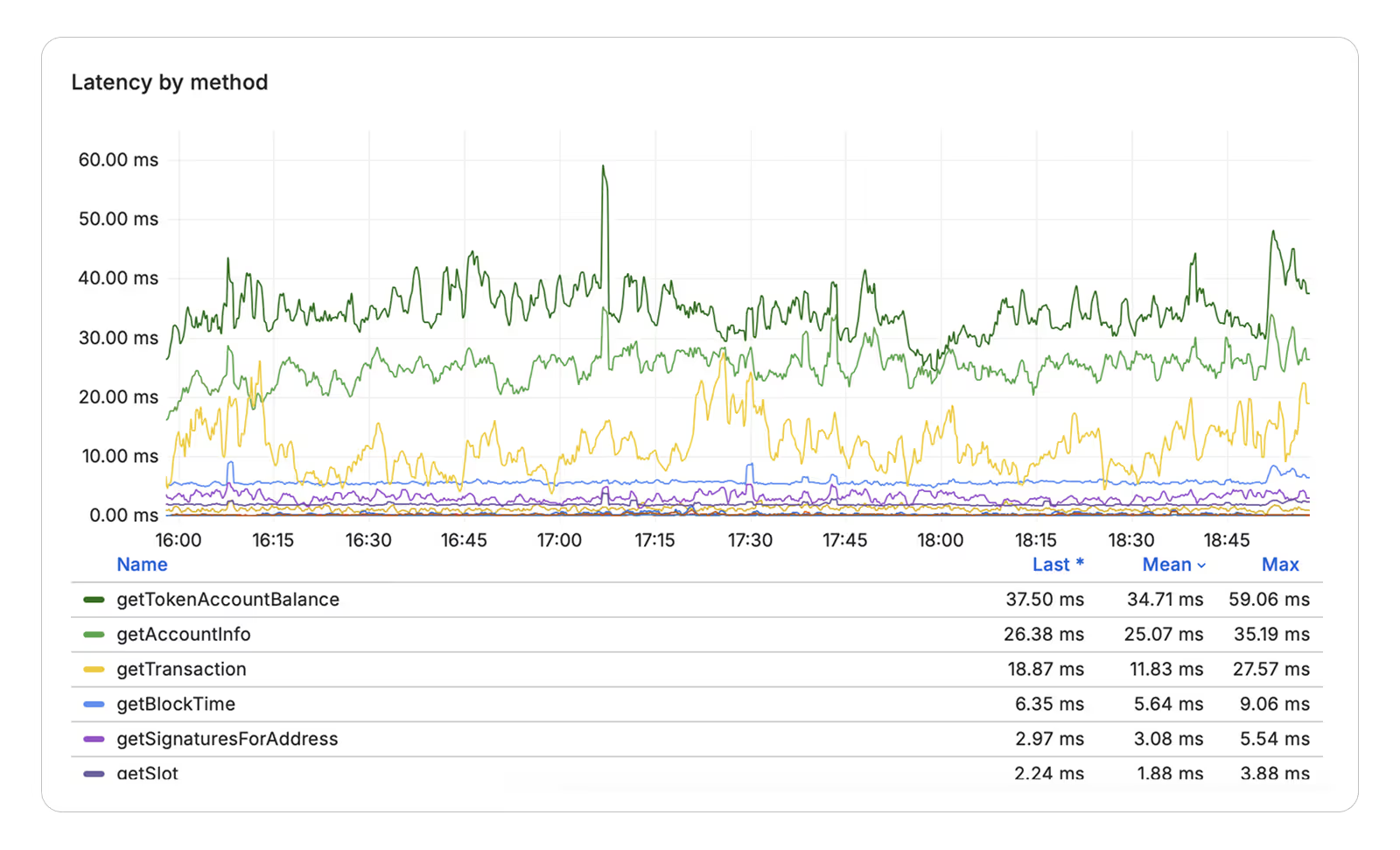
For users on RPC Fast SaaS or dedicated nodes, the transition to Alpenglow will not require you to rebuild your integration from scratch. The commitment level simplification (one finality level instead of three) actually reduces integration complexity. What changes is the performance ceiling—and RPC Fast infrastructure is being built to reach it.
.jpg)


.jpg)


