





.jpg)
RPC Fast is the strongest Triton One alternative for Solana HFT, MEV, arbitrage, liquidation, and other execution-sensitive systems when your bottleneck spans the whole path from early transaction detection to transaction landing. Its main differentiator is Aperture TxStream: decoded shred-derived transactions with Address Lookup Table resolution and optional real-time execution simulation, paired with Beam for low-latency transaction submission.
That does not make Triton One an outdated baseline. Triton entered 2026 with one of the deepest Solana infrastructure stacks: Dragon’s Mouth Yellowstone gRPC, Deshred transactions, Fumarole, Jet transaction sending, SWQoS, dedicated nodes, RPC 2.0 work, and now Riptide plus raw shred streaming across New York, London, Amsterdam, Frankfurt, and Tokyo.
The right alternative therefore depends on which Triton layer you are replacing.
TL;DR
- RPC Fast: best Triton One alternative for HFT and MEV teams that want pre-execution data, execution prediction, and transaction routing inside one trading-focused stack.
- Helius: strongest alternative for teams wanting a broad Solana-native platform around RPC, LaserStream, raw/decoded shreds, preconfirmations, APIs, and Sender.
- eRPC: strong fit when physical placement, raw Direct Shreds, SWQoS, and colocated application compute matter most.
- Shyft: strong price/performance choice for Yellowstone gRPC and decoded shred-level RabbitStream with straightforward flat plans.
- QuickNode: strong option for multi-chain teams that want managed Solana gRPC, Jito tooling, staked transaction paths, and enterprise platform features.
- Alchemy: strong fit for multi-chain enterprises prioritizing managed Yellowstone compatibility, redundancy, and consumption-based streaming rather than a specialized Solana trading stack.
Test RPC Fast against your current Triton endpoint with the same region, filters, transactions, blockhash policy, and fee logic. The useful metric is signal-to-landed-transaction time, not endpoint response time.
Why look for a Triton One alternative in 2026?
Triton One is harder to replace than a generic RPC provider because it covers several different jobs.
Its Project Yellowstone stack includes Dragon’s Mouth gRPC, while Fumarole targets persistent and resumable streaming. Deshred moves transaction visibility earlier than normal Geyser output. Jet handles transaction forwarding, and Triton made SWQoS routing available by default rather than retaining it as a separate Cascade marketplace product.
In August 2026, Triton also introduced Riptide, a lower-latency path for the existing Dragon’s Mouth service, and raw Triton Shred Streaming from five locations in cooperation with DoubleZero and Malbec Labs. Existing Riptide customers retain the same subscriptions, filters, SDKs, tokens, and pricing.
Its pricing is equally different from traditional credit plans. Triton requires a $125 prepaid balance valid for 12 months, then charges standard RPC and unary gRPC at $0.08/GB plus $10 per million calls; streaming is listed at $0.08/GB. Features are not separated into conventional product tiers.
Below, we explain how Triton alternatives might cover at least five use cases to help your project grow faster.
.jpg)
Triton One alternatives: Quick comparison
Pricing and product availability checked August 11, 2026.
- Triton pricing is public usage-based pricing;
- RPC Fast lists Stream at $249/month and Aperture at $499/month;
- Helius lists Business from $499/month and LaserStream data tiers from $400/month;
- Shyft Build starts at $199/month with gRPC and RabbitStream;
- QuickNode includes Solana gRPC from Scale at $499/month;
- Alchemy prices Yellowstone gRPC at $75/TB.
RPC Fast as the best Triton One alternative for MEV and HFT
Best for: MEV searchers, HFT systems, arbitrage, liquidations, market makers, copy trading, sniper infrastructure
RPC Fast fits as a Triton alternative when the requirement is broader than “replace Yellowstone gRPC.” The architecture splits RPC reads, structured streams, earlier data, and transaction delivery into separate layers, rather than treating RPC latency as the only performance metric.

TxStream reconstructs transactions from Solana shreds, decodes them, resolves Address Lookup Tables, applies server-side filters, and sends the resulting transaction before validator replay completes. Optional real-time simulation adds a predicted execution result while the signal is still inside the early-data path.
That changes the HFT pipeline from:
shreds → deshred → decode → resolve ALTs → simulate → decide
to:
TxStream → decoded transaction + ALT data + predicted result → decide
For a strategy engine, fewer application-side stages mean less processing before the decision point.
What the RPC Fast benchmark shows
RPC Fast’s July 17 internal test raced 44,574 shared transactions. TxStream arrived before Jito ShredStream in 82% of those races, with a 284 µs median lead. Against Yellowstone, full decoded mode won 68.4% of matched races with a 62 µs median lead; signatures-only mode recorded a 7.77 ms median advantage.
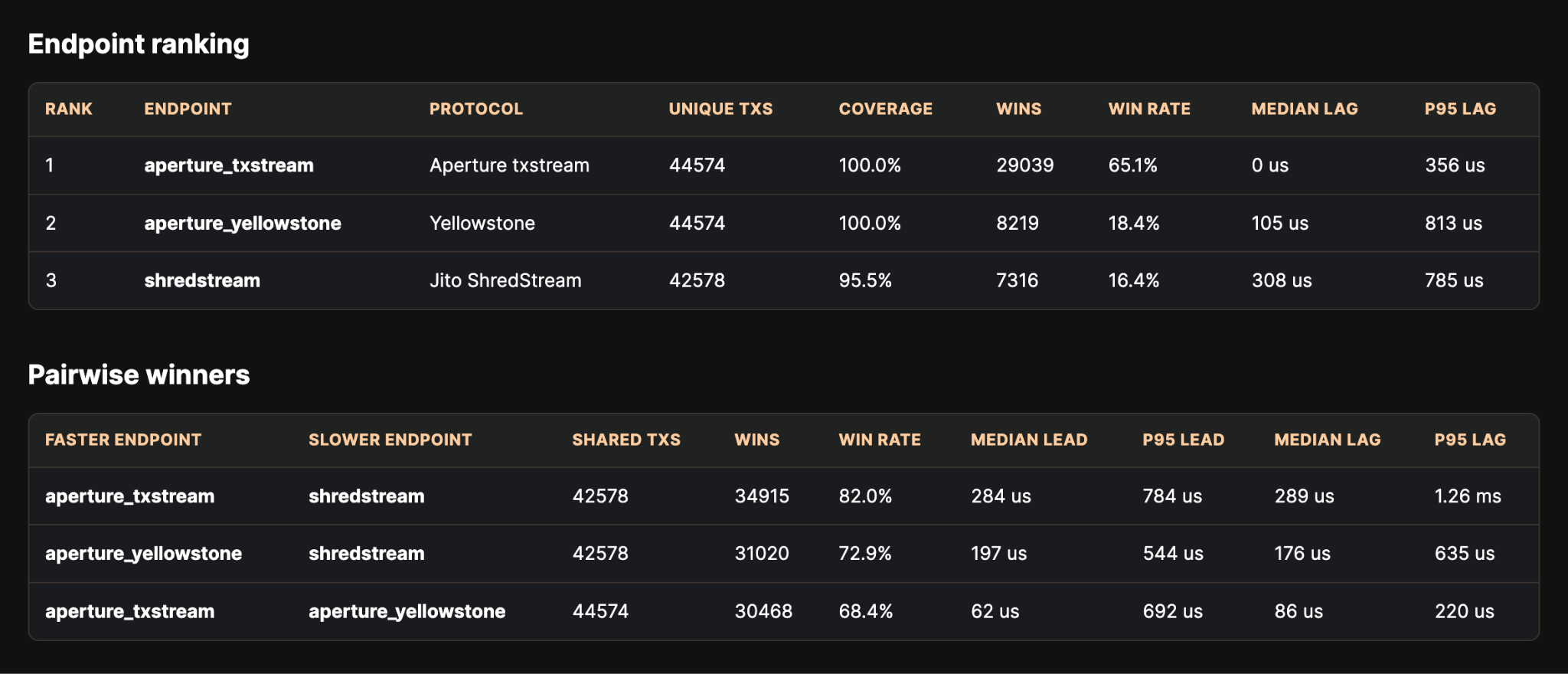
The simulation benchmark reported roughly 95% agreement with observed execution while adding 791 µs to median delivery. These are RPC Fast measurements, not independent cross-provider results, so production teams should repeat the experiment from their own strategy location.
The trade is explicit: 791 µs is not free. A bot where raw reaction time dominates should test simulation disabled. A liquidation or arbitrage engine where false signals trigger expensive transaction construction, simulation, route selection, or submissions has a different latency budget.
Transaction landing matters equally
RPC Fast Beam sits on the output side of the loop. Beam is a low-latency transaction submission layer and now includes Nozomi among its routes, giving the strategy more than one delivery path rather than binding execution to the data provider’s default sendTransaction route.
That produces a useful architecture for trading:
TxStream → strategy filter → transaction build → Beam → leader → confirmation
RPC Fast has treated those as separate infrastructure problems from the start: Yellowstone for structured state, early streams for latency competition, Beam for delivery, and dedicated nodes when shared infrastructure introduces unacceptable variance.
.jpg)
Pricing
RPC Fast’s regular shared plans are $249/month for Stream and $499/month for Aperture. Stream includes up to 10 Yellowstone streams; Aperture lists up to 25 Yellowstone and 10 Shredstream streams alongside TxStream.
Dedicated Solana infrastructure starts from $2,200/month for the 512 GB EU tier, with larger setups for heavy methods and custom infrastructure.
.avif)
Where RPC Fast fits better than Triton
Choose RPC Fast first when:
- Strategy quality benefits from execution prediction before landing;
- You want decoded shred-derived transactions without running your own reconstruction path;
- The system needs both low-latency ingestion and independent transaction routes;
- Fixed SaaS capacity fits budgeting better than usage-metered streaming;
- Your infrastructure team wants a path from shared RPC to dedicated nodes and HA.
Where Triton still has an advantage
Triton has a stronger open-source footprint around Yellowstone and a newer network-layer stack around Riptide, DoubleZero-assisted shred distribution, and raw Shred Streaming. Teams that already run custom deshredding, strategy logic, and transaction routing might value that lower-level control more than TxStream’s server-side processing.
Verdict: RPC Fast is the best Triton alternative for MEV/HFT when the objective is not just the rawest feed, but the shortest practical path from usable signal → qualified decision → transaction submission.
Helius—broad Solana-native alternative
Best for: Solana applications needing one provider for RPC, data APIs, streaming, historical data, and trading infrastructure
Helius now competes with Triton across far more than RPC.
LaserStream provides Yellowstone-compatible low-latency streaming with multi-node aggregation, automatic failover, and up to 24 hours of replay. Helius also exposes raw Shred Delivery and decoded shred-derived signals for teams moving farther upstream in Solana’s data pipeline.
Its 2026 trading stack extends even earlier through preconfirmations. Helius describes these as execution results emitted from participating leaders before the resulting block data leaves the machine. Coverage depends on participating leaders, and the result is not final.
For submission, Helius Sender dispatches transactions through high-speed pathways and lists seven regional endpoints with a default 50 TPS limit. Sender is included across plans, with a minimum tip currently listed at 0.000005 SOL.
This makes Helius one of the closest Triton substitutes in total product breadth.
Trade-off: broad functionality also means more pricing surfaces. Helius lists Business at $499/month, dedicated nodes from $2,900/month, and fixed LaserStream/WebSocket data add-ons starting at $400 for 5 TB.
Verdict: choose Helius when you want a Triton alternative with deep Solana-specific product breadth, especially when trading infrastructure shares a backend with wallets, historical queries, digital assets, or application APIs.
eRPC—best for region and colocation-sensitive systems
Best for: trading teams that control their own transaction parsing and want low-level network placement close to their application compute
eRPC approaches the problem from the physical network upward.
Its platform includes Solana RPC, Geyser gRPC, Direct Shreds, SWQoS, VPS, and bare-metal servers. The infrastructure spans locations including Salt Lake City, Chicago, New York, Dublin, London, Amsterdam, Frankfurt, Stockholm, Singapore, Tokyo, and Sydney.
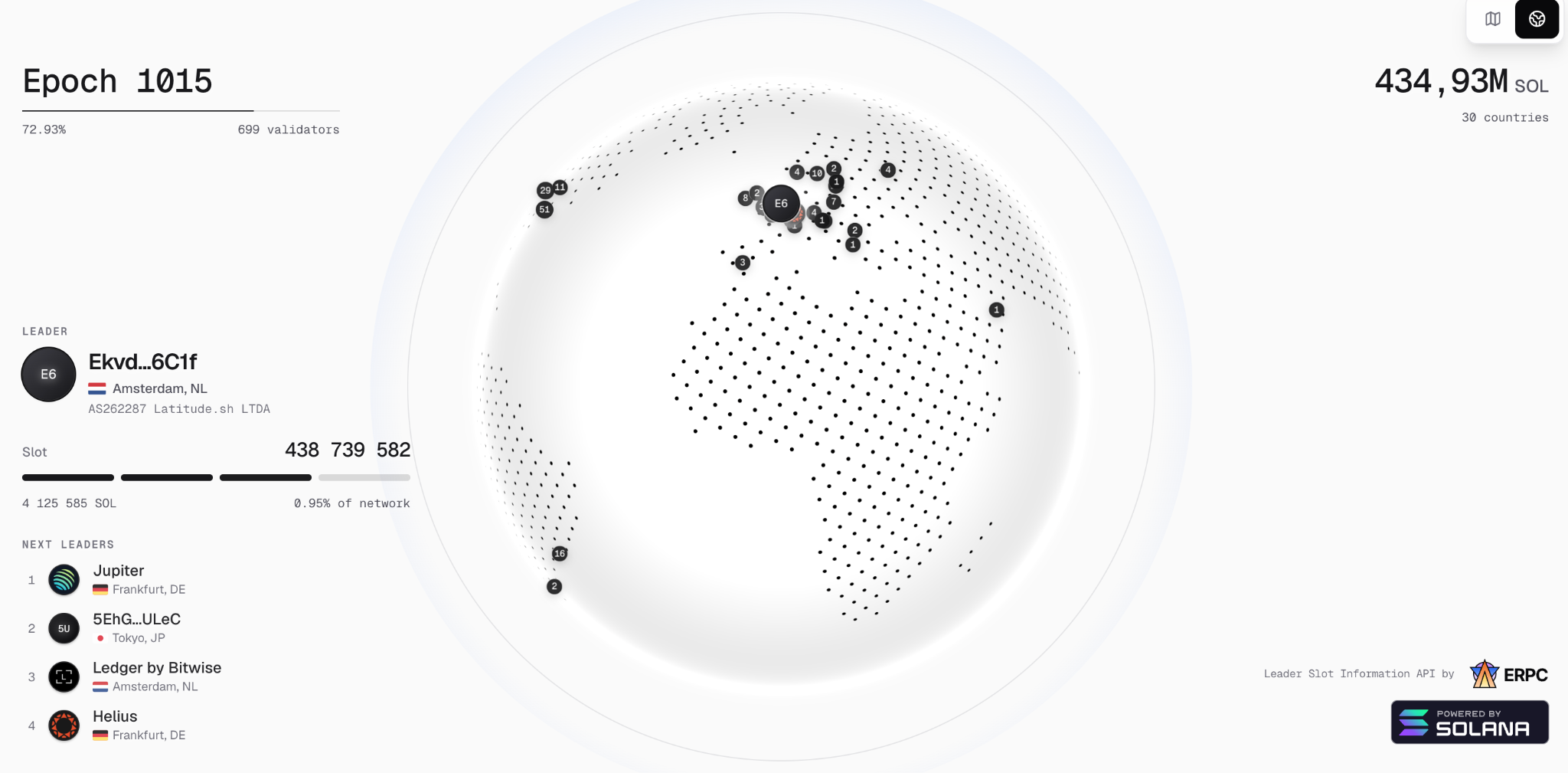
The important differentiator is the ability to place the trading application and Solana data infrastructure on the same provider network.
eRPC sells Direct Shreds separately from Yellowstone/Geyser gRPC and offers colocated VPS and bare-metal configurations described as “zero-distance” communication inside its platform. Direct Shreds retains the raw UDP path rather than converting the feed into an execution-aware object.
That makes eRPC attractive when your team already owns:
- Shred reconstruction;
- Parsing;
- ALT/state enrichment;
- Simulation logic;
- Strategy evaluation;
- Transaction construction.
In that model, provider-side processing is not necessarily desirable. You want packets into your process as early as possible.
Public pricing is unusually granular. The pricing page currently shows shared Direct Shreds from €198/month on the displayed discounted monthly option, dedicated variants at several hardware levels, bundled RPC/gRPC/Shreds plans, and application VPS or bare-metal options on the same network.
Trade-off: this is a more modular infrastructure model. Teams seeking one managed pre-execution object containing decoded transactions, resolved ALTs, and a predicted execution result still need additional strategy-side work.
Verdict: eRPC is one of the strongest Triton alternatives when network geography and ownership of the processing pipeline matter more than higher-level trading abstractions.
Shyft—low-cost decoded shred alternative
Best for: bots, indexers, and Solana teams that want Yellowstone and a shred-derived stream without assembling a large infrastructure stack
Shyft’s strongest Triton substitute is RabbitStream.
RabbitStream consumes raw UDP shreds from multiple sources, reconstructs and decodes transactions server-side, then exposes them through Yellowstone-style transaction filters. The RPC execution pipeline does not sit between the shred source and RabbitStream output.
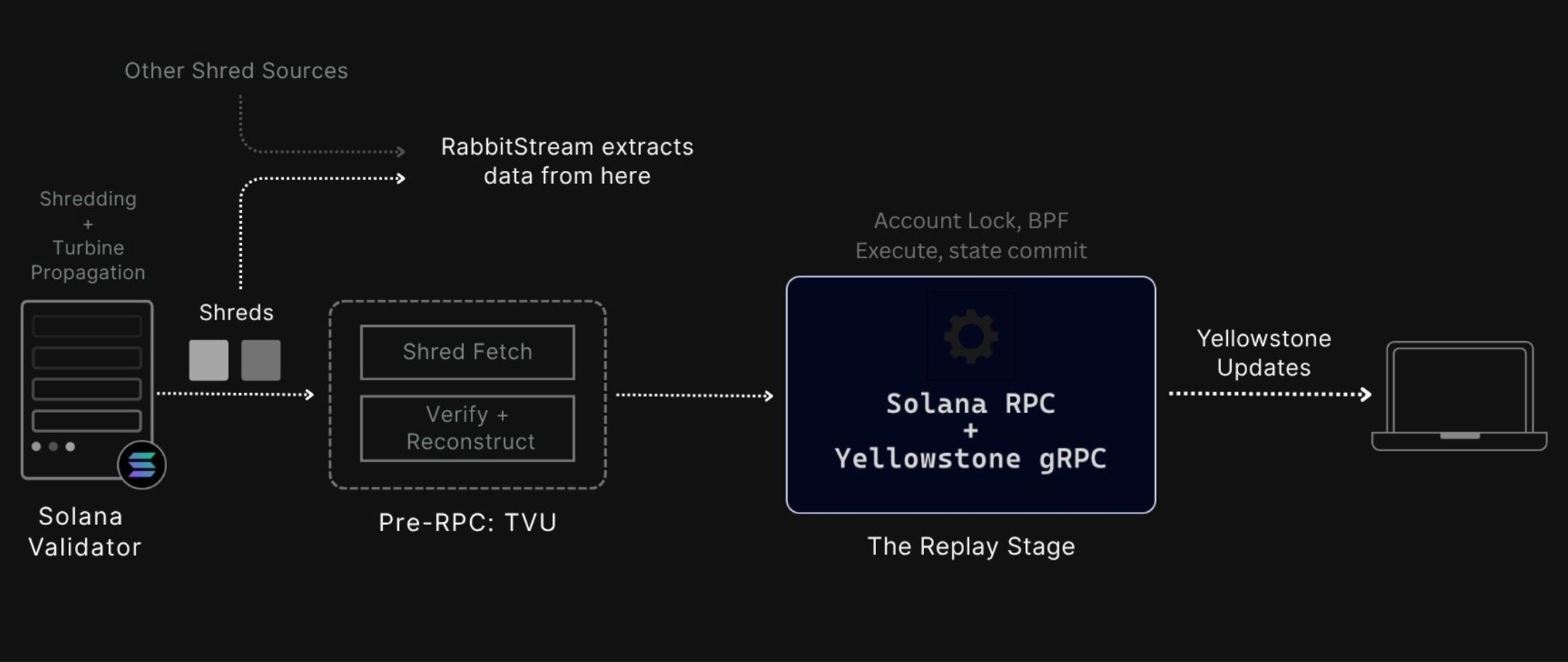
Shyft added Address Lookup Table resolution in July 2026. Its own post-change testing reports 98.9%–99.9% transaction coverage parity with Yellowstone gRPC for the measured workloads, without reported added latency from ALT resolution.
Like Triton Deshred, RabbitStream has no post-execution metadata at that stage. Logs, inner instructions, final balance changes, and execution status only exist after replay. Strategies still need Yellowstone or another confirmation path.
Pricing is one of Shyft’s strongest arguments. Its current Build plan is $199/month and includes unlimited RPC credits, 100 RPC requests/sec, Yellowstone gRPC, RabbitStream, accelerated getProgramAccounts, and staked connections. Grow is $349 and Accelerate—$649.
The transaction-delivery side is less differentiated than Helius Sender, Triton Jet, or RPC Fast Beam. Shyft lists staked connections and Jito simulateBundle, but its core public positioning centers more heavily on data streaming and RPC.
Verdict: Shyft is a strong Triton alternative when the main bottleneck is streaming cost and early decoded transaction detection, rather than a fully managed signal-to-routing trading loop.
QuickNode as a multi-chain alternative with mature Solana gRPC
Best for: engineering organizations operating Solana alongside EVM and other chains
QuickNode is less Solana-specialized than Triton, but its 2026 Solana stack is materially stronger than older provider comparisons suggest.
As of June 2026, Yellowstone-compatible Solana gRPC is included directly with the $499 Scale and $999 Business plans. Scale includes 10 concurrent gRPC streams, 250 RPS, and 950 million monthly API credits; Business raises the stream limit to 25 and RPS to 500.
QuickNode’s managed gRPC product also supports recent-slot replay and clients for Rust, Go, TypeScript, and Python. Its June 2026 documentation lists JFK, EWR, FRA, IAD, and NRT availability for the managed Solana gRPC service.
QuickNode also exposes Jito functionality through its Lil’ JIT add-on. That includes bundle submission for atomic multi-transaction strategies such as arbitrage and liquidations.
Where Triton still differs is the depth of directly exposed early-data infrastructure. Triton now sells Deshred, Riptide, and raw Shred Streaming as first-class products. QuickNode’s public product architecture remains more centered around managed gRPC, RPC, platform services, stake-backed transaction optimization, and Jito add-ons.
Verdict: choose QuickNode when Solana is one part of a larger infrastructure footprint and standardization across chains matters more than owning every upstream Solana latency layer.
Alchemy—best for multi-chain enterprise streaming
Best for: teams prioritizing managed reliability, multi-chain consolidation, and usage-based gRPC
Alchemy launched its Yellowstone-compatible Solana gRPC service in May 2026. It streams accounts, transactions, slots, blocks, and entries and adds multi-node redundancy plus replay during reconnects.
Pricing is bandwidth-based at $75 per TB, prorated by bytes streamed. Access requires a Pay-As-You-Go or Enterprise team rather than a separate high-tier Solana streaming package.
That model is attractive for organizations already standardized on Alchemy. You retain a familiar operational platform while replacing Triton’s Yellowstone endpoint with another Yellowstone-compatible service.
Alchemy also documents Solana transaction submission and markets staked connections on its Solana infrastructure. Its public product stack, however, does not expose a Triton-style raw Shred Streaming layer or an RPC Fast TxStream-style decoded pre-execution stream with execution prediction.
That distinction matters for HFT.
If your system reacts to normal Geyser events, Alchemy is relevant. If your competitive edge starts before validator replay, another provider belongs in the benchmark.
Verdict: Alchemy is a strong Triton replacement for enterprise RPC and managed Yellowstone streaming, but not the first choice for the earliest pre-execution Solana signal.
Triton One vs RPC Fast for MEV and HFT
For a trading team, this is the most important comparison.
Triton Deshred and RPC Fast TxStream solve a similar first problem: do not wait for normal post-execution Yellowstone data when the strategy acts on transaction intent.
The next step differs.
Triton keeps Deshred deliberately close to the transaction itself: reconstructed transaction data, ALT information, filtering, but no logs, execution status, balance changes, or other replay-generated metadata.
RPC Fast adds an optional predicted execution result to the pre-execution path. The current internal benchmark puts the extra median cost at 791 µs with roughly 95% agreement against observed execution.
Triton optimizes how early data reaches you. RPC Fast additionally optimizes how quickly that early data becomes an execution decision.
It is not a universal performance ranking. A strategy that performs its own state reconstruction and simulation faster than the managed path might prefer raw shreds. A strategy where rejected signals consume meaningful compute, transaction-building time, or route capacity has more reason to test execution-aware TxStream.
.jpg)
Which Triton One alternative fits your bottleneck?
The selection should start with the failure mode, not the provider name.
Switching providers has a cost. If Triton already meets your p95/p99 stream budget, your transaction landing target, and your cost envelope, migration has no engineering ROI. Triton’s 2026 additions — Deshred, default SWQoS, Riptide, and raw Shred Streaming — have removed several reasons that existed in older comparisons.
The alternative becomes valuable when it removes your bottleneck rather than winning a checklist.
How to benchmark Triton One alternatives correctly
Do not benchmark providers with getSlot latency alone.
For trading systems, measure the entire execution loop under identical conditions:
- Run both feeds from the same machine and region.
- Apply equivalent transaction/account filters.
- Match events by signature or slot.
- Record first complete usable message, not first TCP byte.
- Track coverage alongside first-seen rate.
- Record p50, p95, and p99 instead of one average.
- Measure strategy-processing latency after receipt.
- Submit identical transaction classes with equivalent priority fees, tips, and blockhash age.
- Record landed slot, confirmation latency, failure, expiry, and route.
- Repeat during high-volume periods.
Triton itself recommends attention to network distance and subscriber throughput for gRPC. Its 2026 optimization guide targets ≤50 ms RTT to the streaming endpoint and recommends up to 10 Gbps download capacity for broad full-chain subscriptions.
Those constraints apply to every provider comparison. A Frankfurt server racing a Frankfurt endpoint says little about a strategy running from Tokyo.
For early feeds, also separate three metrics:
first signal → usable transaction → decision
A raw shred feed might win the first metric and lose time to client-side reconstruction. A decoded feed might arrive slightly later at byte zero yet reach a strategy-ready object earlier. A simulated feed spends additional microseconds before delivery but reduces downstream uncertainty.
That is why the correct benchmark ends at successful landing, not at the network socket.
The best Triton alternative must improve your project
Triton One remains one of the strongest Solana infrastructure providers in 2026. The alternatives become stronger in narrower scenarios.
Choose RPC Fast for HFT and MEV when early transaction data, execution prediction, and transaction routing belong to one latency budget. Aperture TxStream is the key differentiator because it moves decode, ALT resolution, and optional simulation ahead of the strategy decision, while Beam addresses the separate problem of landing the response transaction.
Choose Helius for the broadest Solana-native application and trading stack. Choose eRPC when placement, raw shreds, and colocated compute are the architecture. Choose Shyft for straightforward gRPC and RabbitStream economics. Choose QuickNode or Alchemy when Solana belongs inside a larger multi-chain platform.
For production trading teams, the final decision should come from a side-by-side race on your workload.
.jpg)


.jpg)


