





TL;DR
→ Solana hit 2,000+ live dApps and 600M+ daily RPC requests in 2025. Not every RPC node is built to handle that load.
→ Most teams default to public or shared endpoints—and only discover the ceiling when a memecoin launch or liquidation cascade exposes 800+ ms tail latencies.
→ Evaluate by 4 pillars: Performance (slot lag, p99, landing rate), Streaming (gRPC, ShredStream), Reliability (failover, observability), Economics (pricing, free tier).
→ Top picks by workload: RPC Fast and Triton One for trading-grade execution, Helius for data-rich dApps, QuickNode and Alchemy for multi-chain.
→ Shared vs dedicated isn't a tier choice—it's a workload choice. Under congestion, shared p99 jumps to 800–1850 ms while dedicated holds 25–60 ms. Chart below.
→ Average latency tells you nothing. p99 under congestion is the only metric that maps to production P&L.
By early 2026, Solana more than doubled its active address count to over 5 million in a single month, with daily transactions climbing from 52 million to 87 million—and behind every one of those, a Solana RPC node does the work. With more than 2,500 live dApps on mainnet and over 600 million daily RPC requests routed through provider infrastructure, the network is putting pressure on the layer most teams never think about until it breaks.
Not every Solana RPC node is built to handle that load. When traffic spikes, the difference between a reliable provider and a bottleneck becomes painfully clear: missed blocks, dropped transactions, seconds of slot lag—and suddenly your trading bot loses the edge.
Many teams still default to public or shared Solana RPC endpoints, unaware of how much performance depends on the node behind the scenes. Choosing the right Solana RPC node provider in 2026 means choosing how well your app scales, confirms, and competes.
In this guide, we break down the top Solana RPC providers of 2026 and explain how to evaluate them based on speed, uptime, and production-grade infrastructure. We've built this around what we call The 4-Pillar RPC Audit—the framework production teams should run before picking a provider.
.jpg)
Each pillar maps to a specific failure mode. Skip performance, and your bot lands late. Skip streaming, and you react to stale events. Skip reliability, and a provider outage takes your app down with no warning. Skip economics, and the bill catches up in two months. The providers below differ sharply on which pillars they actually optimize for.
Best Solana RPC providers + alternatives
In this section, we break down the leading Solana RPC providers of 2026—from low-latency trading-grade solutions to developer-friendly API layers.
RPC Fast (by Dysnix)
Best for high-load dApps and low-latency execution. RPC Fast, built by Dysnix, delivers a performance-first RPC layer tailored for Solana's high-throughput architecture. Unlike many shared services, it runs on bare-metal infrastructure with dedicated compute clusters across global regions—minimizing slot lag and ensuring fast, consistent transaction confirmation.
Key advantages:
- Ultra-low latency Solana RPC endpoints — shared SaaS plans served from Frankfurt (Equinix FR13), dedicated nodes deployable across the US, EU or Asia
- Sub-1-slot lag under load due to aggressive replication strategies and validator co-location
- Staked validator identity (SWQoS) to boost transaction success rates in congested blocks
- Aperture TxStream attaches a predicted execution result to each transaction while it is still in flight — roughly 95% accurate against actual execution, at a cost of +791 µs to median delivery, included on the Aperture plan
- gRPC streaming — Yellowstone gRPC with up to 10 concurrent streams on the Stream plan and 25 on Aperture, plus gRPC Shredstream on Aperture; on dedicated nodes Yellowstone gRPC, Aperture gRPC and ShredStream are all included at no add-on cost
- Built-in failover with automated rerouting between nodes
- Detailed usage dashboards and ready-to-integrate DevOps tooling
Ideal for DeFi platforms, trading bots, and large-scale dApps, RPC Fast emphasizes real-time consistency, especially under volatile network conditions. It's one of the few providers focused on deep infrastructure control rather than abstracting complexity away.
RPC Fast runs more than one line. Shared SaaS plans start at $0 with no credit card, which is enough to benchmark the endpoint against whatever you run today. Dedicated bare-metal nodes start at $2,200/month with the server, setup and maintenance included, and carry no rate limits — that is the line most trading teams eventually cross.
Helius
Best for data-rich Solana apps (NFTs, wallets, explorers). Helius goes beyond base RPC—offering enhanced APIs for NFTs, SPL tokens, account history, and webhooks. It acts more like a Solana-native indexing and developer platform than a raw RPC node provider.
Highlights:
- NFT, token, and metadata APIs (DAS) ready out-of-the-box
- LaserStream gRPC with auto-reconnect and historical replay
- Webhooks for instant subscription to account or transaction changes
- Staked and prioritized RPC endpoints for higher confirmation probability
- SOC 2 certified—relevant for institutional clients
Helius is trusted by teams like Backpack, Phantom, and Helium. For developers building wallets, marketplaces, or analytics tools, Helius removes the need to maintain custom indexers. The trade-off: Solana-only with no multi-chain support, and credit-based pricing can introduce cost variability on streaming-heavy workloads.
Triton One
Best for latency-critical applications. Triton One caters to developers who need the absolute fastest Solana RPC response times—think algorithmic traders and real-time gaming systems. It combines staked RPC endpoints with Yellowstone gRPC streaming for near-instant block access.
What sets it apart:
- Sub-100 ms average RPC latency in production
- Creator of Project Yellowstone (Dragon's Mouth gRPC, Steamboat, Old Faithful)
- Cascade Marketplace for stake-weighted QoS bandwidth
- Dedicated support for HFT, MEV, and transaction bundling
It's not designed for casual use—Triton is a premium solution for apps where milliseconds mean profit or loss. Dedicated nodes start around $2,900/month, which reflects the enterprise focus.
QuickNode
Best all-purpose multi-chain RPC provider. QuickNode remains one of the most popular RPC node providers across all chains. On Solana, they serve billions of monthly requests and power many production dApps.
Features:
- Shared and dedicated Solana RPC endpoints with 99.99% uptime SLA
- Yellowstone gRPC (via port 10000), WebSockets, webhooks
- Add-on marketplace: MEV protection, TX speed boost, NFT APIs
- Enterprise support and detailed performance dashboards
QuickNode is a solid pick if your team works across chains or needs reliability at scale. Their Solana integration is deep and battle-tested. The main limitation for latency-sensitive Solana workloads is throughput capping at 400 RPS on standard tiers, and some advanced Solana features require paid add-ons rather than being included by default.
Alchemy
Best for teams already using Alchemy for other chains. Alchemy was early to Solana and brought its Supernode architecture—known for high accuracy and uptime—to the network. While their Solana offering isn't as advanced in feature depth as Helius, it's stable and backed by excellent documentation and support.
Key benefits:
- Full archive node access
- 99.99% uptime SLA
- Developer tooling, observability, and SDK polish among the best in the industry
- 30M compute units/month free tier
- Strong onboarding experience for larger teams
If you already use Alchemy for Ethereum or L2s, their Solana RPC offering fits right into your workflow. The cap is 300 RPS even on the highest shared plans, and the Solana-native optimization isn't as deep as Helius or Triton One.
Syndica
Best for teams focused on monitoring and observability. Syndica provides RPC infrastructure with real-time analytics built in. Their platform includes native observability—tracking request latencies, node health, and error rates in real-time.
Key features:
- Streaming logs via ChainStream
- SLA-backed shared and dedicated endpoints
- Custom RPC caching and pre-indexing support
- Focus on dev UX and incident debugging
A great match for infrastructure-minded teams or apps where visibility and response metrics are critical. The trade-off: less focus on raw latency optimization than RPC Fast or Triton One.
Chainstack
Best budget-friendly option with production-grade reliability. Chainstack offers affordable Solana RPC access with reliable uptime and clear API limits. It's popular among startups and mid-scale projects looking to avoid platform lock-in.
What to expect:
- Transparent free tier and pay-as-you-grow pricing
- Self-healing RPC clusters with auto-recovery (Bolt instant sync)
- Trader Nodes product with Jito ShredStream by default
- SOC 2 Type II compliant
- Global endpoints via GCP and AWS, 70+ chains
Unlimited Nodes start at $149/month, providing a middle-ground option for teams that want predictable costs without full dedicated infrastructure.
Comparing providers? Start with a benchmark, not a brochure.
RPC Fast offers a free SaaS tier — Solana-only, no credit card.
Start for freeHow to evaluate a Solana RPC provider
Here's a breakdown of the core factors that differentiate production-grade RPC infrastructure from basic or unreliable setups—the operational checklist behind the 4-Pillar framework above.
| Evaluation factor | Why it matters |
|---|---|
| Slot alignment | Accurate, low-lag slots prevent failed transactions and ensure timely execution. Each slot of lag is a slot of blockhash budget already spent. |
| Staked validator access | SWQoS boosts prioritization during congestion. Critical for dApps under load. Public RPCs drop first when validators are oversubscribed. |
| Latency under load | Ensures response times stay stable during peak usage (NFT mints, DeFi spikes, memecoin launches). Marketing-page latency means nothing here. |
| Error transparency | Clear logs, traceable failures, and structured RPC responses simplify debugging. A generic timeout is the worst possible signal. |
| Rate limits & throttling | Defines how much throughput your app can safely handle without errors. Shared endpoints frequently throttle at 30–50 RPS per IP. |
| Failover mechanisms | Automatic rerouting across nodes reduces downtime during regional or node outages. |
| Developer tooling | Observability, analytics, and request tracing reduce operational guesswork. The cost of bad tooling shows up in production debugging time. |
| Streaming support | Yellowstone gRPC and Jito ShredStream replace polling and WebSocket subscriptions for execution-critical events. 5–15 ms vs 50–200 ms. |
Comparison of performance and speed
In the Solana ecosystem, speed isn't a luxury—it's a requirement. With the network processing up to 65,000 transactions per second and operating on 400 ms block times, any lag between your application and the RPC layer creates friction that users will feel. But raw TPS isn't the only metric that matters. When comparing Solana RPC providers in 2026, real-world performance comes down to slot freshness, response consistency, and throughput under pressure.
A key differentiator is slot alignment—how closely the RPC node tracks the current slot leader on the Solana cluster. Even a 1–2 slot delay (less than a second) can cause missed transaction confirmations, especially when submitting priority transactions like mints or swaps. Top providers like RPC Fast and Triton One have invested heavily in replication strategies and custom validators to maintain sub-slot-level freshness. Others rely on shared or archived nodes that fall behind during congestion, introducing invisible delays that compound under load.
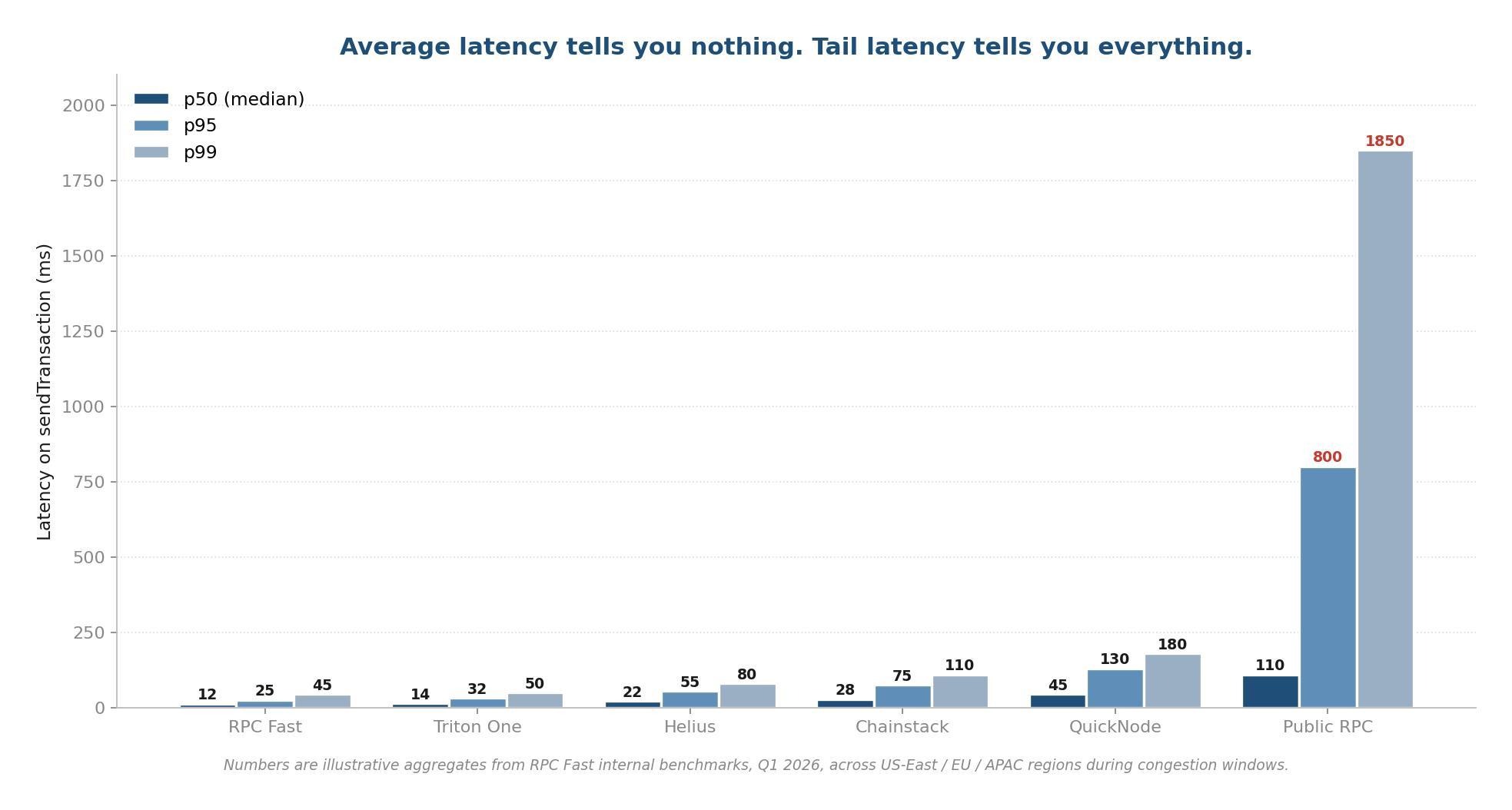
Another critical factor is latency under volume. While many providers advertise millisecond-level pings in idle conditions, true performance emerges during NFT launches, airdrops, or high-frequency trading bursts. The chart above tells the story: at p50, most providers look acceptable. At p99, the gap widens by 4x or more. Public RPC endpoints can spike to several seconds or return 429 errors when limits are hit.
Connection handling and throughput limits also vary widely. Some providers silently rate-limit at 30–50 RPS per IP, while others scale horizontally across regional clusters. Advanced setups use load-aware routing and connection pooling to handle thousands of concurrent requests without degradation.
Finally, consistency beats peak speed. A provider that returns 10 ms responses 90% of the time but stalls unpredictably under pressure is far more dangerous than one that maintains a stable 150 ms. In Solana, where many applications rely on precise block timing, predictability of performance is often more important than absolute speed.
Performance optimization with add-ons
Beyond baseline RPC speed, many modern Solana providers offer performance-enhancing add-ons—tools and services that help developers scale reliably, reduce latency, and simplify integration with complex workloads. These optimizations aren't just extras; in high-throughput production environments, they're essential.
One major advantage is prioritized access through staked validators. By delegating stake or operating their own validators, providers like RPC Fast and Triton ensure client transactions are more likely to be included in congested blocks. This is especially critical for apps with time-sensitive logic—such as trading bots, real-time auctions, or high-volume DeFi protocols. QuickNode's optimization guide notes that Solana has maintained 100% uptime for 17+ consecutive months—which means when transactions drop, it's almost always the provider, not the network.
Another boost comes from custom caching layers. Instead of fetching the same account or token metadata over and over, advanced providers cache frequently accessed on-chain data—speeding up queries by orders of magnitude and reducing Solana cluster load. Helius, for example, offers dedicated APIs for NFTs and SPL tokens that skip redundant RPC roundtrips entirely.
Some providers also offer block streaming via Yellowstone gRPC or WebSockets, giving apps low-latency access to slot updates, vote transactions, or state changes without polling. This is a huge win for developers building explorers, notification systems, or dynamic UIs.
Here are the most impactful RPC add-ons available in 2026:
- Staked transaction relaying—ensures higher inclusion rate under congestion
- Enhanced APIs (NFTs, tokens, memos)—pre-indexed data access
- Webhooks and event triggers—for real-time transaction or account monitoring
- gRPC block streams—lower latency and cleaner integration than REST
- Jito ShredStream—50–200 ms earlier visibility on chain state than Turbine fanout
- Observability dashboards—trace performance issues and rate limits in real-time
- Failover routing / multi-region balancing—keeps latency low and availability high
Taken together, these add-ons form a performance layer that sits above the core RPC—one that's increasingly necessary as dApps push Solana's limits. In 2026, it's no longer enough for an RPC to just work—it needs to anticipate load, adapt to network conditions, and give your engineering team the tools to operate with confidence.
Infrastructure reliability
Reliability is where Solana RPC providers either prove themselves—or quietly fail at scale. In a network where blocks are produced every 400 ms, even momentary downtime or slot lag can lead to transaction replays, UI errors, or broken dApp flows. For engineering teams, this makes infrastructure resilience just as important as raw speed.
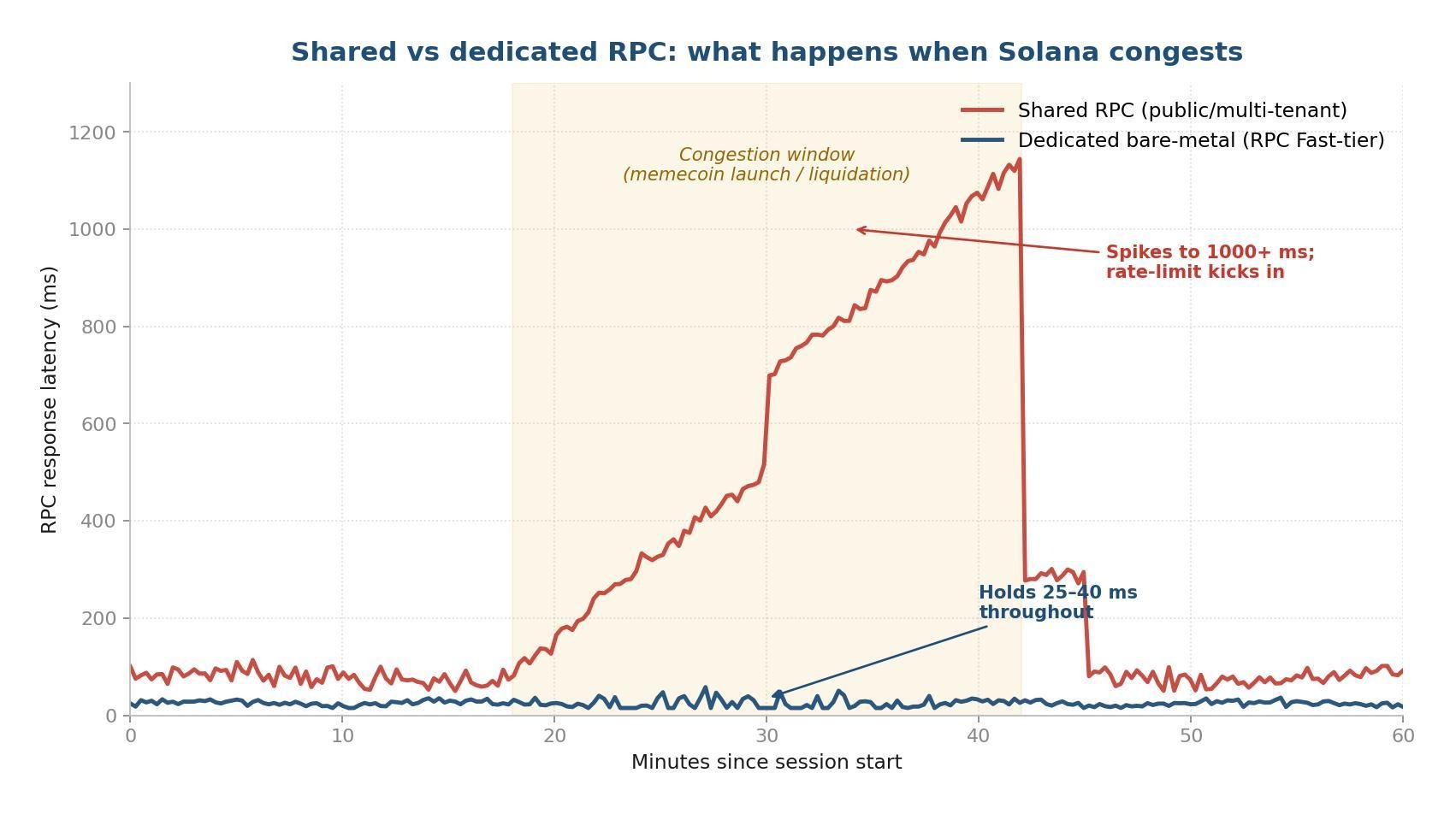
The chart above shows the reliability difference in raw form. During a 24-minute congestion window — a typical memecoin launch or liquidation cascade — shared Solana RPC latency climbs from a healthy 80 ms baseline to over 1000 ms, with rate-limit errors kicking in around the peak. A dedicated bare-metal node co-located with validators holds steady at 25–40 ms throughout. Same network, same congestion, different infrastructure.
Reliable Solana RPC providers invest in geographically distributed clusters, often across multiple cloud regions or bare-metal data centers. This ensures that node health isn't tied to a single zone, and request routing adapts dynamically to regional congestion or outages. Providers like RPC Fast and QuickNode operate active-active setups with regional load balancing — minimizing latency and ensuring continuity even during Solana mainnet stress.
Another key factor is node synchronization strategy. Some providers use lightweight, load-balanced read replicas that fall out of sync during high block churn. Others maintain full archival or validator-connected nodes that track slot leaders in real-time. The difference becomes visible under load: one stays aligned, the other returns stale or partial data.
Failover routing is critical. The best RPC stacks detect anomalies—like unhealthy responses or sudden latency spikes—and automatically reroute traffic to secondary endpoints without affecting app performance. This happens in milliseconds and is invisible to the end user, but requires tight orchestration between monitoring, DNS, and traffic layers.
Finally, reliability also means transparency. Do you get logs, error types, and metrics when something goes wrong—or just a generic timeout? Teams that run real businesses on Solana need clear, explainable infrastructure behavior, not guesswork when issues occur.
Dedicated nodes vs shared nodes
One of the most important architectural choices when integrating a Solana RPC provider is whether to use shared or dedicated nodes. While shared RPC endpoints are easier to start with, they introduce performance ceilings that many production teams outgrow quickly. In 2026, the gap between these two models is clearer than ever—and increasingly critical for apps that depend on fast, predictable execution.
Shared nodes pool traffic from many customers on the same infrastructure. While this works for basic interactions and low-RPS dApps, it's vulnerable to noisy neighbors, rate limiting, and unpredictable congestion—especially during network events like mints or airdrops. Transaction latency and slot freshness can vary wildly from minute to minute.
Dedicated nodes, on the other hand, are isolated environments with reserved resources, tuned for the specific workloads of your application. They offer better consistency, fewer failures, and full control over traffic, retries, and monitoring.
Here's how the two approaches compare:
| Feature | Shared node | Dedicated node |
|---|---|---|
| Resource isolation | No—shared with multiple tenants | Yes—isolated infrastructure |
| Latency under load | Variable; can spike to 1000+ ms during high traffic | Stable; consistent 25–60 ms under pressure |
| Rate limits | Enforced; often 30–50 RPS per IP or app | Custom or none; defined per client |
| Slot freshness | May lag 1–3 slots in congestion | Near-zero lag; aligned with slot leader |
| Write path under congestion | 200–1850 ms during congestion | No rate limits; SWQoS via the bloXroute Trading API included on every tier |
| Streaming included | Often paid add-on | gRPC + ShredStream typically default |
| Customization | Limited or none | Full tuning possible (caching, region, filters) |
| Best for | MVPs, testnets, low-RPS apps | Production dApps, bots, time-sensitive flows |
For apps pushing thousands of transactions per minute, or those requiring ultra-low latency (like trading systems or real-time gaming), dedicated Solana RPC infrastructure isn't just a performance upgrade—it's a prerequisite. Independent guides on RPC selection in 2026 generally suggest crossing into dedicated territory once you exceed roughly 10 hours per month of active RPC use, or once your strategy depends on landing transactions during congestion windows.
Shared nodes are useful to prototype and explore the network, but in 2026, scaling means owning your RPC layer.
Cost vs performance: where each provider lands
Pricing across Solana RPC providers ranges from free public endpoints to $2,900+ per month for top-tier dedicated nodes. But raw cost isn't the right comparison; cost-per-performance is. A cheap provider that drops 30% of your transactions costs you far more than the bill saved.
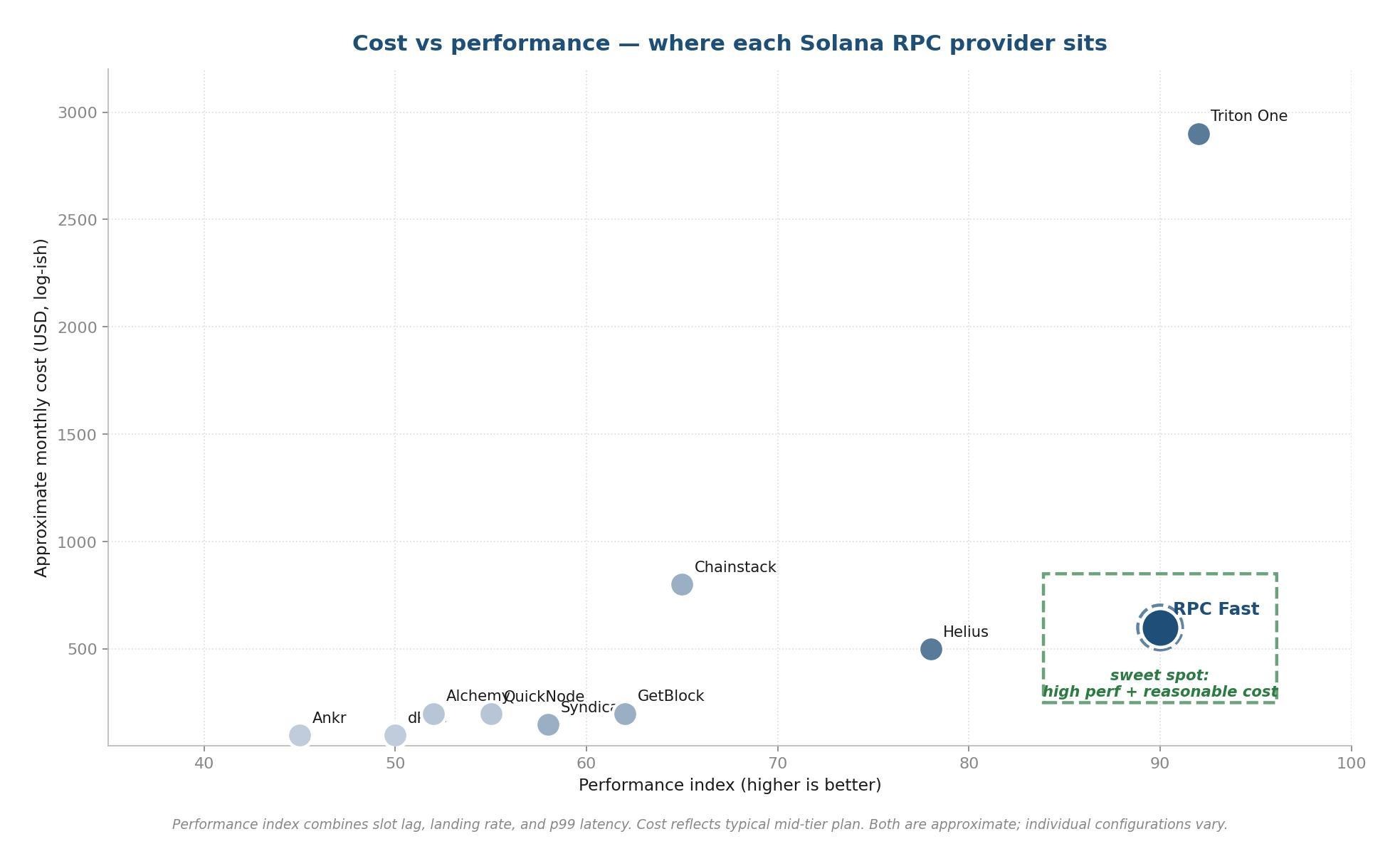
Three clusters worth noting on the chart. Triton One occupies the high-performance, high-cost corner—top-tier numbers but enterprise pricing. The bottom-left cluster (Ankr, dRPC, Alchemy, QuickNode at base tier) trades performance for affordability. RPC Fast sits in the green sweet-spot box—high-performance numbers without the enterprise tier, designed specifically for teams that need trading-grade infrastructure but aren't running institutional volume. Its own pricing runs from $0 on the shared free tier to $499/month on Aperture, with dedicated nodes from $2,200/month, server and maintenance included.
The right choice depends on workload, not on a single best provider. The decision matrix below maps common workloads to the providers that fit each.
Quick decision matrix
| Workload profile | Primary recommendation | Why |
|---|---|---|
| HFT bot, MEV searcher, sniper | RPC Fast or Triton One | Aperture TxStream and gRPC Shredstream on the Aperture plan, Beam SWQoS on every plan; dedicated nodes when you need no rate limits and single-tenant hardware |
| Solana-native dApp with NFT/token APIs | Helius | Best Solana data tooling, DAS API, SOC 2 |
| Multi-chain dApp (Solana + ETH + other) | QuickNode or Alchemy | Widest chain coverage with solid Solana support |
| Enterprise / regulated workload | Chainstack or Helius | SOC 2 Type II, transparent pricing, audit trails |
| Observability-first engineering team | Syndica | Native analytics, request tracing, error logs |
| Cost-sensitive / early-stage | Chainstack Unlimited or Ankr | Predictable flat-fee pricing, decent baseline performance |
| Production stack with redundancy | RPC Fast (primary) + secondary | Best-in-class write path plus a fallback for failover |
Need help choosing?
Ask in the RPC Fast Solana chat
RPC Fast engineers will help you choose.
Join the RPC Fast Solana chat.jpg)


.jpg)


