

→ How to snipe token launches on Robinhood Chain, in one line: not at second zero, and not on the curve.
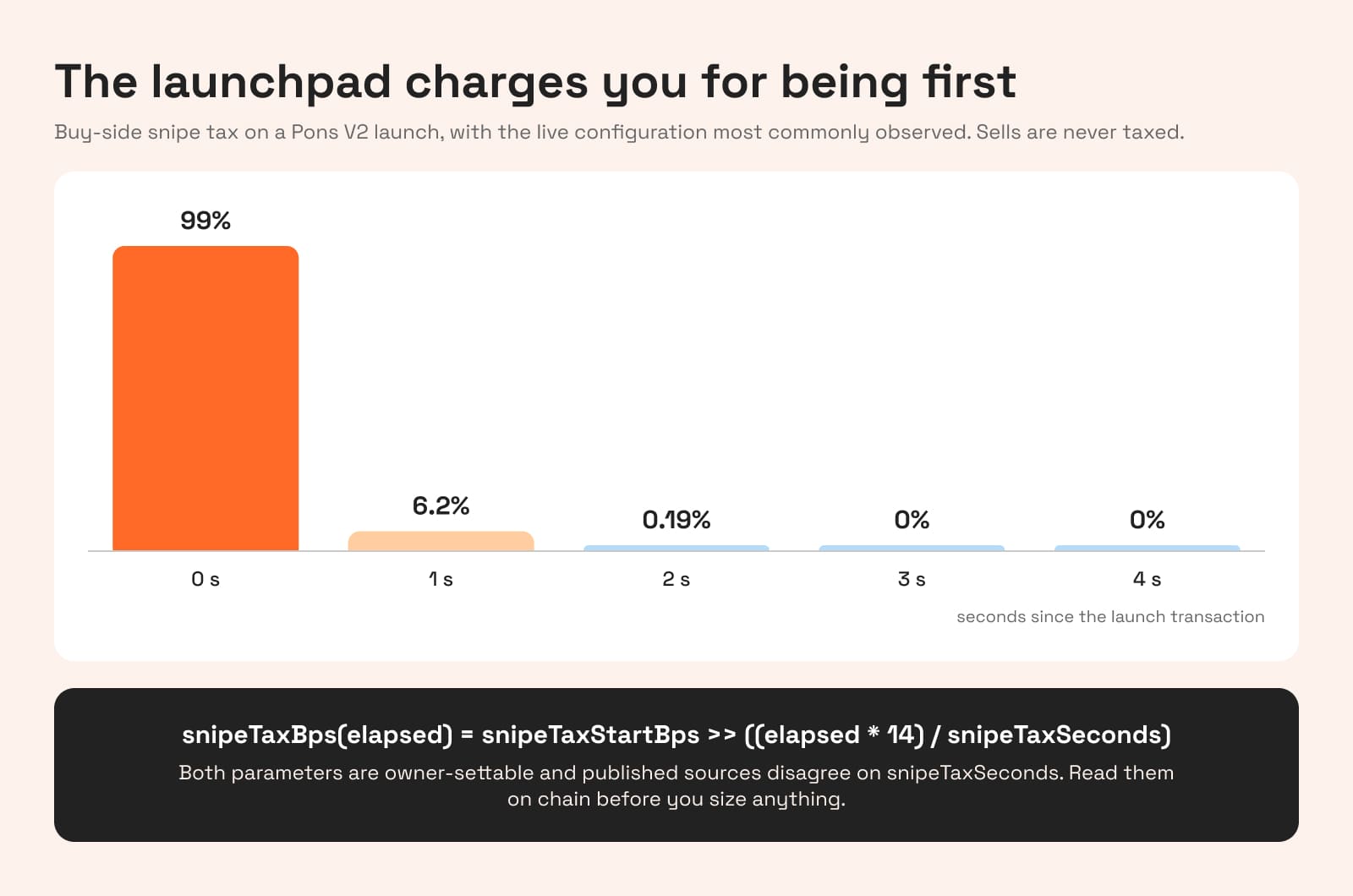
→ Pons V2 applies a buy-side snipe tax that starts at 99% and decays over seconds. A perfect zero-second entry hands almost the whole buy to the protocol.
→ 1.55% of launches graduated in the measured month, and the median graduated token trades 85% below its first-hour price.
→ Returns in that range exist. They are the right tail of a distribution whose median is negative, and this guide treats them that way.
→ The repeatable trade is the graduation, not the curve. It runs as two permissionless calls and its price is known in advance.
This is a how to snipe token launches guide written for people who will build the bot and read the contracts. It covers the launch mechanics at source level, the detection path on a chain with no public mempool, a working token launch trading strategy with its filters, and profit scenarios computed from published base rates rather than from screenshots. Most answers to how to snipe token launches on Robinhood Chain stop at the detection step, and this one carries the arithmetic through to the exit.
The 10-second window: profits before price discovery
Token sniping Robinhood Chain style begins before a chart exists. A new token has no price history, no chart and no holders. For the first seconds it has only a bonding curve and whoever is willing to trade against it. That window is the whole opportunity, and on Robinhood Chain it is both shorter and more expensive than on other chains.
Real example (Robinhood-like scenario)
Take a launch with the commonly observed configuration: one billion tokens minted into the curve, a graduation threshold of 4.2 ETH, a 1% curve trade fee. Four participants arrive at different moments.
The decay schedule above uses one live reading. It is configuration, not a constant, and the next section explains why you must read it on chain before every session. Note what it does to a profit target set in advance: a 2x target struck at second zero needs the position to recover the tax before it earns anything.
Why this beats other strategies
A Robinhood launchpad sniping bot earns its keep here for one reason. Nothing else on this chain gives you a position before a price exists. Arbitrage needs two venues that already disagree. Liquidations need somebody else's position to go bad. Token launch sniping is the only strategy where you are not reacting to a price, you are setting one, and that is the first-mover advantage people are actually paying for.
The structural reason it works here is the same reason it is hard. Ordering is first-come first-served by arrival at a single sequencer and fees do not move you up the queue, so the contest is decided by engineering rather than by capital. Fast execution trading is the whole game and it cannot be outbid.
Reality check
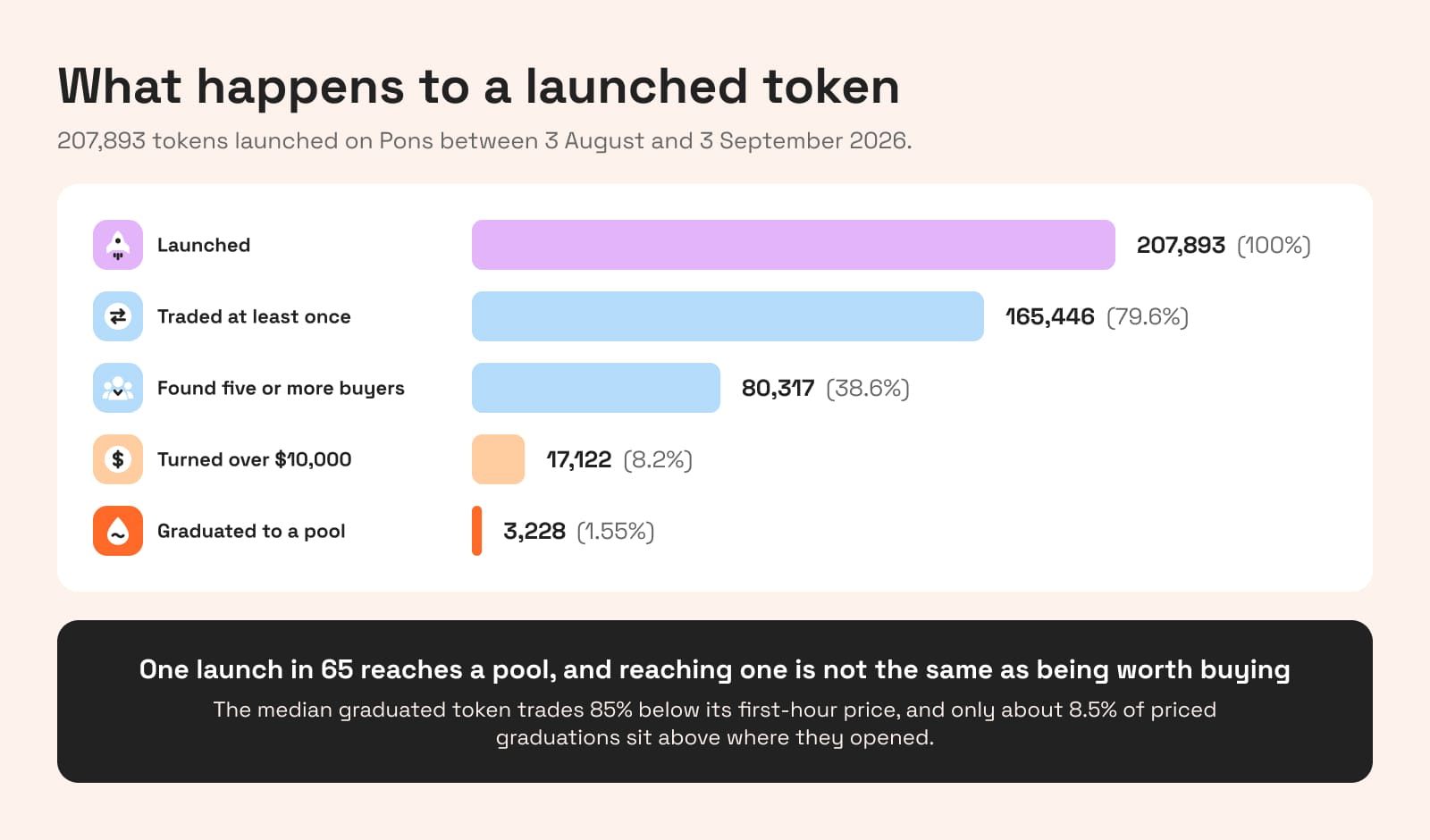
Bitquery rebuilt a month of launches from raw contract logs: 207,893 tokens launched between 3 August and 3 September 2026. Of those, 79.58% traded at least once, 38.63% found five or more buyers, 8.24% turned over $10,000, and 1.55% graduated to a pool.
The outcome data is harsher than the funnel. The median graduated token trades 85% below its first-hour price. Of 2,339 graduated tokens with enough trading to price, roughly 8.5% sat above their opening price. Across the whole dataset, 66.8% of 314,736 wallets finished at a net loss, and around 1,000 high-frequency wallets were over a quarter of volume while deep in the red.
What the headline number means
Gains in the 50% to 300% range are real and they are the right tail. A strategy that produces them does so across many small positions where most expire worthless, not by picking winners.
Any token sniping Robinhood Chain model that assumes a positive median is modelling a different chain.
Requirements
How token launches work on Robinhood
Robinhood Chain is an Arbitrum Orbit L2 with roughly 100 ms blocks. The official documentation states that ordering is first-come, first-served by sequencer arrival time and that priority gas auctions do not exist. There is no public mempool, so nothing is visible until the sequencer has already decided its order.
Launch process (typical)
- A creator calls launchAndBuy() on the Pons router, which deploys the token and takes an initial buy in the same transaction.
- One billion tokens are minted into a bonding curve contract. The curve is constant product with a phantom quote reserve rather than a simple linear ramp.
- Buyers trade against the curve, not against a pool. The snipe tax applies to every buy and decays with time since launch.
- The curve reports itself ready when its sellable token balance reaches zero. The trigger is the token side, not the quote side, because a large trade could sail past a quote figure.
- graduate(token) sweeps the curve and locks the excess supply.
- createGraduatedPool(token) opens the Uniswap v4 position in a separate transaction. A liquidity pool launch happens at this step and not before.
Why early = profitable
On a constant-product curve the price rises as supply leaves it, so the first buyer pays the lowest price by construction. That is the arithmetic every sniping pitch rests on, and on this launchpad it is modified by two things.
- The snipe tax is applied on top of the curve price for buys only, never for sells. Being early costs more than the curve price suggests.
- A buy that would cross the reserved allocation is partially filled and refunded rather than reverted. The source comment gives the reason: reverting would let anyone grief a launch by slipping a small buy in ahead. Your bot has to treat a partial fill as a normal outcome.
Launchpad types on Robinhood (2026 onwards)
Pools.trade is the one most sniping guides have not caught up with. Uniswap Labs announced it on 5 August 2026 with a fixed one billion supply, a 0.25% autocompounding LP fee against roughly 1% elsewhere, and a Crowd Launch mode that scores a four-hour window on a time-weighted average and either graduates at a $10,000 launch FDV or refunds. A Robinhood launchpad sniping bot written only against Pons will not see any of it.
Finding upcoming launches
Four ways to catch new token releases, with very different latency and very different reliability. Rank them by how close they sit to the chain.
Method 1: Discord bots (easiest)
Community alert channels relay launches within seconds of them happening. The setup cost is zero and the information is secondhand by definition: somebody else saw the chain, decided it was worth posting, and posted it. Treat a launch alert bot in a Discord channel as a discovery tool for projects and never as an execution trigger.
The honest use is filtering rather than speed. If a launch is being discussed before it happens, that is social signal you cannot read from the contracts, and it belongs in your quality filter rather than in your hot path.
Method 2: On-chain monitoring (best)
Subscribe to the sequencer feed at wss://feed.mainnet.chain.robinhood.com and decode the factory and router yourself. A reference decoder from Chainstack Labs puts the cost at roughly 4 microseconds per transaction for cheap fields and 70 microseconds with sender recovery, and notes that the block already exists when the message reaches you.
#  token launch detection straight from the feed
FEED    = "wss://feed.mainnet.chain.robinhood.com"
FACTORY = "0x7eD598BcEf8bd9Edd8C97A195C6d13f40801EC7e"
ROUTER  = "0xe33E9E479dF8802cb0866d5d05258bEc4cF62948"

async def watch():
    async with websockets.connect(FEED) as ws:
        async for frame in ws:
            block = decode_block(frame)
            stamp_arrival(block)              # for drift detection
            for tx in block.transactions:
                if tx.to in (FACTORY, ROUTER):
                    yield decode_launch(tx)   # events plus router calldata
Launch metadata travels in the arguments to launchAndBuy() rather than in the events, so a bot that reads logs alone knows a token exists without knowing what it claims to be. Decoding the calldata is what turns a detection into something your filter can act on. Anyone working out how to snipe token launches on Robinhood Chain reliably ends up here, at the calldata, rather than at the event log.
Method 3: Twitter tracking
Useful for the hours before a launch and useless in the seconds around it. Creators and communities announce in advance, which gives you a watchlist, a theme and sometimes a scheduled time. None of that is an execution path, and a bot that trades on a social post is trading on something anybody can fake.
Method 4: Calendar approach
Scheduled listings convert the problem from detection to submission timing, which is the easiest version of this trade. Pools.trade Crowd Launches are the clearest example on this chain: a four-hour window with a published close is a calendar event, not a race, and your edge there is pricing rather than speed. It is also the gentlest answer to how to snipe token launches on Robinhood Chain, because nothing in it depends on winning a millisecond.
Best sources ranked
Setting up sniping bot
Simple sniping bot structure
A launch trading bot has five components. Everything expensive happens before the opportunity exists, and the hot path does nothing but decode, decide, sign and send.
feed subscriber   -> decodes blocks, stamps arrival, detects launches
state cache       -> launch configs, curve state, pool keys, nonces
filter            -> rug pull detection, token supply analysis, tax check
sizer             -> position sizing from the daily budget, not the quote
executor          -> pre-signed templates, one attempt, no retries

#  prepared once at startup, never in the hot path:
#    approvals, Permit2 allowances, ABI encoders, pool key hashing,
#    the launch config cache, and a warm connection per role
#  the automated snipe bot, hot path only
async def on_launch(ev):
    tax = factory.functions.currentSnipeTaxBps(ME).call()
    if tax > MAX_TAX_BPS:            return    # almost always true at t=0
    if not passes_filter(ev):        return
    size = ticket_for(ev)                      # capped before the quote
    if not safe_to_buy(ev.token, size):  return
    tx = template(ev, size, nonce=next_nonce())
    tx["maxPriorityFeePerGas"] = 0             # ordering ignores tips here
    return await send(tx)                      # fire once, then stop
Execution timing breakdown
A launch trading bot lives or dies on this table. Millisecond trading on this chain means accounting for six segments separately. One aggregate number tells you that you are slow, six tell you which part to fix.
The first row dominates and it is the cheapest to fix. A published benchmark of the official feed across three availability zones inside one cloud region measured median delays of 7.4 ms, 30.7 ms and 27.1 ms, which is four times the spread from placement alone. That is why the operator's own documentation warns that the public endpoints are rate-limited and not recommended for production.
Critical settings
Two RPC methods are worth wiring in from day one. eth_simulateV1 shows what the snipe tax and your slippage cap do to a buy before you sign it, and eth_sendRawTransactionSync returns the receipt in the same call, so the bot knows within one round trip whether it holds the token. Both are on RPC Fast's Robinhood Chain API, alongside eth_subscribe for launch events.
Execution timing and tactics
Strategy 1: Exact 0-second execution
The strategy everyone wants, and the one the launchpad is built to stop. The formula, consistent across the V2 documentation and Bitquery's decoding of the live contracts, is a right shift: snipeTaxBps(elapsed) = snipeTaxStartBps >> ((elapsed * 14) / snipeTaxSeconds). The source default for the starting rate is 9,900 basis points.
Read the schedule before every session
Published sources disagree on snipeTaxSeconds: the contract source default is 15, the V2 documentation describes about 5, and Bitquery's live reading is 3. These produce completely different curves.The tax is per recipient, so query currentSnipeTaxBps(yourAddress) rather than a nominal launch rate.
Who actually buys at second zero is the exemption list. On-chain analysis relayed by The Block linked 53 launches between 10 July and 21 September 2026 to one operation that extracted at least $18.43 million, with nearly every launch sniped for 70% or more of supply by bundles of 70 to 200 wallets. The analysts matched them by funding flow, shared signing keys and a shared collector wallet.
Worth naming a discrepancy rather than hiding it. The published factory source caps exemptions at 32 per call while the reported bundles run to 200 wallets, so either the deployed contract differs from the published source or exemptions accumulated across calls. Neither is confirmed. The conclusion holds either way: if you are not on the list, second zero is not your trade.
Strategy 2: Follow Discord bot
Entering a few seconds behind a community alert puts you past the expensive part of the tax curve, which is the one genuine advantage of being slow. You are buying at a higher curve price with a much lower tax, and on a 99% starting rate that trade is better than it sounds.
The cost is that you are now one of many reacting to the same post, and the curve has moved for all of you. Treat this as a discovery channel feeding a filter, with execution still driven by your own feed subscription so your entry is priced on current state rather than on somebody's screenshot.
Strategy 3: Aggregator sweep
Once a token graduates it trades in a Uniswap v4 pool alongside whatever else lists it. Routing a buy through an aggregator rather than straight at one pool is where multi-pool arbitrage enters a launch strategy, because a freshly graduated pool and a secondary venue rarely agree in the first minutes.
One constraint specific to this chain. The graduated pool uses fee 0 because the hook charges instead, so anyone constructing the pool key with a conventional fee tier computes the wrong pool id and reads an empty pool. Verify the key from the factory rather than from a cached list.
Tactical tips
- Fire once per event. Two transactions from one account serialise on the nonce, and the second prices against state the first already changed.
- Hold the connection open. A reconnect costs a handshake, and handshakes happen at the worst possible moment.
- Stamp every feed frame on arrival and compare against the frame's own timestamp. The backup feed runs about 500 ms behind the primary, and a silent failover looks like valid data five blocks late.
- Set the deadline as a timestamp. Block numbers drift fast at 100 ms per block.
- Treat a partial fill with a refund as success, not as an error. The curve is designed to do that.
Example execution flow
t+0 ms     feed frame arrives, block contains TokenLaunched
t+2 ms     decoded; router calldata gives name, supply, config id
t+3 ms     filter: supply ok, exemption count low, creator unseen
t+9 ms     currentSnipeTaxBps(ME) -> 620 bps. above threshold at t=0,
           below it from the next second. arm, do not fire.
t+1,050 ms re-read tax -> 19 bps. size from the daily budget.
t+1,056 ms round-trip simulation passes, sell path exists
t+1,058 ms sign from template, priority fee 0
t+1,064 ms submitted. one attempt. log and stop.
Risk management and rugs
Red flags (avoid these)
- A long exemption list at creation. Most of the supply is already spoken for before your transaction exists.
- Supply concentrated in the first block across many funded wallets. Funding-flow tracing catches this: proceeds of one launch paying the key that funds the next is the documented pattern on this chain.
- No sell path in simulation. A token you cannot exit is worse than a launch you missed, and of all the token red flags this is the cheapest to test directly.
- Transfer restrictions or a hook with permissions beyond fee collection. Check the hook's declared permissions rather than assuming.
- A creator address with a history of launches that never graduated.
Token red flags are cheap to check and rug pull detection on this chain still has one honest caveat worth stating. We found no published rate for rugs or honeypots on Robinhood Chain, so anybody quoting one is estimating. What is published is the funnel, and the funnel already tells you that most launches fail without anyone needing to rug them.
Green flags (good projects)
- A short or empty exemption list, which means the creator is not pre-allocating to themselves.
- Holder count growing across blocks rather than appearing in one. The median graduated token has 74 real holders and two in five have fewer than 50, so this bar is low and still discriminating.
- Curve progress that comes from many distinct buyers rather than a few large ones.
- A creator who has graduated tokens before and did not sweep the pool afterwards.
- Launch metadata that matches something discussed publicly before the launch, which is the one thing social channels are genuinely useful for.
Risk sizing
Set the profit target and the loss cap before the position, then size from the base rate rather than from conviction. If one launch in 65 reaches a pool and the median graduate is 85% below its first-hour price, the distribution you are sampling has a negative median and a long right tail. The only position sizing that survives that is small and uniform.
#  risk-reward calculation, written down before any trade
DAILY_BUDGET   = 200          # USD you are willing to lose today
MAX_TICKETS    = 40           # so one ticket is 5 USD
TICKET         = DAILY_BUDGET / MAX_TICKETS

#  expected value, with gas charged on every attempt including losses
#    ev = p_win * avg_win - (1 - p_win) * avg_loss - gas_per_attempt
#  solve for the p_win your filter must achieve, then measure whether
#  it does. if the measured rate is below the solved rate, the filter
#  is the problem, not the latency.
Portfolio approach
Optimization and advanced tactics
Technique 1: Quality filtering
The highest-value change you can make, because it moves the base rate rather than the win size. Token supply analysis is the core of it: read the launch config, compare the reserved allocation against the exemption list, and count distinct funders behind the first buyers.
def passes_filter(ev):
    cfg = launch_config(ev.config_id)              # cached
    if len(ev.exemptions) > MAX_EXEMPTIONS:   return False
    if cfg.supply != EXPECTED_SUPPLY:         return False   # odd config
    if cfg.curve_fee_bps > MAX_CURVE_FEE:     return False
    funders = distinct_funders(first_buyers(ev.token))
    if funders < MIN_DISTINCT_FUNDERS:        return False   # bundled
    return True
Technique 2: Staggered exit
A single profit target assumes you know where the top is. A staggered exit strategy does not. Sell a fixed fraction at each multiple so the position pays for itself before it decides what it wants to be, and let the remainder run into whatever right tail exists.
The time stop matters more than the multiples. The median graduated token is 85% below its first-hour price, so a position that has not moved within your holding window is not waiting, it is decaying.
Technique 3: Mempool sniffing
Mempool sniping is the standard name for this technique and on Robinhood Chain it describes something that does not exist. There is no public mempool, so there are no pending transactions to inspect and nothing to get ahead of.
What replaces it is the sequencer feed, and the difference is worth being precise about. The feed carries blocks the sequencer has already ordered and executed, so you are reading, not racing. It puts you ahead of RPC nodes that must re-execute a block before they can answer, not ahead of execution itself. Every technique in this article that sounds like front-running is back-running with a shorter delay.
The leak that no mempool does not close
Front-running has still been measured here, through off-chain intent rather than through the chain. Bitquery found 3,532 orders worth $6.5 million bought ahead of between 12 and 25 September 2026, with buys landing a median of 0.15 to 0.30 seconds after an off-chain relay logged each order and before the fill arrived.A bot that signs locally and submits straight to the sequencer has no such surface. One that routes intent through a hosted API does.
Technique 4: Market cap limit
A hard ceiling on the implied market cap at entry removes the worst cohort of trades without any judgement call. The curve gives you a price and a circulating supply at every moment, so the implied valuation is a number you already have.
implied_mcap = price_on_curve(token) * CIRCULATING_AT_GRADUATION
if implied_mcap > MAX_ENTRY_MCAP:
    return False        # you are buying someone else's exit
Combined optimization results
Stacking the four changes the shape of the distribution rather than any single trade. The table below is a worked model, not a backtest, and it is written so you can substitute your own measured numbers.
Realistic profit scenarios
Four models. Each states its assumptions, charges gas on every attempt, and uses the published base rates rather than a screenshot. Substitute your own measured win rate once you have one, because these are illustrations of the arithmetic and not a forecast.
One input is not optional. The original gas subsidy expired on 29 September 2026 and was replaced the same day by gas-free swaps through the Robinhood Wallet above $0.50, running to 31 December 2026. Bots calling contracts directly sit outside that programme and pay on every attempt, including losses.
Scenario 1: Conservative sniper ($1K capital)
This configuration loses money, and showing that is the point. At a 12% win rate and a 2.2x average win, the arithmetic does not clear gas plus the losing side. Either the filter has to lift the win rate, the exit has to lift the average win, or the strategy is not worth running at this size.
Scenario 2: Moderate sniper ($10K capital)
Also negative, for the same reason at larger scale. A 3x average win on 15% of trades does not cover a 0.7x loss on the other 85%. This is the trap in most sniping content: the win multiples are quoted honestly and the loss rate is left out.
Scenario 2B: Optimized moderate ($10K capital)
The same capital, the same chain, four changes to the process. Attempts fell by three quarters and the result turned positive, which is the single most important relationship in this article: on a chain where you cannot buy priority, the filter and the exit are the strategy and the speed is only the entry ticket.
Scenario 3: Aggressive sniper ($50K capital)
The last row is the one that breaks naive scaling. A ticket large enough to move the curve changes your own entry price, so the win multiple that held at $50 does not hold at $250. Measure your fills against your quotes before assuming the model scales.
Truth table
Solana comparison, and why the numbers differ
A Solana comparison is useful because the two chains run the same strategy under different concentration. Bitquery compared them over 4 August to 2 September 2026 and found the top 1% of wallets at 62% of volume on Robinhood Chain against 97.5% on Solana, wallets with 10,000 or more trades at 16% of volume against 83%, and a bonding-curve graduation rate of roughly one in 16 against one in nine.
Read that as a statement about who you are racing. Solana’s launch flow is dominated by programs to a degree Robinhood Chain is not, which means a competent bot here is competing against a shallower field. The graduation rate is worse, so the entries are harder to pick, and the field is softer, so the ones you pick are more winnable. Those two pull in opposite directions, and how to snipe token launches on Robinhood Chain profitably comes down to which one your filter lets dominate.
Where the edge actually is
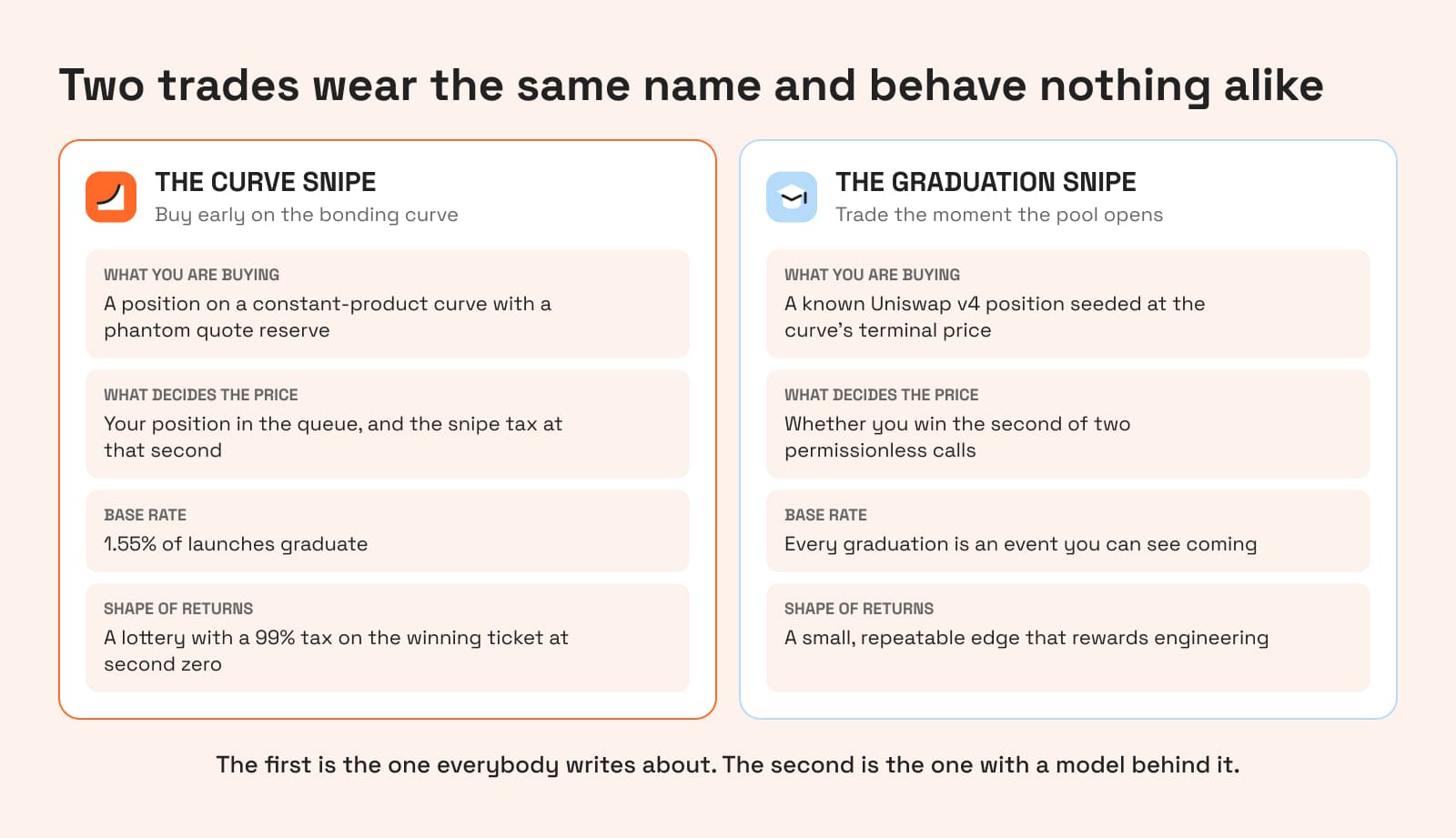
Launch sniping Robinhood Chain rewards is two different businesses. The first is a race into a bonding curve that the protocol taxes at up to 99% at precisely the moment everybody wants to be there, where the published graduation rate is 1.55% and two thirds of participants ended the month down. Unless you are on an exemption list, that race was decided before you entered it.
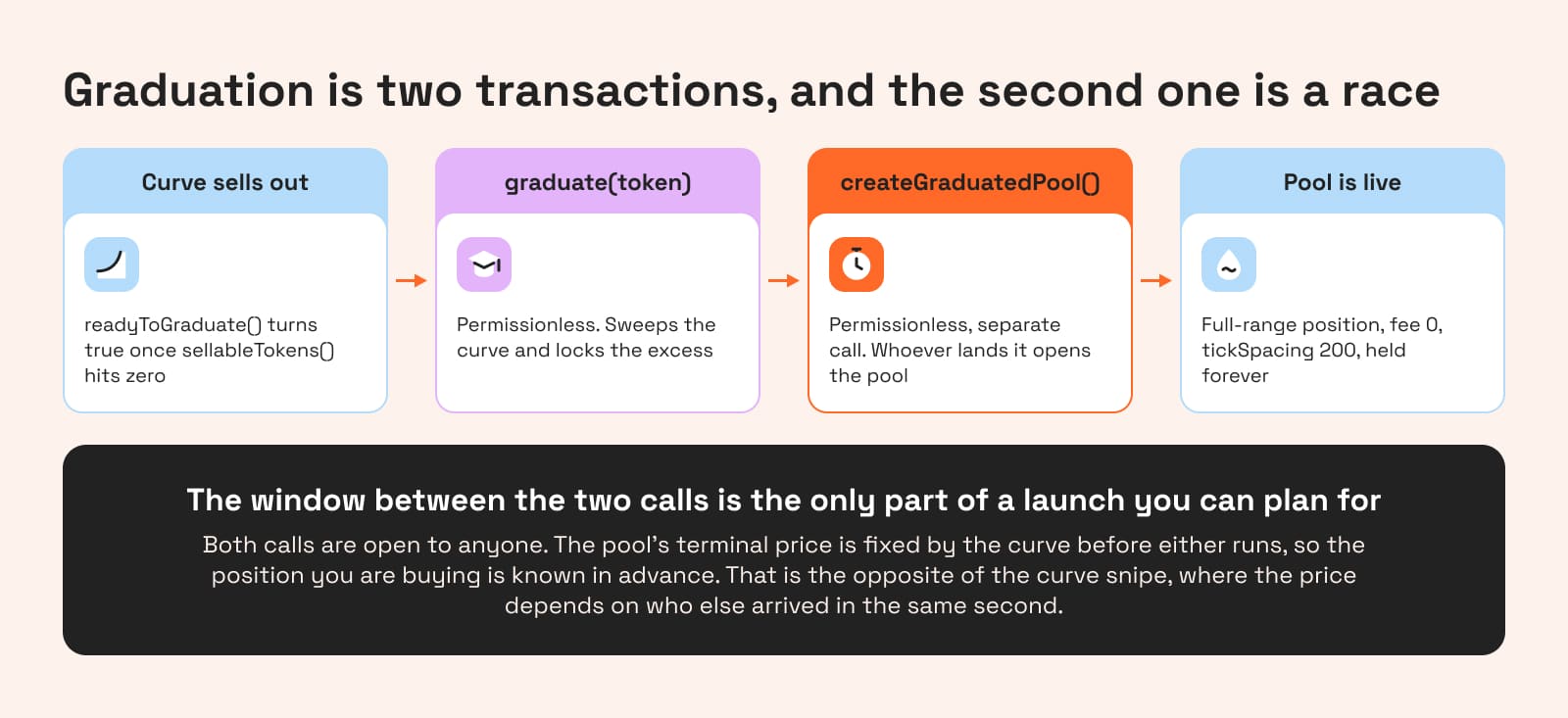
The second is a known price appearing at a known moment through two permissionless calls that anybody can make. The pool is seeded full-range at the curve’s terminal price, so the position you are buying is priced before it exists. It pays less per event and it pays more often, and it rewards exactly the things you can control: a fast read path, a tight filter and an exit written down in advance. If you want one answer to how to snipe token launches on Robinhood Chain, that is it.
Everything above rests on parameters the launchpad owner can change. Read them on chain, re-read them when a launch behaves oddly, and treat any guide that publishes a fixed decay table as out of date, this one included.