





TL;DR
→ Solana processed 33B+ transactions in 2025—more than any other public blockchain. Infrastructure has become the bottleneck, not protocol speed.
→ Best for HFT, MEV, trading bots: RPC Fast and Triton One. Bare-metal dedicated nodes, Aperture TxStream, Beam (Beta) transaction delivery.
→ Best for Solana-native dApps and NFT/data work: Helius and Syndica. Enhanced APIs, integrated tooling, deepest data layer.
→ Best for multi-chain teams: QuickNode, Alchemy, Chainstack. Solana supports 70+ other networks under one dashboard.
→ The metric that actually matters: transaction landing rate under congestion, not headline RPS. The gap between providers stretches from ~72% to ~97% in benchmarks below.
→ Most serious teams now run multi-provider stacks—one provider for writes, another for enriched reads, an aggregator for failover. We diagram exactly how this looks in production.
Solana processed over 33 billion transactions in 2025, more than any other public blockchain. DEX volume on the network exceeded $1.95 trillion for the year, and stablecoin supply grew to over $15 billion. With the Firedancer validator client now live on mainnet and the Alpenglow consensus upgrade activating sub-150 ms finality through late 2026, the network is entering a phase where raw protocol speed is no longer the bottleneck. Infrastructure is.
Every interaction with Solana—whether it's a wallet checking a balance, a trading bot submitting a bundle, or a DeFi protocol updating a price feed—goes through RPC (Remote Procedure Call) infrastructure. RPC providers are the middleware layer between applications and the blockchain itself. They maintain synced nodes, serve read requests, forward transactions to validators, and increasingly offer real-time data streaming via technologies like Yellowstone gRPC and Jito ShredStream.
The choice of infrastructure provider directly affects transaction landing rates, data freshness, execution speed, and application reliability. A shared RPC endpoint might handle 80% of use cases during normal conditions, but when the network spikes—during a major token launch, a liquidation cascade, or a high-volume trading session—the gap between commodity infrastructure and purpose-built solutions becomes the difference between profit and missed opportunities.
What to evaluate in a Solana infrastructure provider
Not all providers optimize for the same things. Before looking at individual options, it helps to understand the dimensions that matter most in 2026:
- Latency and slot lag—how many slots behind the network tip your RPC node sits. Even 2–3 slots of lag (800–1200 ms) means stale data and potential transaction failures from expired blockhashes.
- Transaction landing rate—the percentage of submitted transactions that successfully land in a block. Staked connections with Stake-Weighted Quality of Service (SWQoS) significantly improve this metric under congestion.
- Data streaming capabilities—support for Yellowstone gRPC (Geyser plugin), Jito ShredStream, and WebSocket subscriptions determines how quickly your application reacts to on-chain events.
- Node isolation—shared vs. dedicated infrastructure. Multi-tenant clusters degrade unpredictably under load; dedicated nodes provide consistent performance but cost more.
- Uptime and failover—whether the provider has multi-region redundancy, automatic failover, and transparent incident reporting.
- Solana-specific tooling—enhanced APIs for token data, transaction parsing, NFT metadata, and MEV-related features.
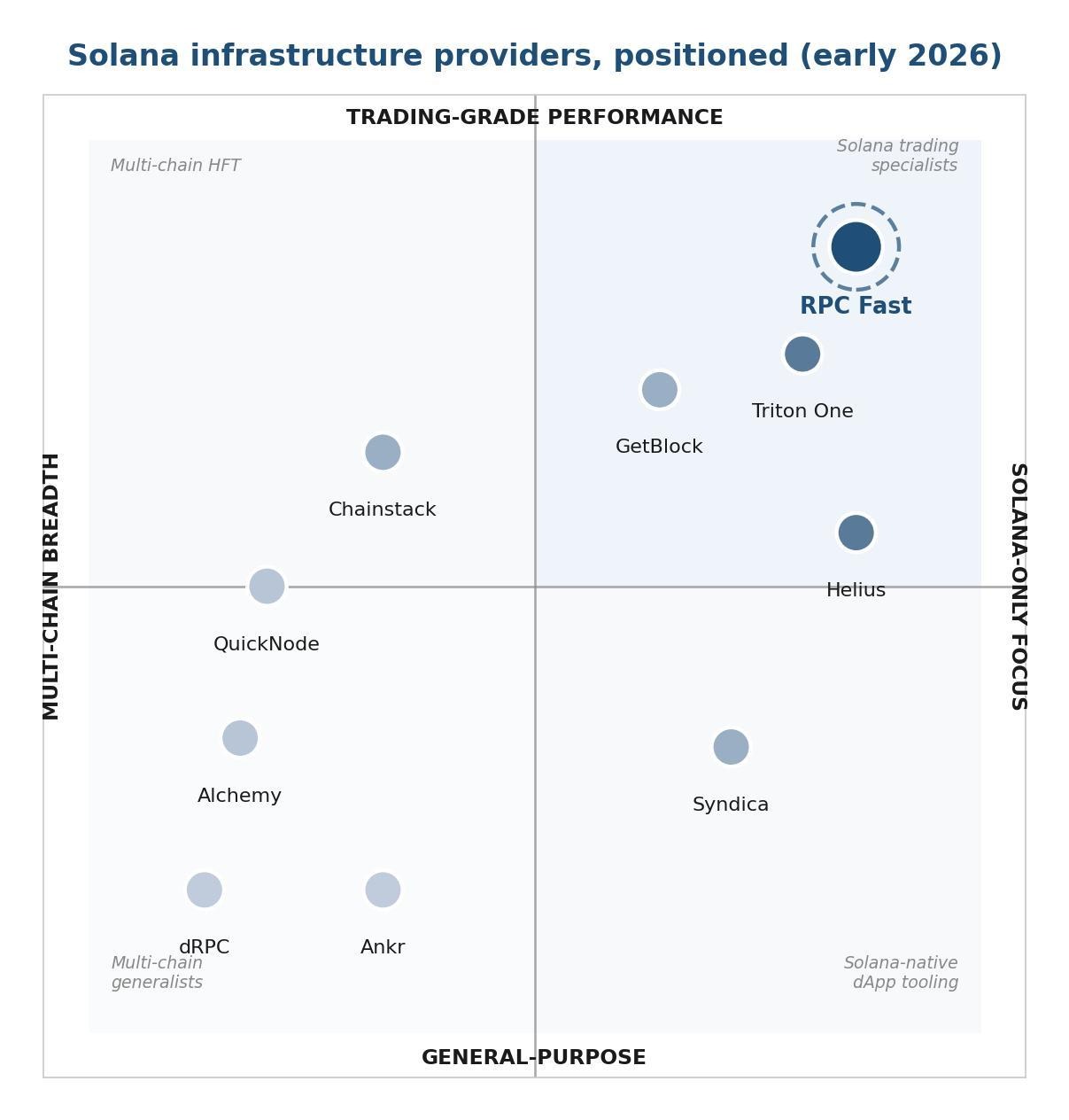
With these criteria in mind, here are the top Solana infrastructure providers as of mid-2026, evaluated for production-grade workloads.
10 Solana infrastructure providers
1. RPC Fast
RPC Fast, built by Dysnix, is a performance-first Solana RPC provider designed for latency-sensitive and high-throughput workloads. Unlike many multi-chain vendors, RPC Fast focuses exclusively on Solana infrastructure, running bare-metal dedicated node clusters across multiple global regions to minimize slot lag and maximize transaction landing rates.
Every dedicated node ships with Jito ShredStream enabled by default, providing the earliest possible block data awareness—critical for trading bots, MEV searchers, and real-time analytics. As a full-stack Solana API provider, RPC Fast offers Yellowstone and Aperture gRPC streaming for filtered, structured data feeds, and staked RPC paths with SWQoS priority for transaction submission under congestion. On the Aperture plan, TxStream also attaches a predicted execution result to each transaction while it is still in flight, around 95% accurate against actual execution, at a cost of about 791 µs to median delivery. The infrastructure is backed by Dysnix's managed DevOps, including 24/7 monitoring, automated failover, and continuous latency benchmarking against the validator set.
RPC Fast positions itself specifically at trading desks, market makers, and DeFi protocols that need consistent execution quality—not just during normal conditions, but during the moments when infrastructure matters most: network congestion, validator churn, and high-frequency trading bursts.
| Feature | Details |
|---|---|
| Node type | Bare-metal dedicated (single-tenant), plus shared SaaS tier |
| Jito ShredStream | Dedicated nodes: yes. SaaS: gRPC Shredstream on the Aperture plan, up to 10 streams |
| Yellowstone gRPC | Stream: up to 10 streams / Aperture: up to 25 |
| Aperture gRPC (Yellowstone-compatible) | Aperture plan only, no published stream cap. It is the Yellowstone-compatible interface that is being deprecated in favour of Aperture TxStream, not Aperture gRPC itself |
| Aperture TxStream | Stream: limited (no real-time simulation) / Aperture: full. Aperture-exclusive from September 1 |
| Staked connections (SWQoS) | Yes, native staked validator identity |
| Global regions | SaaS: Frankfurt, Equinix FR13. Dedicated: EU, NA and APAC, with Frankfurt, London and New York tuned for HFT workloads |
| Solana focus | 100%—no multi-chain distractions |
| Best for | HFT bots, MEV searchers, AI trading agents, DeFi protocols |
| Pricing | Start $0 / Focus $45 / Stream $249 / Aperture $499, plus custom dedicated from $2,200 |
2. Helius
Helius is a Solana-exclusive RPC and data platform that combines infrastructure with a rich API layer. It processes billions of RPC requests daily across a globally distributed network with 99.99% uptime. All paid plans route traffic through staked validator nodes by default, giving transactions higher priority during congestion.
What distinguishes Helius from pure RPC providers is its integrated data tooling. The Digital Asset Standard (DAS) API provides token and NFT metadata queries. Enhanced Transactions API returns human-readable, parsed transaction data. LaserStream, its gRPC offering, is Yellowstone-compatible and adds historical replay, auto-reconnect, and multi-region endpoints. For transaction submission, Helius Sender submits in parallel to both Jito and Helius infrastructure across 7 regions.
Helius also operates one of Solana's top-staked validators and is SOC 2 certified—a factor that matters for institutional clients. The trade-off is that Helius is Solana-only with no multi-chain support, and streaming volume can introduce cost variability on credit-based plans.
| Feature | Details |
|---|---|
| Node type | Shared (default) and dedicated validators |
| Streaming | LaserStream (gRPC), Enhanced WebSockets, Webhooks |
| Staked connections | Yes (default on paid plans) |
| Enhanced APIs | DAS, Enhanced Transactions, getTransactionsForAddress |
| Compliance | SOC 2 certified |
| Pricing | Free: 1M credits; Developer $49/mo; Business $499/mo |
| Best for | Solana-native dApps, NFT platforms, data-heavy apps |
3. Triton One
Triton One is the creator of Project Yellowstone—the suite of tools (Dragon's Mouth gRPC streaming, Steamboat indexing, Old Faithful historical data) that has become foundational infrastructure across the Solana ecosystem. The company powers critical backend for protocols like Openbook, Pyth, and Wormhole, handling hundreds of millions of daily requests.
Triton One's core strength is ultra-low latency for write-heavy, trading-grade workloads. Its staked nodes with Yellowstone gRPC deliver some of the lowest observed latencies in the ecosystem (~100 ms), and the Cascade Marketplace provides stake-weighted QoS bandwidth for priority transaction inclusion. Professional Trading Centers offer direct validator access for institutional operations.
The pricing reflects the enterprise focus—dedicated nodes start around $2,900/month. Shared endpoints exist but are positioned for frontend usage, not backend throughput.
| Feature | Details |
|---|---|
| Node type | Dedicated (primary), shared (limited) |
| Streaming | Yellowstone gRPC (Dragon's Mouth), Steamboat, Old Faithful |
| Staked connections | Yes, with Cascade Marketplace for SWQoS |
| Observed latency | ~100 ms (among the lowest in the ecosystem) |
| Pricing | Dedicated from ~$2,900/mo; hybrid options available |
| Best for | Enterprise trading, MEV, institutional DeFi, indexers |
4. QuickNode
QuickNode is one of the most widely adopted Web3 infrastructure platforms, supporting 75+ chains and 120+ networks. On Solana, it provides globally distributed RPC endpoints with strong uptime guarantees, a polished developer dashboard, and a marketplace of add-ons that extend base functionality.
Yellowstone gRPC is available on QuickNode endpoints (via port 10000), and the platform offers historical data backfills, real-time webhooks, WebSocket support, and archive node access. The add-on marketplace includes MEV protection, transaction speed boosters, and NFT/token APIs. QuickNode is a good choice for teams running multi-chain applications that need Solana alongside Ethereum, Base, or other networks under a single provider.
The main limitation for latency-sensitive Solana workloads is that throughput caps at 400 RPS on standard tiers, and some advanced Solana features require paid add-ons rather than being included by default.
| Feature | Details |
|---|---|
| Node type | Shared and dedicated |
| Streaming | Yellowstone gRPC, WebSockets, Webhooks |
| Multi-chain | 75+ chains |
| Add-ons | MEV protection, TX speed boost, NFT APIs |
| Pricing | Free: 10M credits; Starter $49/mo; Growth custom |
| Best for | Multi-chain dApps, wallets, broad coverage needs |
Benchmarked head-to-head: where the gaps actually live
Marketing pages on every provider claim sub-100 ms latency and "competitive" landing rates. The actual numbers diverge sharply once you put them under congestion. The chart below is from internal RPC Fast benchmarks across Q1 2026—roughly 50,000 paired requests per provider across US-East, EU, and APAC regions, captured during real congestion windows (memecoin launches, liquidation cascades) where infrastructure quality decides outcome.
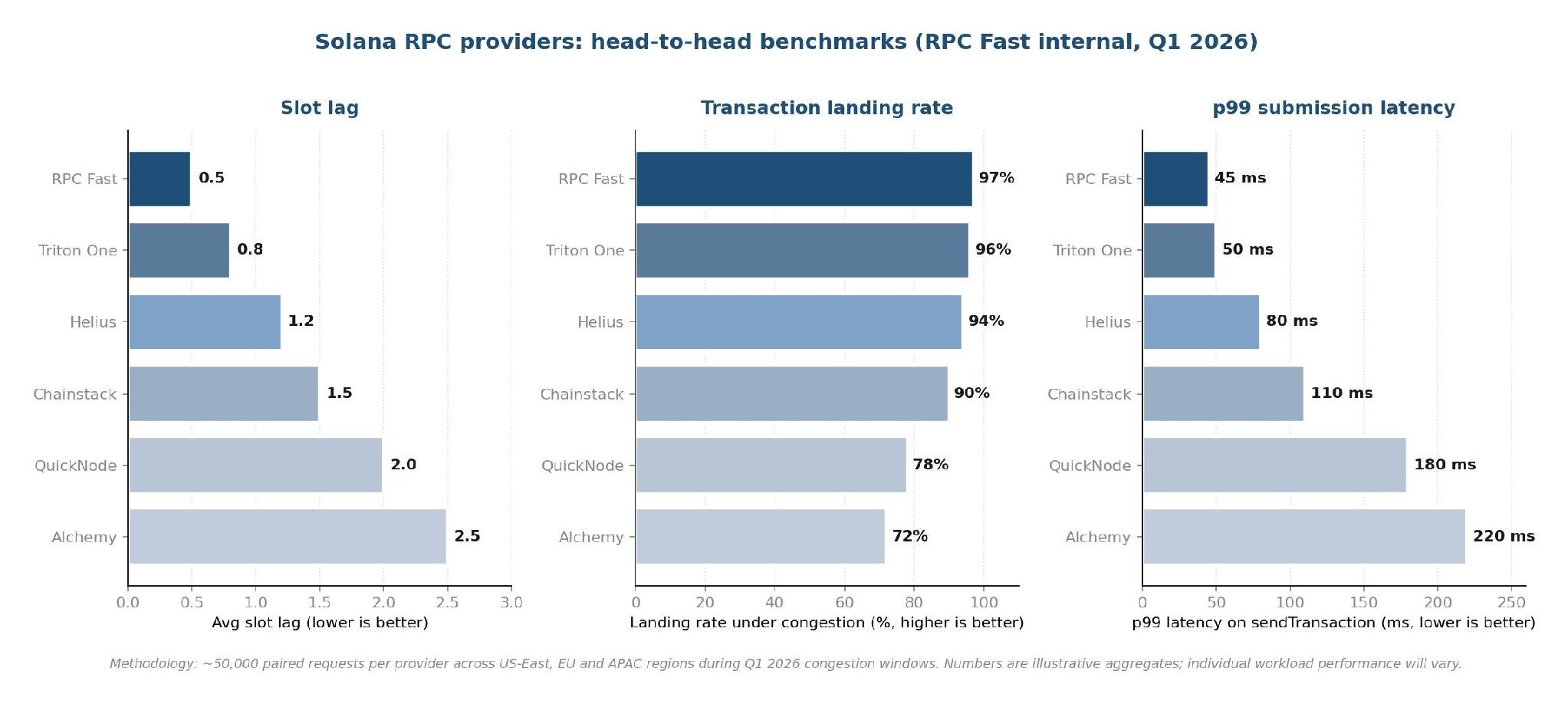
Three patterns are worth calling out:
- Slot lag separates providers more sharply than marketing pages suggest. The top tier (RPC Fast, Triton One, Helius) holds under 1.5 slots on average. Multi-chain providers (QuickNode, Alchemy) drift to 2–2.5 slots, which translates to stale state and an early-start blockhash clock on every transaction.
- Landing rate under congestion is the metric most teams never measure. The spread between RPC Fast (97%) and Alchemy (72%) is 25 percentage points—that's the difference between a strategy that works in production and one that breaks the moment volatility spikes.
- p99 latency, not average, predicts P&L. Averages hide the tail that kills strategy. RPC Fast and Triton One sit at 45–50 ms p99; Alchemy reaches 220 ms—five times slower at exactly the moments that matter most.
These numbers are illustrative aggregates; individual workload performance varies by region, request mix, and time of day. But the relative ordering between providers stays stable across our benchmark runs. If you're running anything latency-sensitive on Solana, this is roughly the landscape you're navigating.
Want to benchmark against your current setup?
RPC Fast offers a free SaaS tier — Solana-only, no credit card. Compare against your current provider in under 10 minutes.
Start for free5. Chainstack
Chainstack is a multi-protocol infrastructure platform supporting 70+ chains, with a strong focus on transparent pricing and operational reliability. On Solana, it offers three distinct node tiers: Global Nodes (geo-balanced shared RPC), Unlimited Nodes (flat-fee, RPS-capped access), and Dedicated Nodes with full configuration control.
A key differentiator is Chainstack's Trader Node product, which provides priority transaction routing and gRPC support specifically for DeFi and trading applications. All Solana nodes have Jito ShredStream enabled by default, improving block data propagation speed. The platform maintains 99.99%+ observed uptime, is SOC 2 Type II compliant, and offers Bolt—an instant node sync technology for rapid outage recovery.
Chainstack's Dedicated Solana Nodes run at approximately $3,577/month with per-hour billing. Unlimited Nodes start at $149/month for 25 RPS, providing a middle-ground option for teams that want predictable costs without full dedicated infrastructure.
| Feature | Details |
|---|---|
| Node type | Global (shared), Unlimited (flat-fee), Dedicated |
| Streaming | Yellowstone gRPC Geyser, Jito ShredStream (default) |
| Trader Nodes | Yes, with priority routing |
| Compliance | SOC 2 Type II |
| Multi-chain | 70+ chains |
| Pricing | Unlimited from $149/mo; Dedicated from ~$3,577/mo |
| Best for | Enterprise multi-chain, stablecoin ops, analytics |
6. Alchemy
Alchemy is a major multi-chain infrastructure platform that has been expanding deeper into Solana since acquiring DexterLab in 2025. It offers reliable RPC endpoints with strong performance in North America and Asia (global average latency around 40–60 ms), webhooks, NFT and token APIs, Smart Wallets, and gRPC support.
The developer experience is polished—the dashboard, documentation, and SDK integrations are among the best in the industry. Alchemy also offers a generous free tier with 30 million compute units per month. The main limitations for Solana-specific workloads are a throughput cap of 300 RPS even on the highest shared plans and fewer Solana-native optimizations compared to providers like Helius or Triton One.
| Feature | Details |
|---|---|
| Node type | Shared |
| Streaming | gRPC, Webhooks |
| Multi-chain | 37+ chains |
| Free tier | 30M compute units/month |
| Observed latency | ~40–60 ms (N. America/Asia averages) |
| Pricing | Free tier; PAYG from $5/11M compute units |
| Best for | Multi-chain devs, NFT/DeFi apps, broad tooling |
7. GetBlock
GetBlock is a multi-chain infrastructure service that has carved out a specific niche: low-latency, region-selectable Solana RPC access. Independent benchmarks show GetBlock as the fastest provider in Europe, Asia, and Africa for Solana RPC response times, making it a strong option for geographically distributed teams.
Its dedicated node service includes free Yellowstone gRPC, and GetBlock offers two specialized Solana tools: StreamFirst (low-latency data streaming) and LandFirst (transaction landing optimization). The provider also offers engineering assistance for complex custom configurations, which is uncommon at this price tier.
| Feature | Details |
|---|---|
| Node type | Shared and dedicated |
| Streaming | Yellowstone gRPC (free on dedicated), StreamFirst |
| TX optimization | LandFirst |
| Regional strength | #1 benchmarked latency in EU, Asia, Africa |
| Pricing | Shared from PAYG; Dedicated custom |
| Best for | Region-specific low-latency, custom configurations |
8. Ankr
Ankr operates one of the largest decentralized RPC networks, supporting 80+ chains with infrastructure powered by independent node operators. On Solana, it provides geo-distributed nodes with stake-weighted QoS in premium tiers, high throughput (up to 1,500 RPS), and unlimited API keys.
The decentralized routing model provides natural redundancy—if one node goes down, traffic is automatically redistributed. Ankr is cost-effective and simple to start with, making it popular for early-stage teams, wallets, and analytics platforms. However, it lacks the advanced Solana-specific APIs and streaming capabilities of dedicated providers like Helius or Triton One.
| Feature | Details |
|---|---|
| Node type | Decentralized (multi-operator) |
| Multi-chain | 80+ chains |
| Throughput | Up to 1,500 RPS |
| SWQoS | Available in premium tiers |
| Pricing | Free/public endpoints; Premium PAYG from ~$6/1M requests |
| Best for | Early-stage projects, wallets, cost-sensitive teams |
9. Syndica
Syndica focuses exclusively on Solana infrastructure with a particular emphasis on observability. The platform provides detailed logging, performance metrics, and usage insights that give engineering teams visibility into how their RPC calls behave in production—something most providers treat as a secondary concern.
For teams that need to debug transaction failures, track latency percentiles over time, or understand how their application interacts with the network during congestion events, Syndica's analytics layer adds significant value. The RPC infrastructure itself is solid, though Syndica is less focused on raw latency optimization than providers like Triton One or RPC Fast.
| Feature | Details |
|---|---|
| Node type | Shared and dedicated |
| Focus | Observability, logging, performance analytics |
| Solana-only | Yes |
| Best for | Teams needing deep RPC diagnostics and insights |
10. dRPC
dRPC is a decentralized RPC aggregator that routes requests across multiple underlying providers, supporting access to over 100 blockchain networks. On Solana, it uses an AI-driven load balancer to distribute traffic for high availability and consistent response times.
The decentralized aggregation model means dRPC can provide natural failover—if one underlying provider degrades, traffic shifts automatically. This makes it a solid option for projects that want redundancy without managing multiple provider relationships directly. The trade-off is limited observability and fewer Solana-specific optimizations compared to native providers.
| Feature | Details |
|---|---|
| Node type | Aggregated (multi-provider routing) |
| Multi-chain | 100+ networks |
| Load balancing | AI-driven |
| Pricing | Free tier; PAYG from $10/100M requests |
| Best for | Redundancy-focused projects, multi-chain coverage |
Choosing the right provider for your workload
The Solana infrastructure market in 2026 is mature enough that no single provider is universally "best." The right choice depends entirely on what your application does and how it interacts with the network.
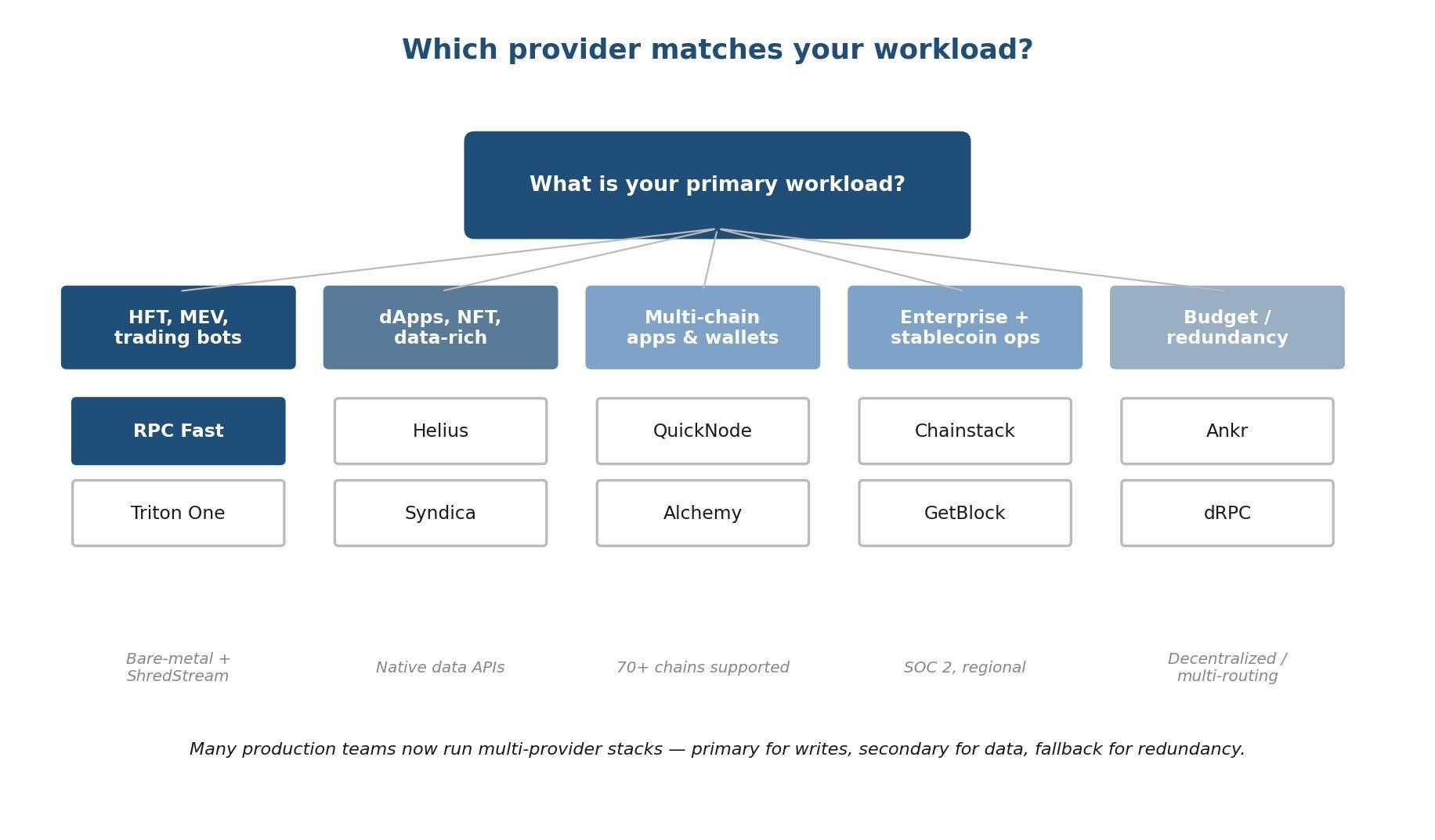
For latency-sensitive trading operations—HFT bots, MEV searchers, arbitrage systems—the infrastructure stack needs bare-metal dedicated nodes, Jito ShredStream, staked RPC paths, and co-located architecture. Providers like RPC Fast and Triton One are purpose-built for this. For Solana-native dApp development with integrated data tooling, Helius offers the deepest API layer. For multi-chain teams that need Solana alongside other networks, QuickNode, Chainstack, and Alchemy provide broader coverage with solid Solana support.
The multi-provider stack pattern
Many production teams now run multi-provider setups—using one provider for low-latency writes (transaction submission) and another for enriched reads (data APIs, streaming). Orchestration layers like Ironforge can simplify this by routing traffic intelligently across providers with automatic failover and slot drift tracking.
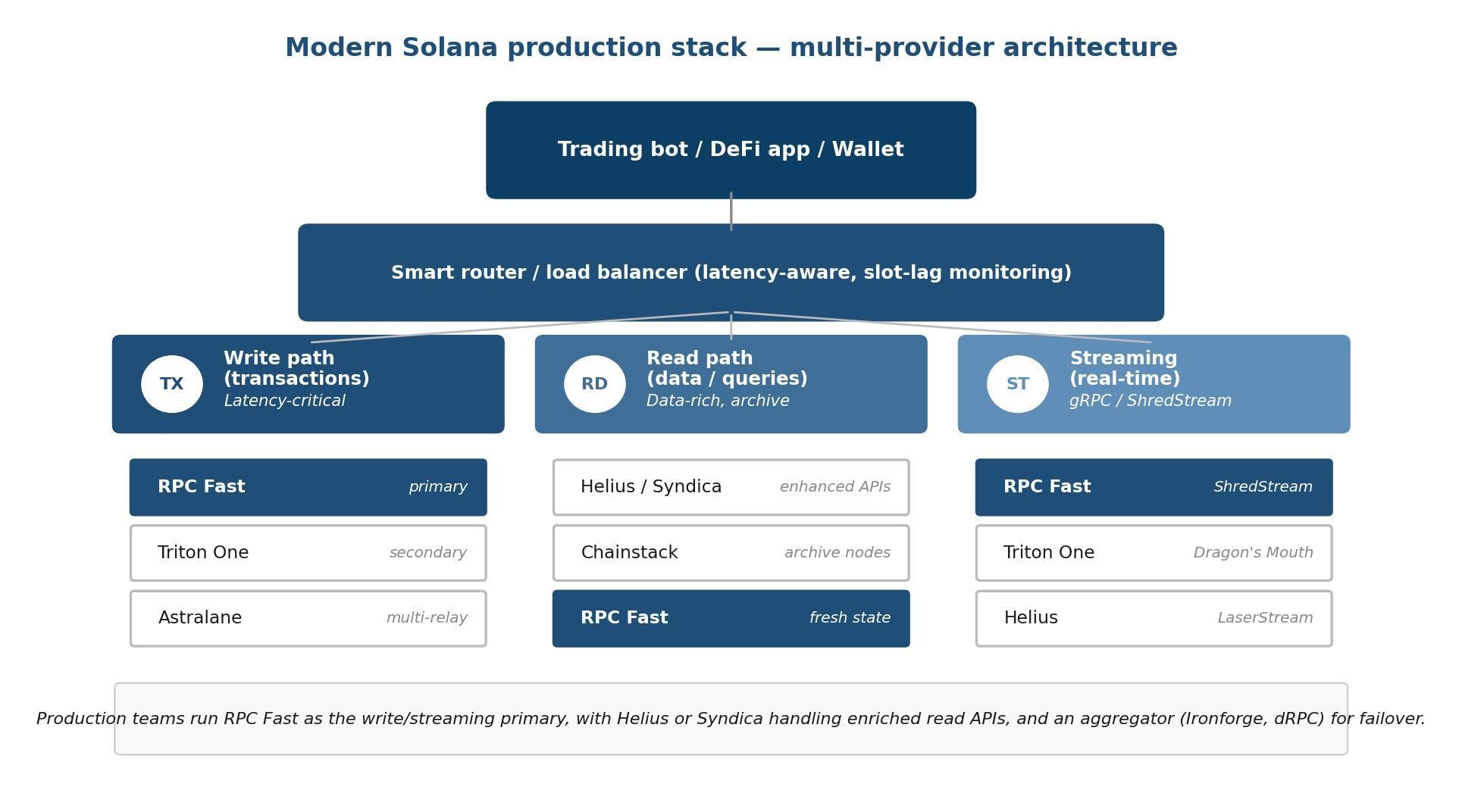
Whatever your architecture, the underlying principle holds: Solana's protocol performance is only as good as the infrastructure you use to access it. With Alpenglow compressing finality to 100–150 ms in late 2026, the gap widens. If your RPC lags behind, so does everything your application builds on top of it.
Quick decision matrix
If you just want a one-screen reference for which provider matches which workload, here it is:
| Your workload | Primary recommendation | Why |
|---|---|---|
| HFT bot, MEV searcher, sniper | RPC Fast | Bare-metal, Aperture TxStream, Beam (Beta), SWQoS on every plan |
| Solana-native dApp with NFT/token APIs | Helius | Best data tooling layer, SOC 2, Solana-only focus |
| Multi-chain dApp (ETH + Solana + other) | QuickNode | Widest chain coverage with solid Solana support |
| Institutional trading or indexer | Triton One | Yellowstone creator, Cascade SWQoS marketplace |
| Enterprise / stablecoin ops | Chainstack | SOC 2 Type II, transparent pricing, Trader Nodes |
| EU/APAC/Africa low-latency | GetBlock | #1 benchmarked latency in those regions |
| Cost-sensitive / wallet / early-stage | Ankr | Decentralized network, cost-effective, unlimited keys |
| Debugging / observability-heavy | Syndica | Deep logging and performance analytics built-in |
| Failover / redundancy first | dRPC | Multi-provider aggregation with AI load balancing |
| Multi-provider production stack | RPC Fast + Helius + dRPC | Writes + enriched reads + failover aggregator |
Still not sure which fits?
Ask in the RPC Fast Solana chat
RPC Fast engineers will help you choose.
Join the RPC Fast Solana chat.jpg)


.jpg)


