
SOLANA RPC COMMUNITY
Built for Solana builders.Run by operators.
Join builders running HFT bots, DEX tools, and AI agents on Solana.
Join Discord

Special offers

Live support

No spam

SOLANA RPC COMMUNITY
Built for Solana builders.Run by operators.
Join builders running HFT bots, DEX tools, and AI agents on Solana.
Join DiscordSpecial offers
Live support
No spam
Solana RPC for copy trading, built for the teams shipping the platform rather than the traders using it, engineered to shorten alert delay, suppress follower orders that will fail, and hold inclusion across a large fan-out.
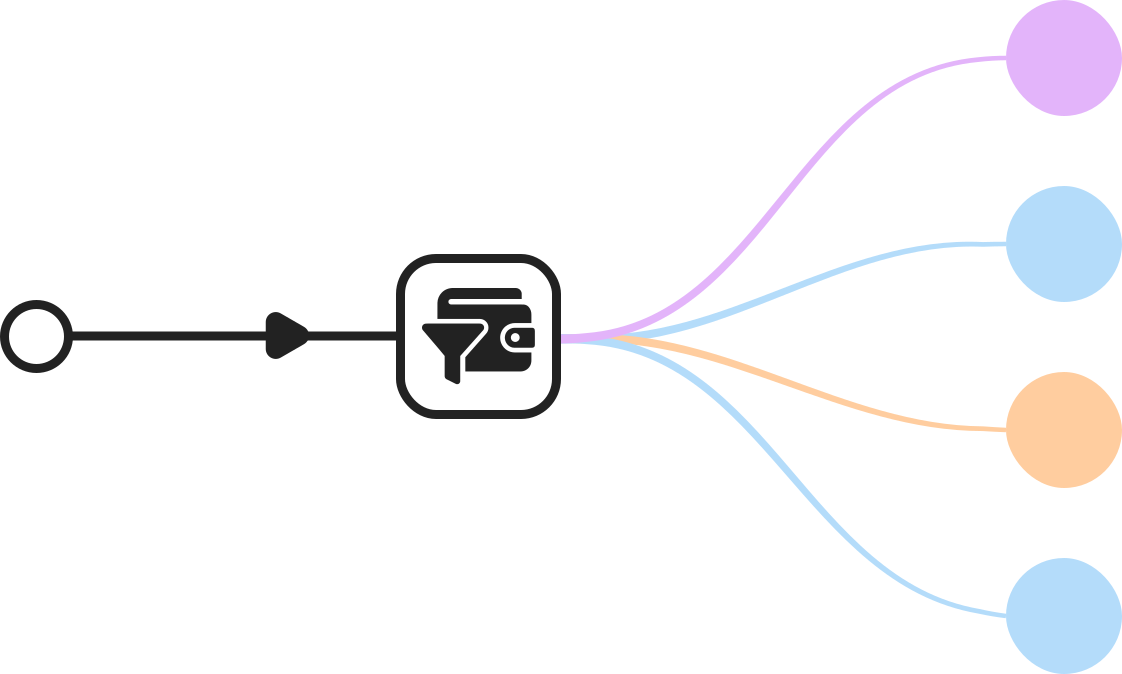
Unlike generic RPC polling or delayed WebSocket feeds, Aperture TxStream taps into native raw shred ingestion and streams the leader's decoded, filterable transaction over one production-ready gRPC interface.

197–231 µs median lead over shredded streams

Server-side filtering by leader wallet lists

Batches of up to 64 transactions, with an index field to restore order

Decoded instructions with lookup tables already resolved

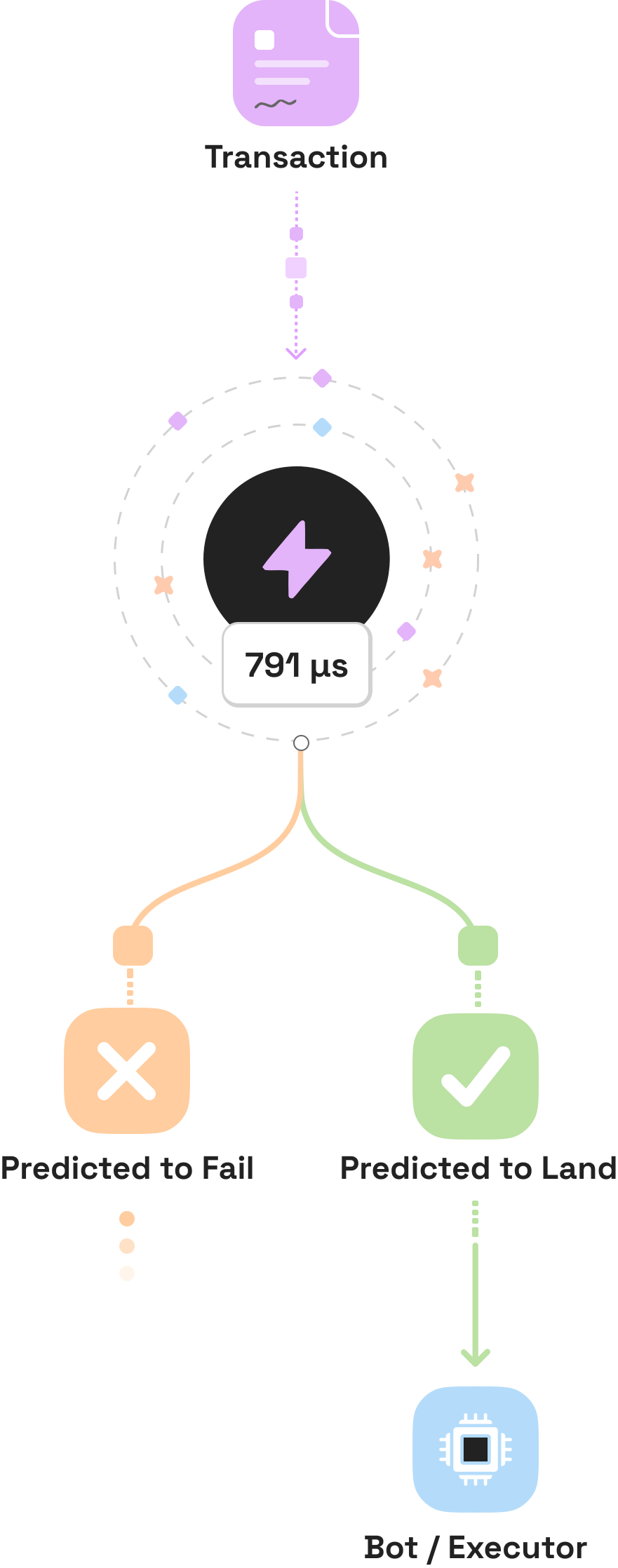
Predicted execution results attached to the stream (~95% accuracy)

Beam delivery, up to 500 transactions per minute

1

The leader's transaction enters the shred pipeline — before the block exists
2

Stream decodes it, filtered server-side to your leader wallet lists
3
The prediction is attached at 791 µs for full payload, 832 µs for signatures only
4

Your sizing logic scales the trade across every subscribed follower
5

Follower orders go out through Beam, and doomed copies never charge a fee

vs Jito ShredStream, signatures only
77.6%
of races — TxStream first
vs Jito ShredStream, full payload
75.6%
of races — TxStream first
vs Yellowstone gRPC
99.97%
of races — TxStream first


LEAD SOLANA. OWN THE TRADE
Ready to cut alert delay at the infrastructure layer?
Access tuned RPC, gRPC, and trading-grade streams from day one.
FAQ
Copy trading means automatically replicating the trades of a successful trader, usually called a leader or signal provider. When the leader executes a trade, your wallet executes the same trade at the same time, without you deciding anything.
Setting it up is straightforward: you pick a leader with a profitable track record, connect your Solana wallet to the platform, and decide how much capital you want to copy with. From that point the mirroring is automatic. When the leader buys a token, your bot buys it too, and you share in the result minus the platform fee.
The trade-off is worth stating plainly. You are not researching markets or choosing entries, which is the appeal. You are also copying the leader's losses as faithfully as their wins, which is the part people underweight. On Solana specifically, fast RPC is what lets your copy execute at nearly the same price the leader got, which is the difference between the arrangement working and quietly bleeding.
Because the entire model depends on executing close to the leader, and price moves in the gap between their trade and yours.
Consider a realistic sequence. The leader spots an opportunity at $0.10 and buys. Within about a hundred milliseconds the price starts moving. A copier on a fast endpoint receives the signal in tens of milliseconds and fills at roughly $0.1005, so the slippage is negligible against a $1,000 position. A copier on a public endpoint might not receive the signal for the better part of a second, by which time the price is $0.15 and the fill is catastrophically worse.
That second copier followed the exact same leader and took the exact same trade. They lost money on a trade the leader profited from, purely because of where they sat in the queue. Fast RPC keeps slippage minimal and preserves the edge you are paying the leader for. Slow RPC converts a winning signal into a losing position.
The main options, and what each is oriented around:
Under 50 milliseconds is where copy trading works as intended: slippage is minimal and your fills land at nearly the leader's price. Between 50 and 100 milliseconds you take small slippage but remain comfortably profitable. Between 100 and 300 milliseconds the slippage becomes noticeable and typically eats 20 to 40 percent of returns. Between 300 and 800 milliseconds most strategies stop being profitable. Above 800 milliseconds the trade is effectively over by the time you copy it.
The arithmetic is easy to follow. Say the leader buys 1,000 tokens at $0.10 for $100, and their own trade pushes the price up by half a cent. On a sub-40 millisecond connection you fill around $0.1005 and your slippage is roughly equivalent to theirs. On a one-second connection the price has already reached $0.12, so you pay a fifth more than the leader did for the same position. The leader made money. You did not.
RPC Fast delivers sub-40 millisecond latency, which puts copy trading in the range where the model actually holds.
Proportional copying scales your position against the leader's. If they commit $100 and you are set to 2x, you commit $200. The advantage is that you inherit their conviction: when they size up, so do you. The disadvantage is the same thing in reverse, because you also size up on their mistakes.
Fixed copying uses a set amount regardless of what the leader does. If they buy $100 or $1,000, you always commit your configured amount. You give up the conviction signal, but you keep direct control over your exposure on every single trade.
Most Solana platforms implement fixed copying, largely because it is simpler to build. Proportional requires more sophisticated position logic. For anyone starting out, fixed is the safer default, because it prevents a single oversized leader position from doing disproportionate damage.
The foundation is that everything happens on-chain. Every trade a leader makes is recorded on Solana, publicly and immutably, so their track record can be verified by anyone rather than taken on trust from a marketing page.
On top of that, platforms compute the standard performance metrics: win rate, average profit on winning trades against average loss on losing ones, risk-adjusted return, Sharpe ratio, and maximum drawdown from peak to trough. Those numbers are then broken out across time periods, typically 7 days, 30 days, 90 days and all-time, which is what separates genuine skill from a lucky fortnight.
A credible leader profile looks unremarkable in a specific way: something like a 65 percent win rate, average winners around +2.5 percent against average losers near -1 percent, a long track record, and a maximum drawdown that is visible rather than hidden.
The warning signs are equally recognizable. A perfect win rate is almost certainly fabricated, because nobody wins every trade. A history of only one or two weeks tells you nothing about skill. Returns above 250 percent monthly are not sustainable and usually indicate either extreme risk or misrepresentation. And any leader without verifiable on-chain history should be disqualified on that basis alone.
The exposures group into four categories:
The behavioural risks tend to cause more damage than the technical ones, because they are the ones nobody monitors for.


.jpg)


.jpg)
.jpg)

