
SOLANA RPC COMMUNITY
Built for Solana builders.Run by operators.
Join builders running HFT bots, DEX tools, and AI agents on Solana.
Join Discord

Special offers

Live support

No spam

SOLANA RPC COMMUNITY
Built for Solana builders.Run by operators.
Join builders running HFT bots, DEX tools, and AI agents on Solana.
Join DiscordSpecial offers
Live support
No spam

Solana RPC for MEV, built for searchers whose expected value is set by the races they lose, engineered to surface state changes sooner, discard attempts that cannot execute, and route the survivors into competitive blocks.
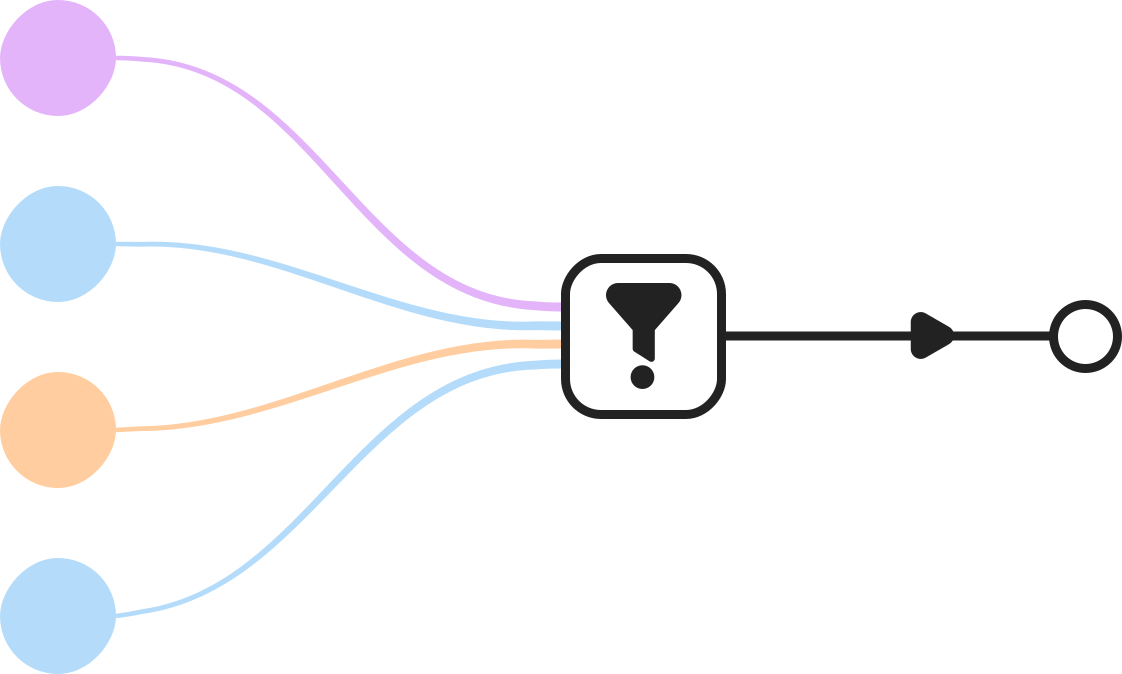
Unlike generic RPC polling or delayed WebSocket feeds, Aperture TxStream taps into native raw shred ingestion and streams decoded, filterable transactions over one production-ready gRPC interface.

197–231 µs median lead over shredded streams

Batches of up to 64 transactions, with an index field to restore order

Decoded instructions with lookup tables already resolved

Server-side filters: accounts, programs, signatures

Predicted execution results attached to the stream (~95% accuracy)

Beam delivery, fastest or MEV-protected routing
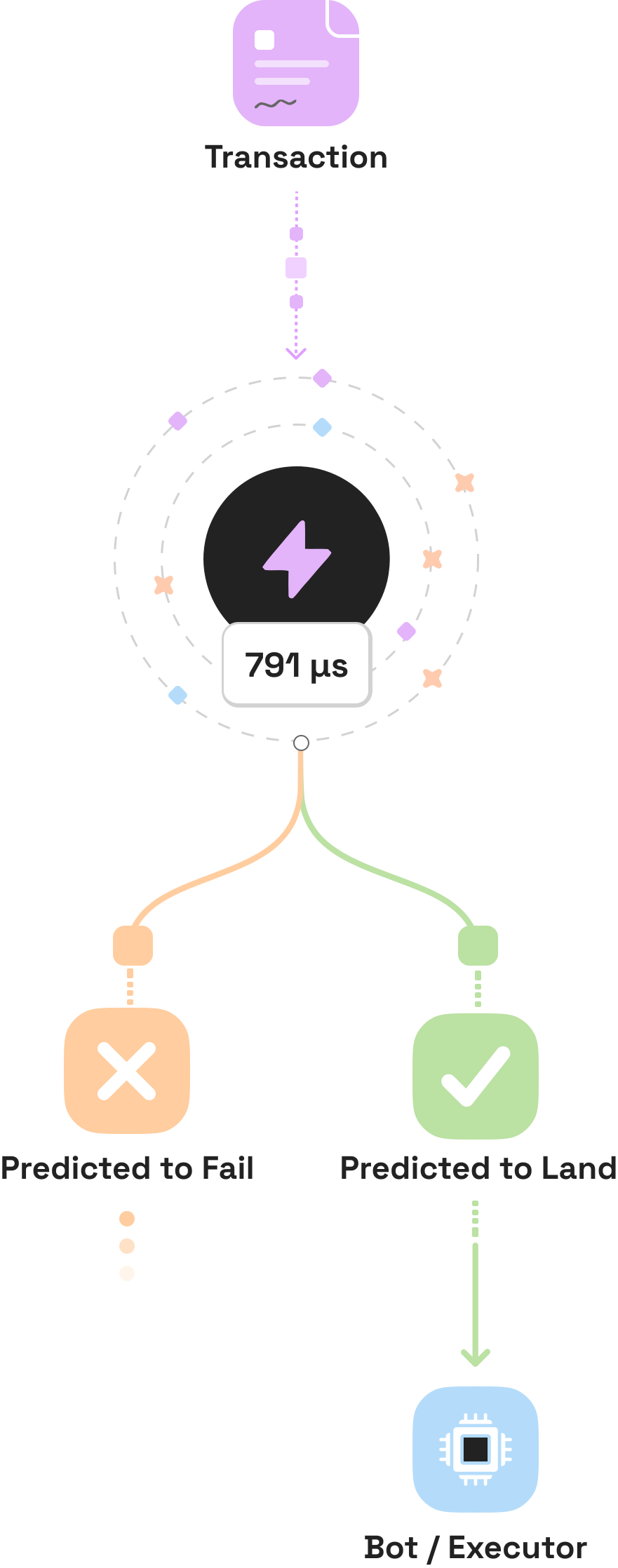

1

A transaction enters the shred pipeline — before the block exists
2

Stream reconstructs and decodes it server-side
3
The prediction is attached at 791 µs for full payload, 832 µs for signatures only
4

The result lands in your stream as a flag: will execute or will fail
5

You drop the doomed attempts and spend tip budget on the rest

vs Jito ShredStream, signatures only
77.6%
of races — TxStream first
vs Jito ShredStream, full payload
75.6%
of races — TxStream first
vs Yellowstone gRPC
99.97%
of races — TxStream first


LEAD SOLANA. OWN THE TRADE
Ready to react before the block forms?
Access tuned RPC, gRPC, and trading-grade streams from day one.
FAQ
MEV means Maximal Extractable Value: the profit available from reordering, including or excluding transactions in a block. On Solana, MEV bots watch pending transaction flow and act on it in a few recognizable ways — front-running a known large purchase, sandwiching a swap by buying before and selling after, liquidating risky positions on lending protocols, and arbitraging price differences between DEXes.
Solana's roughly 400ms block time is what makes this a high-frequency game. The faster your RPC, the sooner you see the opportunity and the more likely you beat competitors to it.
Because the whole window is measured in milliseconds. A large swap appears, a fast bot detects it within about ten milliseconds, buys ahead of it, and sells once the victim's trade has moved the price — the entire round trip finishing inside 150ms.
On a slow endpoint you see that same transaction half a second later, by which point it has already confirmed. There is nothing to front-run. The opportunity was never yours to lose; you simply never saw it in time. Every 100ms of latency costs real money daily.
Block time is the main divide. Solana settles in around 400ms against Ethereum's 12 seconds, so Solana produces far more opportunities per day but each one is smaller. Ethereum is the reverse: fewer, larger extractions.
That shapes the competition too. Ethereum MEV is extremely saturated and requires competing against thousands of bots and Flashbots infrastructure. Solana needs sub-100ms bot speed to be viable at all, but the field is less crowded. More opportunities per day, less value per opportunity.
The main ones, with rough returns and how crowded they are:
Liquidation hunting — monitor lending protocols like Solend and Marinade, liquidate risky positions. Around 5-10% of the liquidated amount, medium-high competition
DEX arbitrage — buy on Raydium, sell on Orca or vice versa. 0.1-0.5% per trade, very high competition
Sandwich attacks — front-run large swaps. 0.5-2% per target, extremely high competition since it is the most profitable
Token launch sniping — buy at launch before price moves. Potentially 5-50x, high competition and high risk since most launches fail
Flash loan arbitrage — borrow, trade, repay with fee. 0.2-1% per trade, very high competition
Liquidation hunting is the easiest entry point: clearer signals and less competition than the rest.
Under 50ms covers everything, including front-running and sandwich attacks. Between 50 and 100ms works for liquidations and arbitrage. Between 100 and 300ms you are limited to arbitrage alone. Above 300ms, MEV stops being realistic.
As a rule of thumb, each 100ms of latency removes roughly 30% of your profitable opportunities. At 500ms, most MEV is simply out of reach. RPC Fast delivers sub-40ms, which keeps every strategy on the table.
It means watching pending transactions before they confirm, and for MEV it is the whole basis of the strategy. It is how you spot large swaps to front-run, liquidation transactions to compete on, new launches to snipe, and price movements worth arbitraging.
Without it you only learn about opportunities once they are already in blocks, which is too late to act on. With it you get a head start measured in blocks rather than milliseconds.
Legally, yes. MEV is a structural property of how blockchains order transactions, and validators and block builders extract it routinely.
Ethically it is genuinely debated. The case against is that sandwich attacks take value directly from retail users. The case for is that MEV exists at the consensus level regardless, so wider distribution beats concentration. On Solana the retail impact is smaller than on Ethereum because fees are low — a sandwich might cost a user a dollar rather than fifty.
Professional traders and protocols already anticipate MEV and structure transactions around it. If the ethics bother you, liquidation hunting is the strategy to pick: it supports protocol solvency rather than extracting from individual traders.
It varies sharply by strategy. Liquidation hunting and flash loan arbitrage need essentially no trading capital, since one requires only an RPC connection and the other borrows the funds it uses; realistic daily profit sits in the low hundreds. DEX arbitrage wants somewhere between $1,000 and $5,000 working capital for $50-200 a day. Sniping needs $500-5,000 and produces volatile results that can run into thousands. Sandwich attacks are the most capital-intensive at $5,000-20,000, with correspondingly larger daily numbers.
For anyone starting with little capital, liquidation hunting is the obvious entry.
Three transactions in sequence. You buy first, pushing the price up. The victim's larger swap then executes at that worse price. You sell immediately after, pocketing the difference.
Concretely: a victim swaps 1,000 USDC expecting 100 COPE. The bot front-runs by buying 50 COPE, which moves the price so the victim receives only 90. The bot then sells its 50 COPE into the elevated price, capturing roughly half of what the victim lost.
Execution depends entirely on speed: sub-40ms detection of the pending swap, instant order placement, priority execution, and minimal slippage on the bot's own two trades.
Ethereum has the larger prizes, with sandwiches ranging from ten thousand to over a million dollars, and far more established research behind it. The problems are saturation, with thousands of bots competing, high gas fees eating margins, and Flashbots dominance making entry hard.
Solana is less saturated, with hundreds of bots rather than thousands, negligible fees, and a simpler architecture that makes bots easier to build. The trade-off is smaller opportunities, in the hundreds to low thousands, and less historical research to lean on.
For a new MEV developer, Solana is the more accessible starting point.
More congestion means more transactions, which means more sandwich targets and more opportunity overall. Quiet periods leave bots idle.
The catch is that congestion also degrades execution: the network is slower, transactions fail more often, and everyone is competing for the same extractions, so prices worsen. The practical answer is to scale aggressiveness with conditions — extract hard during peaks, and fall back to arbitrage and liquidations during quiet stretches, since those depend less on winning a race.


.jpg)


.jpg)


