





RPC Fast has completed a strategic migration to a higher-capacity data center and upgraded to more powerful hardware, delivering improved throughput and network connectivity for Solana users.
Our team picks the new facility with significant Solana stake and a superior network channel, while preserving seamless operation—the team reports no downtime during the transition.
We present fresh benchmarks comparing latency, request‑per‑second capacity, and reliability before and after the upgrade, and explain what the improvements mean for developers, validators, and apps relying on RPC Fast.
Performance report
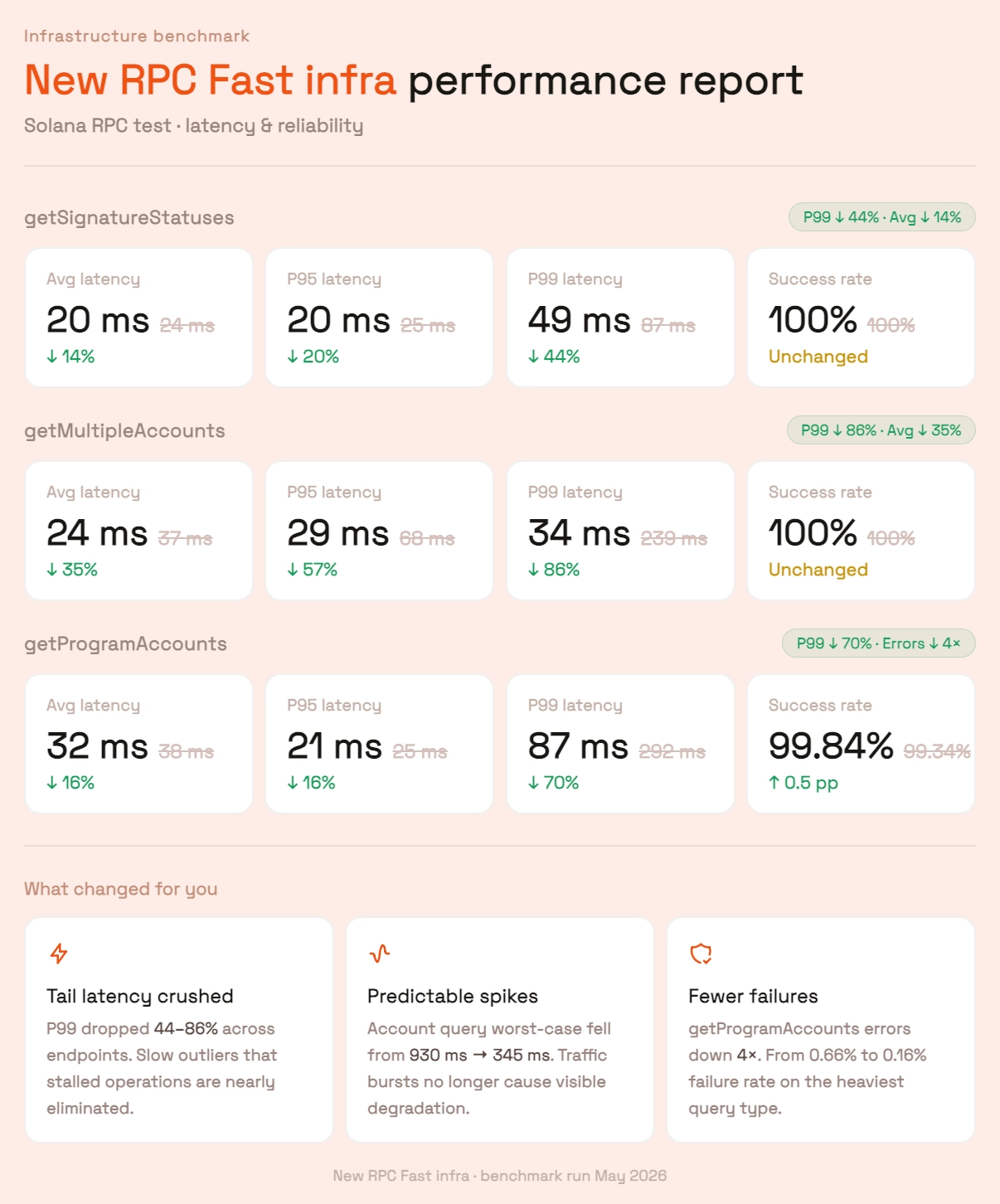
The performance report outlines the key metrics data for the most popular methods used in RPC Fast-powered projects. This report mirrors the “before-and-after” migration state. The previous state is described here.
Practical impact for builders
- Far fewer slow outliers and predictable spikes—heavy account scans and burst traffic no longer cause visible degradation.
- Lower avg & tail latency reduces need for aggressive client-side retries/backoffs and simplifies timeout tuning.
- Higher stability and lower error rates mean fewer compensating workarounds (caching, queuing) for critical reads; also, scaling becomes simpler.
Practical impact for traders
- Much tighter windows for price reads and signature checks—faster confirmations and lower effective slippage.
- Reduced tail latency and fewer failures improve reliability during market spikes and thin-arbitrage opportunities.
- Fewer transient errors mean less automated retry noise and more consistent order execution logic.
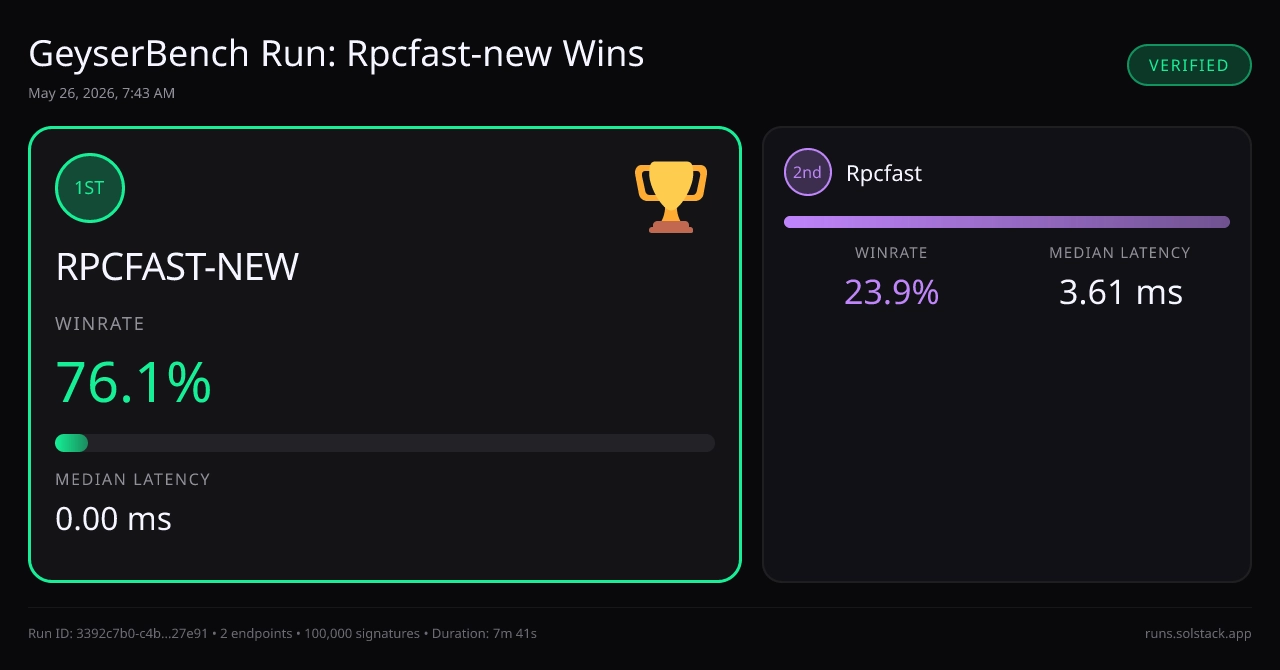
Yellowstone gRPC benchmark: New vs old RPC Fast infrastructure
Also, after our migration, we’ve run the Geyser vs. RPC Fast benchmarks, and the results were intriguing.
Recommended next steps
- Run your own workload tests (especially multi-account and program-account queries) against the new infra.
- For critical flows, consider using higher-tier or dedicated nodes to guarantee capacity and isolation.
- Adjust retry/timeouts and observability thresholds to take advantage of the improved tail behavior.
Plans for the rest of 2026
The migration unlocks stronger, more reliable performance across all RPC Fast offerings.
RPC Fast Aperture
A cost-effective public RPC tier for general dApps and lightweight backends—low-latency access, autoscaling, and straightforward onboarding for developers.
RPC Fast Beam
A performance-focused tier for latency-sensitive and high-throughput apps—higher RPS limits, prioritized routing, and enhanced observability for demanding production workloads.
RPC Fast dedicated Solana nodes
Isolated, single-tenant nodes for validators and enterprise users who need custom configuration, predictable capacity, and direct access to stake-backed data center resources.
Yet, we’re not going to stop while improving our hardware stack. Our team receives many requests to open our New Year endpoint to power up the US market with the RPC Fast toolstack. We promise to think about that.
Benchmark the metrics of your project on our setup
Run with us.jpg)


.jpg)


