





Most people building MEV bots on Solana optimize for the wrong thing. They spend weeks refining their arbitrage logic, sandwich detection, or liquidation triggers—and then run it all through a shared RPC endpoint that adds 200ms before the transaction even hits the network. By that point, the opportunity is gone.
The numbers tell the story clearly. In 2025, MEV revenue on Solana reached $720.1 million for the full year, overtaking priority fees for the first time as the largest component of the network's real economic value (REV).
Jito bundles, the primary submission path for MEV searchers, processed over 3 billion bundles in the past year, generating 3.75 million SOL in tips. Also, Jito tips accounted for over 22% of total validator rewards.
The right setup gives you faster access to fresh slot data, lower-latency transaction submission, and direct validator connectivity that improves your bundle's chance of landing. The wrong one costs you real money on every missed extraction.
This guide covers 8 Solana RPC providers evaluated specifically for MEV workloads: latency, Jito integration, gRPC streaming, SWQoS support, and how they hold up when the network is under load.
What MEV actually means on Solana—and why infrastructure determines who wins
Maximal Extractable Value (MEV) on Solana refers to the profit that can be captured by controlling the order in which transactions are included in a block.
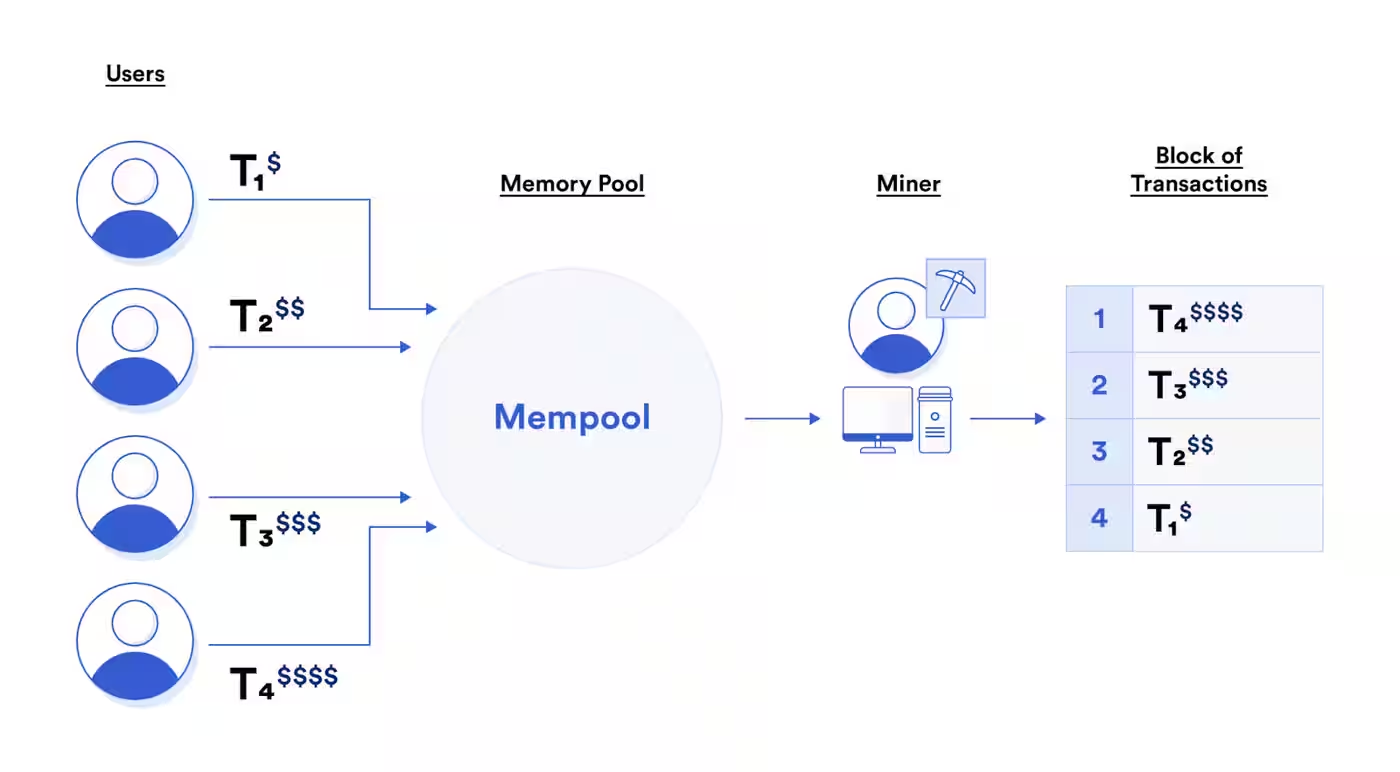
The main strategies are:
- Arbitrage—buying and selling the same token across different DEXs atomically within one transaction, capturing a price difference between pools on Raydium, Orca, Meteora, Phoenix, or others.
- Backrunning—submitting a transaction immediately after a large swap to capture the price rebound before the pool rebalances.
- Liquidations—monitoring undercollateralized positions across lending protocols and triggering liquidations as soon as they become eligible, collecting the liquidation bonus.
- Sandwich attacks—front-running a user's large swap to move the price, letting the user's transaction execute at a worse rate, then selling back for profit.
Solana's architecture makes MEV both more accessible and more competitive than Ethereum. Block times are 400ms. There is no public mempool—transactions propagate through gossip directly to validators or through private relays like Jito. Searchers submit bundles of up to five atomic transactions with a tip; validators include the highest-paying bundles at the top of the block, guaranteeing execution order.
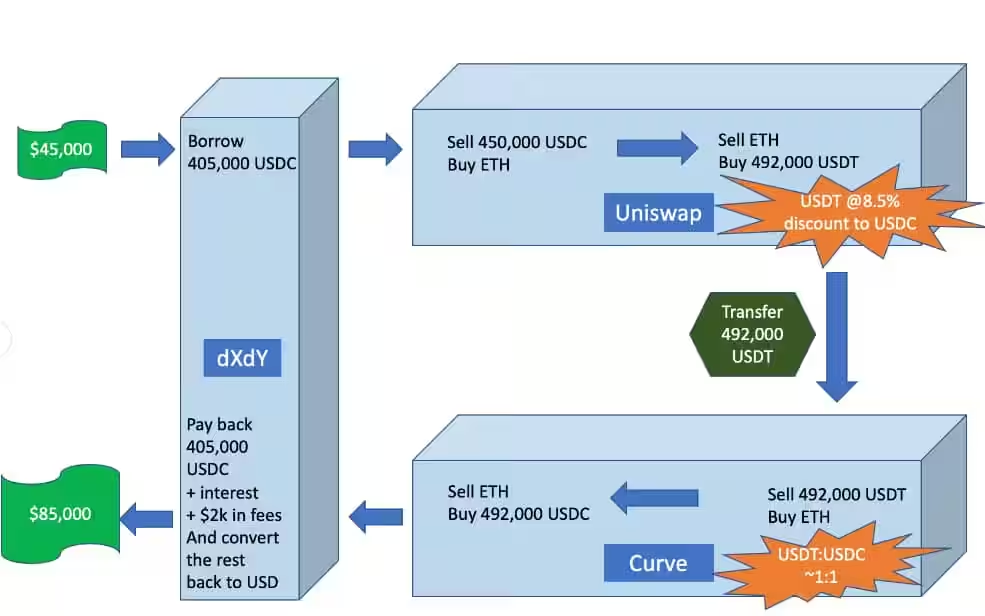
Because the entire race happens in sub-second windows, every layer of your stack has to be optimized. Your bot's logic is the starting point—but your RPC node is what determines how quickly you receive new state data and how fast your transaction reaches the validator. A 50ms delay in receiving a slot update or submitting a bundle can be the difference between landing a profitable extraction and a failed attempt that still costs you priority fees.
Key infrastructure requirements for MEV on Solana:
- Sub-50ms latency for reading account state and submitting transactions
- Geyser / gRPC streams for real-time account and slot updates—faster than standard WebSocket
- Jito bundle submission endpoint or native integration with the Jito block engine
- Stake-weighted Quality of Service (SWQoS)—transactions forwarded by staked nodes get priority during congestion
- Dedicated bare-metal or co-located infrastructure—shared cloud VMs add unpredictable latency spikes
- ShredStream access—catching transaction shreds before full block propagation for the earliest possible signal
Top 8 Solana RPC providers for MEV
1. RPC Fast—built for MEV from the ground up
RPC Fast, built by Dysnix, is the most purpose-built option for MEV workloads on this list. The team comes from a DevOps and DeFi infrastructure background and has tuned over 100 trading bots on Solana—which means the product reflects what searchers actually need, not what sounds good on a pricing page.
The infrastructure runs on bare-metal EPYC co-located servers, not shared cloud VMs. That matters because shared environments introduce "noisy neighbor" latency—unpredictable spikes caused by other tenants competing for the same CPU, memory, or network resources. With dedicated hardware, your p99 latency stays consistent even when Solana is under congestion.
For MEV specifically, RPC Fast offers native integrations with both Jito and bloXroute, giving clients access to stake-weighted QoS (SWQoS) and the ability to submit bundles directly to the Jito block engine. They support Yellowstone gRPC streams (via the Geyser plugin), which push account state, slot updates, and transaction notifications faster than standard WebSocket subscriptions—a meaningful edge when you're racing other searchers to the same opportunity. On the Aperture plan, TxStream also attaches a predicted execution result to each transaction while it is still in flight, around 95% accurate against actual execution, at a cost of about 791 µs to median delivery.
Their internal benchmarks report 40% average latency reductions from launch. The managed service model includes 24/7 monitoring, automated failover between nodes, and proactive alerts before issues affect your bot's performance.
RPC Fast also handles MEV relay diversification out of the box—routing across multiple relays to reduce exposure to sandwich attacks on your own transactions and improve bundle inclusion rates above 90%.
| Parameter | Value |
|---|---|
| Infrastructure | Bare-metal EPYC co-located servers, dedicated per client — from $2,200/mo with server, setup and maintenance included, delivered within 72 hours |
| Transaction landing | Beam average landing 330 ms vs 457 ms on standard RPC |
| Jito integration | Native — RPC Fast Beam (Beta): SWQoS + Jito Block Engine. gRPC Shredstream on the Aperture plan (up to 10 streams) |
| gRPC / Geyser | Aperture TxStream — decoded transactions, server-side filters. Stream: limited / Aperture: full |
| SWQoS | Yes—via bloXroute and staked validator partnerships |
| Transaction delivery | Multi-path routing via Beam across four submission providers (astralane, bloXroute, nozomi, falcon), in fastest or MEV-protect mode |
| Free tier | Yes — Start plan, $0/mo, 1.5M credits, no credit card |
| Best for | HFT bots, MEV searchers, liquidation bots requiring maximum reliability |
2. Triton One—validator-level latency, respected by serious builders
Triton One is one of the few providers that consistently earns respect from experienced Solana searchers. Their infrastructure runs with direct validator connections and geographic placement optimized for proximity to current slot leaders—the most critical factor for minimizing the delay between your transaction submission and its inclusion in a block.
Average response times stay below 50ms, putting Triton in the same performance tier as dedicated bare-metal setups. They also support automatic load balancing—routing requests to the fastest available node in real time, which keeps performance consistent when individual nodes experience momentary load spikes.
Triton supports gRPC streaming via Yellowstone and offers advanced endpoints for both transaction broadcasting and account monitoring. For MEV searchers who need low-latency state feeds and fast submission in a single provider, Triton covers both well. They're less visible than Helius or QuickNode in marketing terms, but builders who care about actual performance know the name.
| Parameter | Value |
|---|---|
| Infrastructure | Dedicated nodes with direct validator connections |
| Avg. latency | < 50ms—consistently competitive |
| Jito integration | Supported—bundle submission available |
| gRPC / Geyser | Yellowstone gRPC streams supported |
| SWQoS | Yes—via direct validator connectivity |
| Free tier | No public free tier—contact for pricing |
| Best for | Serious MEV searchers, arbitrage bots needing sub-50ms consistency |
3. Helius—Solana-native with the deepest data layer
Helius is the most widely used Solana-native infrastructure provider, and for good reason. Their RPC traffic runs through staked validator nodes, which gives transactions higher priority during network congestion—an important advantage for MEV workloads where your bundle competing against dozens of others in the same block.
Average latency sits around 140ms according to Chainstack's 2025 benchmarks, which is solid for most arbitrage and liquidation strategies, though not in the sub-50ms tier for ultra-HFT setups. Where Helius stands out is the richness of the data layer around the RPC: Geyser-powered streams, webhook triggers on specific program events, parsed transaction APIs, and DAS for token and NFT metadata.
For MEV bots that need to monitor specific programs—such as lending protocols for liquidation opportunities or AMM pools for arbitrage signals—Helius gives you real-time event streams without building a custom indexer. Enterprise tiers add dedicated validator access and higher sendTransaction rates, which bring latency performance closer to the sub-100ms range.
| Parameter | Value |
|---|---|
| Infrastructure | Staked validator nodes, Solana-native |
| Avg. latency | ~140ms (enterprise tiers improve this) |
| Jito integration | Available—Geyser streams for MEV triggers |
| gRPC / Geyser | Yes—full Geyser streams, webhooks, DAS API |
| SWQoS | Yes—via staked validator routing |
| Free tier | Yes—free tier available; paid from ~$49/month |
| Best for | MEV bots that combine trading logic with on-chain data monitoring |
4. QuickNode—global scale with serious latency investments in 2026
QuickNode published benchmark data in August 2025 claiming 2–3x lower latency than competing providers in several global regions after significant infrastructure upgrades. Their Solana offering runs on a large, globally distributed network with WebSocket support, archive node access, and a detailed analytics dashboard that tracks per-method latency, error rates, and request tracing.
For MEV searchers operating bots across multiple geographic regions, QuickNode's global footprint is a genuine advantage—you can run nodes close to different validator clusters and reduce the distance transactions need to travel. Their automation tools and integrations also make QuickNode a good fit for teams that run both Solana MEV bots and operations on other chains.
MEV-specific features like priority submission require add-ons on standard plans. Rate limits cap at 400 RPS on standard tiers, which is adequate for most bots but can become a constraint for very high-frequency operations.
| Parameter | Value |
|---|---|
| Infrastructure | Staked validator nodes, Solana-native |
| Avg. latency | ~140ms (enterprise tiers improve this) |
| Jito integration | Available—Geyser streams for MEV triggers |
| gRPC / Geyser | Yes—full Geyser streams, webhooks, DAS API |
| SWQoS | Yes—via staked validator routing |
| Free tier | Yes—free tier available; paid from ~$49/month |
| Best for | MEV bots that combine trading logic with on-chain data monitoring |
5. Jito Labs—the MEV infrastructure layer itself
Jito deserves a separate entry because it occupies a unique position: it's not just an RPC provider, it's the dominant MEV infrastructure layer on Solana. Over 92% of Solana validators by stake run the Jito-Solana client. Jito tips comprised 41–66% of Solana's total REV. This is the system you're submitting bundles into, whether you realize it or not.
Jito's block engine accepts bundles of up to five transactions with an attached tip in SOL. Validators who run the Jito client receive these bundles through the relayer (which holds transactions for 200ms to allow bundle auctions), and the highest-paying bundles are included at the top of the block. This is how MEV searchers guarantee execution order for their strategies.
Using Jito directly—via their ShredStream API and bundle submission endpoint—gives you the fastest path to validators and the lowest-level control over your MEV strategy. However, using Jito standalone requires building your own RPC layer on top. Most serious searchers combine Jito's bundle submission with a provider like RPC Fast or Triton One for state reading and transaction monitoring.
| Parameter | Value |
|---|---|
| Infrastructure | Dedicated MEV infrastructure—92% validator adoption by stake |
| Avg. latency | Best-in-class for bundle submission—direct validator ties |
| Jito integration | Is the Jito layer—ShredStream, block engine, bundle API |
| gRPC / Geyser | ShredStream for early shred access |
| SWQoS | Native—the foundation of SWQoS on Solana |
| Free tier | Free API access; tips paid per bundle |
| Best for | Any serious MEV strategy—always used in combination with an RPC provider |
6. bloXroute—ultra-low latency relay with global edge diversity
bloXroute operates a global network of optimized relays and is one of the two main transaction acceleration services used by MEV searchers on Solana (alongside Jito). Their Blockchain Distribution Network (BDN) routes transactions through purpose-built relay nodes rather than the standard gossip network, reducing propagation time to validators.
Where bloXroute has a specific advantage over Jito is geographic diversity—their relay network is designed to cover edge cases where the current slot leader is located in a region where Jito's direct validator ties are weaker. For bots running global MEV strategies or targeting less common validator locations, bloXroute's coverage can make a measurable difference.
bloXroute's Solana offering includes transaction streaming for early signal detection and ultra-fast sendTransaction paths. It's frequently used in combination with Jito rather than as a replacement—sending to both relays simultaneously to maximize inclusion probability.
| Parameter | Value |
|---|---|
| Infrastructure | Global relay network—BDN optimized for low-latency propagation |
| Avg. latency | Competitive—stronger for geographically distributed validator sets |
| Jito integration | Complementary—used alongside Jito, not instead of it |
| gRPC / Geyser | Transaction streaming available |
| SWQoS | Via staked relay relationships |
| Free tier | Developer tier available; enterprise pricing for production |
| Best for | Bots targeting global validator sets, supplementing Jito submission |
7. Chainstack—predictable performance with slot-leader-aware routing
Chainstack offers a well-rounded Solana RPC infrastructure with a feature most providers don't explicitly highlight: routing that actively tracks proximity to the current slot leader. On Solana, the slot leader changes every 4 slots, and minimizing the distance between your RPC node and the current leader directly reduces submission latency. Chainstack's multi-cloud routing attempts to maintain this proximity automatically.
Average latency sits around 140ms, competitive for liquidation bots and slower arbitrage strategies, though not optimal for sub-slot HFT. Where Chainstack stands out for MEV operators is pricing transparency—their model is not compute-unit based, which means your costs scale predictably with request volume rather than varying by query type. That makes budgeting at scale significantly simpler.
Their real-time streaming support and developer console give reasonable control over configuration without requiring hardware management. For teams scaling from development to production MEV workloads, Chainstack provides a stable middle ground between budget providers and premium bare-metal options.
| Parameter | Value |
|---|---|
| Infrastructure | Multi-cloud with slot-leader-aware routing |
| Avg. latency | ~140ms—suitable for liquidations, slower arbitrage strategies |
| Jito integration | Available—not native, requires configuration |
| gRPC / Geyser | Real-time streaming; WebSocket primary |
| SWQoS | Partial—via routing optimization |
| Free tier | Yes—free tier available; paid plans scale predictably |
| Best for | MEV teams needing predictable costs at scale, liquidation bots |
8. dRPC—decentralized multi-provider redundancy for resilient MEV ops
dRPC takes a different architectural approach from every other provider on this list: rather than operating its own nodes, it aggregates capacity from multiple independent node operators across 7 geo-distributed clusters with automatic multi-region failover. This design eliminates single points of failure and provides load balancing across providers—useful for MEV operations where uptime consistency during congestion periods is critical.
The platform handles up to 5,000 requests per second, supports unlimited API keys, and offers stake-weighted QoS for Solana as well as MEV protection features. The decentralized model has attracted institutional DeFi users—Lido DAO and SushiSwap are among the named partners citing cost-effectiveness and workload handling as primary reasons.
For MEV specifically: dRPC is less suited for ultra-low-latency strategies that require bare-metal proximity to validators, but its multi-region failover makes it valuable as a redundancy layer in larger MEV setups, or as the primary provider for liquidation bots where resilience matters more than 10ms of latency.
| Parameter | Value |
|---|---|
| Infrastructure | Decentralized—7 geo-distributed clusters, multi-provider |
| Avg. latency | Variable—depends on cluster routing; not optimized for HFT |
| Jito integration | Available—configured per cluster |
| gRPC / Geyser | Debug and trace APIs; standard WebSocket |
| SWQoS | Yes—stake-weighted QoS supported natively |
| Free tier | Yes—generous limits; PAYG and enterprise plans available |
| Best for | Redundancy layer in MEV stacks, liquidation bots, high-volume operations needing failover |
How to pick the right RPC setup for your MEV strategy
There's no single correct answer—the right choice depends on the type of MEV you're running, your target latency, and how much operational complexity you're willing to manage.
For HFT arbitrage and sandwich strategies:
You need sub-50ms p99 latency, native Jito integration, and Geyser gRPC streams. RPC Fast and Triton One are the options here. Add bloXroute as a parallel submission path for global leader coverage.
For liquidation bots:
Latency matters, but resilience matters more. A liquidation bot that goes down during a market event loses far more than one running at 140ms instead of 50ms. Helius or Chainstack for primary, dRPC as a failover layer is a solid combination.
For multi-chain MEV operations:
QuickNode's global infrastructure and multi-chain support make it the most practical primary provider if you're running bots across Solana and other networks simultaneously.
On running multiple providers:
Every serious MEV setup should run at least two providers—a primary for low-latency submission and a fallback for when the primary node experiences congestion. The cost of downtime during a volatile period exceeds the cost of a second subscription by orders of magnitude. Build failover into your bot from day one.
Summary
The providers on this list cover the full range of MEV use cases—from the most latency-sensitive HFT bots to resilient liquidation operations running around the clock. If you're building or scaling a serious MEV operation on Solana, start by nailing your RPC stack before optimizing anything else. The strategy can be perfect; if the infrastructure loses the race to the validator, none of it matters.
For teams running production MEV bots where every millisecond counts, RPC Fast's combination of bare-metal infrastructure, Jito and bloXroute integration, Yellowstone gRPC streaming, and hands-on DeFi expertise makes it the most complete managed option for serious searchers in 2026.
.jpg)


.jpg)


