Solana RPC for DeFi

Low-latency Solana data, real-time streams, simulation, and transaction delivery for DeFi apps.

One Solana RPC stack for DeFi: fast state reads, real-time streams, transaction simulation, and competitive delivery paths for swaps, liquidations, routing, and trading.
Powering up your DeFI with reliable Solana RPC

DeFi infrastructure built around state freshness and execution

RPC Fast separates reads, streaming, simulation, and transaction delivery so your DeFi backend does not depend on one overloaded RPC path for every critical action.

Fast state reads

Heavy RPC methods

Real-time Yellowstone gRPC

Stronger transaction delivery

Earlier transaction visibility

Transaction simulation

From state change to landed transaction

A DeFi transaction crosses several infrastructure layers before it becomes a confirmed result.
1

Read current state

JSON-RPC
pools
balances
account state
blockhashes
fee data
2

Detect change

WebSocket / Yellowstone gRPC

account updates
transactions
slots
program activity
3

Evaluate execution

Simulation
compute requirements
expected state transition
failure conditions
4

Build transaction

Tx build
fresh blockhash
compute budget
priority fee
route-specific tip if required
5

Submit

Standard RPC / Beam

choose route
send transaction
optimize delivery via SWQoS
6

Confirm and measure

Tracking
signature status
confirmation latency
landing rate
route variance
i

For latency-sensitive workflows, Shredstream or Aperture moves the signal step earlier in the pipeline.
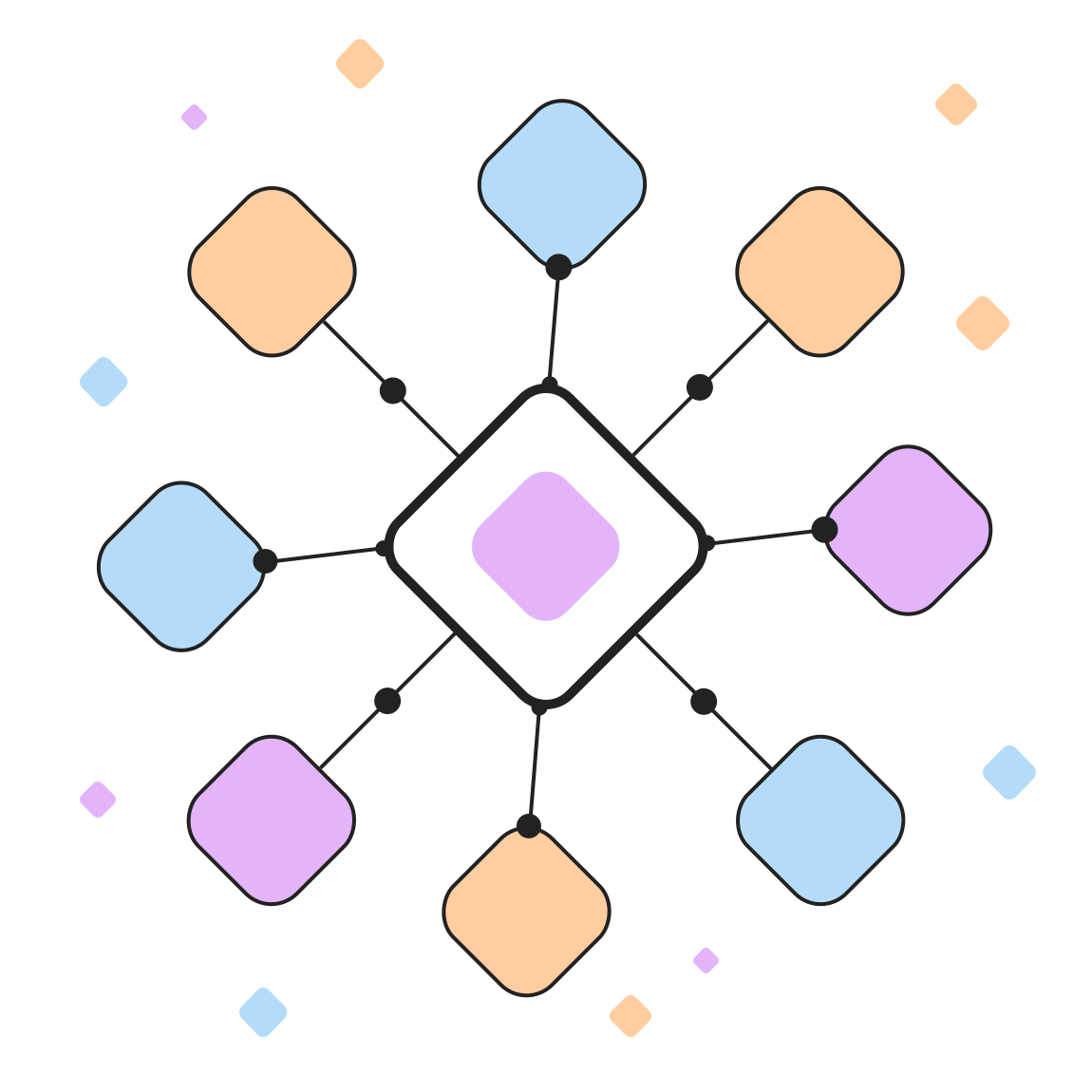
RPC Fast has everything DeFi needs on each maturity stage: from Start and Focus for RPC workloads, to Stream for Yellowstone gRPC, to Aperture for Shredstream and Aperture access.

Dedicated infrastructure is the next step when shared limits or topology become the bottleneck.

Match the RPC layer to your DeFi maturity stage

Do not upgrade because the protocol has more users. Upgrade when the infrastructure problem changes.
1

Prototype

Typical workload

Basic reads, swaps, test transactions

Start
What changes

Standard JSON-RPC and lightweight WebSockets

2

Early production

Typical workload

Token discovery, protocol state, heavier reads

Focus
What changes

Heavy RPC methods and higher request limits

3

Real-time DeFi

Typical workload

Live pricing, monitoring, indexing, event-driven backend

Stream
What changes

Yellowstone gRPC and more WebSocket capacity

4

Latency-sensitive execution

Typical workload

Liquidations, arbitrage, routing, HFT-style DeFi

Aperture
What changes

Shredstream, Aperture, higher stream capacity

5

High-scale infrastructure

Typical workload

Custom indexing, isolation, sustained heavy load

Dedicated node
What changes

Isolated hardware, custom plugins, node-level tuning

6

Business-critical DeFi

Typical workload

Multi-node resilience and failover

HA cluster
What changes

Load balancing, redundancy, geo-distribution
Mizar Case Study
All-in-one CeFi+DeFi trading platform • Cross-chain • Millions of daily requests
Learn more

Before

  • No prod-ready Solana/Base nodes; launch needed in days
  • Risk of missed events and analytics lag
  • Limited observability; manual ops across chains
  • Provisioning delays & hardware lead times

After

  • 2× Base + 1× Solana live in 2–3 days
  • Yellowstone gRPC + bloXroute/Jito → lower latency
  • Pre-synced spares → ~15-min node swap/scale
  • Hybrid bare metal + cloud, Grafana & custom gRPC proxy for observability

Built for DeFi systems where state and execution matter

Sync arrows icon
DEXs
Live pool state, swaps, simulation, and transaction submission.
Liquidation engines

React to account changes and submit time-sensitive liquidation transactions.
DEX aggregators
Fast account data and structured streams for quote and route updates.
Trading terminals
Combine real-time market state with simulation and execution infrastructure.
Lending protocols
Track collateral, positions, oracle-related state, and transaction status.
Bot icon
DeFi automation

Support rebalancing, keepers, arbitrage, and other event-driven on-chain strategies.

OWN THE STATE-TO-EXECUTION PATH

Ready to react before stale state becomes failed execution?

Run reads, real-time Solana streams, simulation, and transaction delivery through one RPC stack—then add Yellowstone, Shredstream, Aperture, Beam, or dedicated infrastructure as your DeFi workload becomes more latency-sensitive.

The related cases and guides

1/1
Guide

Written by:

Maksym Bogdan

Date:

16 Jul 26

13

min read

Guide

Written by:

Olha Diachuk

Date:

05 Jun 26

13

min read

Guide

Written by:

Maksym Bogdan

Date:

12 Mar 26

9

min read

Infrastructure

Written by:

Olha Diachuk

Date:

22 May 25

8

min read

FAQ

What is DeFi on Solana and Why Does It Need Fast RPC?

DeFi (Decentralized Finance) includes swaps, lending, yield farming, and liquidity provision on Solana. Fast RPC is critical because DeFi operations are time-sensitive: swap prices change every 100-200ms, liquidations happen instantly, and MEV bots hunt opportunities. Slow RPC = worse execution prices and missed opportunities.

What Latency Does DeFi on Solana Require?

Latency Viability Use Case
<50ms ✅ Excellent Traders, arbitrage, liquidations
50-100ms ✅ Good Swaps, LP provision
100-300ms ⚠️ Acceptable Casual users, long-term positions
300ms+ ❌ Poor Slippage too high, unprofitable

RPC Fast delivers sub-40ms—optimal for all DeFi activities.

How Do I Execute a Swap on Solana With Fast RPC?

  1. Query pool reserves from RPC (current prices);
  2. Calculate output amount (how many tokens you get);
  3. Check slippage tolerance;
  4. Build transaction;
  5. Sign locally;
  6. Send via RPC;
  7. Monitor confirmation.


Takes ~500ms total with fast RPC.

How Does Lending/Borrowing Work on Solana DeFi?

  1. Deposit collateral (e.g., SOL);
  2. Borrow assets (e.g., USDC);
  3. Interest accrues continuously;
  4. If collateral value drops too much, liquidation occurs;
  5. Fast RPC critical to avoid surprise liquidations.


Why fast RPC:
Price drops happen instantly. You need real-time collateral monitoring to add collateral before liquidation.

What's Yield Farming and How Does RPC Help?

Yield farming = deposit LP tokens to earn additional rewards. ROI varies constantly. Fast RPC lets you:

  • Monitor yield rates in real-time;
  • Switch between protocols quickly if yields drop;
  • Harvest rewards at optimal times;
  • Rebalance positions without delays.

What's Price Impact and How Does It Differ From Slippage?

Price Impact: Market moves due to YOUR trade size (permanent).

Slippage:
Price changes between quote and execution (temporary).


Example $10,000 swap:

  • Price impact: Pool price shifts +$0.01
  • Slippage: By execution, pool price is +$0.02
  • Total cost: $0.03 per token


Larger orders = higher price impact (unavoidable). Fast RPC minimizes slippage.

What Are the Main DeFi Protocols on Solana?

  • Swap/DEX: Raydium, Orca, Jupiter, Magic Eden
  • Lending: Solend, Lending Pool, Mango Markets
  • Yield Farming: Raydium, Orca, Jupiter LP rewards
  • Staking: Marinade (liquid staking), Lido
  • Derivatives: Mango Markets, PerpFi, Drift Protocol
  • Aggregators: Jupiter (best swap routes), 1inch equivalent

How Does Slippage Affect DeFi on Solana?

Slippage = difference between expected and actual execution price. Example: Expect $100 USDC → 1000 COPE, but get 950 COPE due to price movement. Slow RPC increases slippage 5-20%. Fast RPC minimizes slippage to 0.5-2%.

Impact: Every 0.1% slippage on $1000 = $1 loss. 100 trades × $1 = $100/month cost.

What Real-Time Data Do DeFi Users Need From RPC?

Pool reserves (to calculate prices), swap rates, liquidity depths, token balances, transaction history, on-chain events (swaps, deposits, withdrawals), gas prices, and network congestion. Updated continuously for active traders.

What's Liquidity Provision and Why Is Speed Important?

LP = depositing equal value of two tokens into a pool. Earn fees from trades but face impermanent loss. Speed matters because:

  • Impermanent loss changes every block;
  • Fast RPC lets you monitor and rebalance quickly;
  • Slow RPC means you miss optimal entry/exit times.

What Are Flash Loans and Do I Need Fast RPC?

Flash loans = borrow large amounts with zero collateral, must repay in same transaction. Used for arbitrage, liquidations, and protocol exploits. Fast RPC essential because you must analyze opportunity, execute multiple swaps, and repay within milliseconds.

How Do I Monitor Lending Protocol Health With RPC?

Query:

  • Your collateral ratio (deposited / borrowed);
  • Liquidation price (at what price do you get liquidated);
  • Available liquidity in protocol;
  • Interest rates.


Update every 10-30 seconds for safety. Fast RPC means more frequent, cheaper checks.

How Do I Reduce Slippage on Large Swaps?

  1. Use swap aggregators (Jupiter finds best route);
  2. Split into smaller orders (reduces price impact);
  3. Use limit orders (wait for better price);
  4. Check liquidity depth before swapping;
  5. Use fast RPC for instant execution.

Combination of these reduces slippage 50-80%.

We use cookies to personalize your experience