SOLANA RPC COMMUNITY
Built for Solana builders.Run by operators.
Join builders running HFT bots, DEX tools, and AI agents on Solana.
Join Discord

Special offers

Live support

No spam

SOLANA RPC COMMUNITY
Built for Solana builders.Run by operators.
Join builders running HFT bots, DEX tools, and AI agents on Solana.
Join DiscordSpecial offers
Live support
No spam
Solana RPC for market makers, built for desks priced off what they see before the block confirms, engineered to surface price events sooner, keep the tail tight rather than the median, and hold inclusion when a cancel has to land.
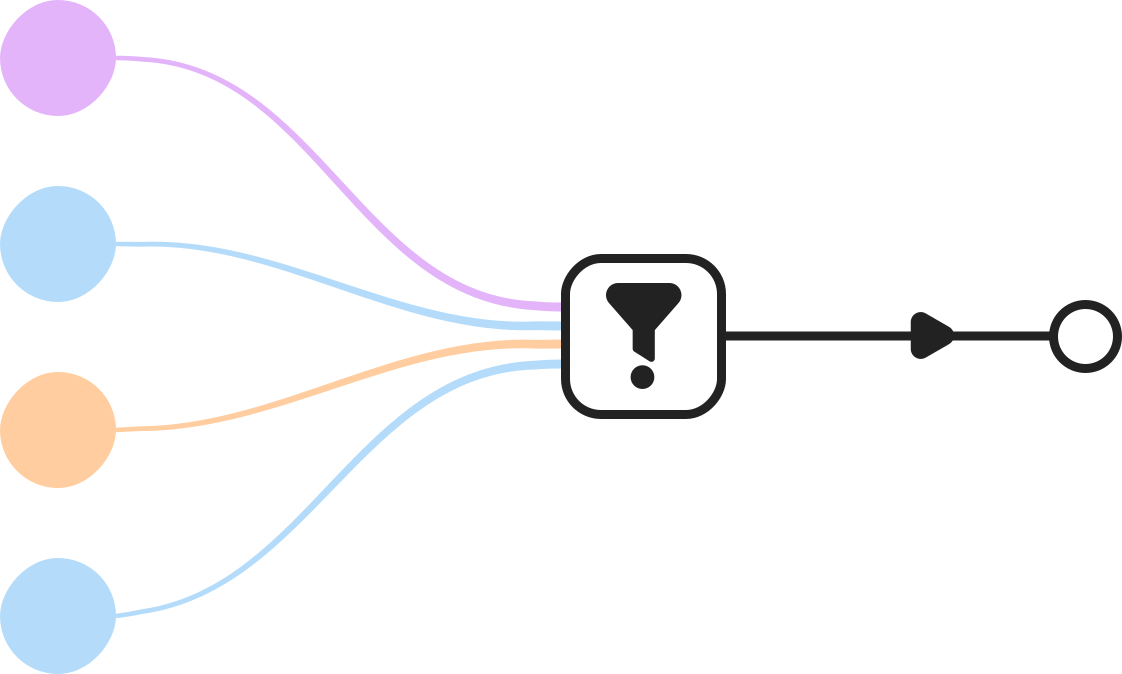
Unlike generic RPC polling or delayed WebSocket feeds, Aperture TxStream taps into native raw shred ingestion and streams decoded, filterable swap instructions over one production-ready gRPC interface.

P95 lead of 35.5 ms over Yellowstone gRPC

197–231 µs median lead over shredded streams

Batches of up to 64 transactions, with an index field to restore order

Decoded instructions with lookup tables already resolved

Server-side filters on the accounts and programs you quote against

Beam delivery in beta, fastest or MEV-protected routing
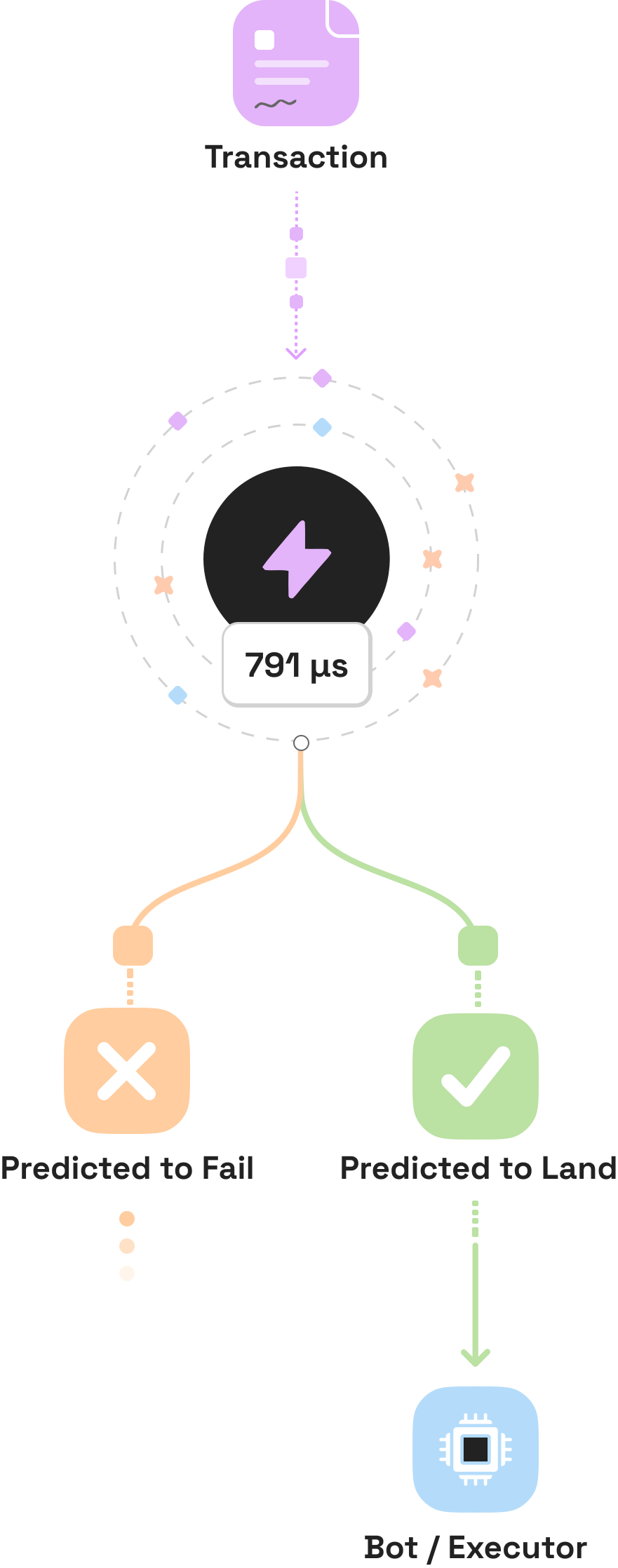

1

The transaction that moves your reference price enters the shred pipeline
2

Stream reconstructs and decodes it server-side
3

The prediction is attached at 791 µs for full payload, 832 µs for signatures only
4

Your pricing model recomputes the quote against flow seen before confirmation
5

The requote goes out through Beam, up to 500 transactions per minute

vs Jito ShredStream, signatures only
77.6%
of races — TxStream first
vs Jito ShredStream, full payload
75.6%
of races — TxStream first
vs Yellowstone gRPC
99.97%
of races — TxStream first


LEAD SOLANA. OWN THE TRADE
Ready to compete on the tail, not the average?
Access tuned RPC, gRPC, and trading-grade streams from day one.
FAQ
An RPC endpoint is the API connection between your bot and the Solana blockchain. For a market maker it delivers the things you cannot trade without: liquidity pool state, current prices, volume, and the ability to post and cancel orders quickly.
The connection speed translates directly into how tight a spread you can hold. Think of it as your terminal's line to the exchange floor — the quality of that line sets the quality of everything you do through it.
Market making profits from the spread, and on a roughly 400ms block time that spread is repriced constantly. On a slow endpoint, by the time you see the price move, faster competitors have already updated their quotes. You are left either holding inventory you did not want or missing the fill entirely.
On a fast endpoint you react to the same move immediately, adjust your spread, and capture it before others do. In high-volume trading, being 50 to 100ms behind costs thousands a day. The endpoint is not overhead here; it is the revenue engine.
Solana's free public endpoint runs above a second of latency, caps you at roughly 200 requests per minute, shares bandwidth with everyone else using it, offers no mempool or liquidity monitoring, and becomes least reliable exactly when volume spikes. A market maker cannot compete on that.
A dedicated endpoint like RPC Fast gives sub-40ms latency, request volume matched to your plan rather than an arbitrary cap, private bandwidth, real-time liquidity and mempool feeds, and a 99.9% uptime SLA. For this workload, dedicated is not an upgrade — it is the entry requirement.
Take a token trading at $0.10. A maker on an 800ms connection sees the price update late, posts a buy at $0.099 and a sell at $0.101, and by then the market has already moved. Their quotes are stale the moment they land, so they get picked off by whoever was faster.
A maker on a 40ms connection sees the same update almost immediately, gets orders in ahead of the slower participants, and captures the spread repeatedly across the day. Same strategy, same pair, opposite outcome — the difference is entirely where each sat in the queue.
It scales with how many pairs you quote, because each one needs price checks, liquidity monitoring, and order placement and cancellation:
Pending transaction flow tells you what is about to happen rather than what already did. Makers use it to spot large swaps and adjust spreads before they land, read whale activity as a directional hint, see sandwich attacks forming and widen defensively, and catch liquidations or cross-DEX discrepancies worth arbitraging.
The defensive use matters as much as the offensive one. Seeing an attack coming is what lets you avoid being the one it lands on.
It means continuously watching pool reserves and volume rather than sampling them occasionally. That data answers four questions you need answered constantly: whether liquidity on a pair is drying up and spreads should widen, how volatile conditions currently are, how much your own order will move the price, and how many other makers are active in the same book.
Without it you are quoting blind, which usually shows up as spreads that were correct twenty minutes ago.
Yes, provided the throughput covers it. A typical setup might run tight spreads on one high-frequency pair, wider spreads on a slower one, and a cross-DEX arbitrage strategy alongside both — all on a single connection at Pro tier or above.
You can also generate multiple API keys to isolate strategies from each other, which is worth doing for risk management even when one connection would handle the load.
RPC Fast runs from a free tier for testing up through Starter, Pro and Enterprise plans, the top of which is priced for high-volume professional operations.
Running your own node means hardware upfront, then hosting, bandwidth and electricity every month, plus twenty or more hours of your time on maintenance. Add it up and the managed option is several times cheaper, deploys in minutes instead of days, and leaves you working on strategy rather than infrastructure.
Yes, and for market making it is the mode you want. Polling over REST means your bot repeatedly asks for the price and waits for an answer, which wastes requests and adds latency to every cycle. WebSocket pushes updates to you the moment they happen.
In practice that means response times in the tens of milliseconds rather than over a hundred, less computational overhead, lower bandwidth use, and better spread capture as a result. It is included on all plans.


.jpg)


.jpg)