





Most “fast Solana RPC” pieces still mainly target general developers. They highlight free tiers and request quotas, multi-chain support, or basics like documentation and SDKs. Important, but not what keeps a trading desk in business.
For a market maker, the critical questions look different:
- How stale is my view of the orderbook versus the network tip?
- What is the P95/P99 latency for cancels and replaces during volatility?
- How does the provider behave under Solana congestion or fee-market spikes?
- How do they support Jito bundles, SWQoS, and co-location?
You saw this play out during major Solana congestion events and meme seasons. Shared endpoints for some providers may experience sharp latency spikes and 429/5xx bursts, while dedicated and staked setups maintain stable tails.
Most lists also ignore failure modes:
- Slot divergence between providers
- Inconsistent results from
getProgramAccountsunder load - Hidden rate limits on
sendTransactionduring peak traffic
A ranking that doesn’t cover these is not a ranking for trading desks. So, this article fixes those misleading optics. Not “top RPCs for dApps,” but which Solana RPC setups in 2026 protect your PnL when everyone rushes the door at once.
Top RPC providers for market makers
For trading desks, the question is less “who has the nicest docs” and more “who gives my bots the cleanest, fastest path to the leader with the least variance.”
Here is a high-level view focused on market-making use cases:
| Provider | Primary edge for market makers | Typical fit |
|---|---|---|
| RPC Fast | Dedicated, co-located Solana nodes, shred/gRPC, multi-path landing; per-method latency from ~2–3 ms on light reads to 25–35 ms on heavy account reads | HFT desks, copy-trading bots, active MM |
| Triton | Yellowstone gRPC, rich streaming, performance-obsessed infra | Large desks with strong internal DevOps |
| Helius | Trading-focused APIs, LaserStream, Sender, great tooling | Teams that want strong APIs plus speed |
| ERPC | Highly distributed edges, low global latency | Global arb, experimental latency-sensitive |
More details on each:
RPC Fast
RPC Fast focuses on dedicated Solana nodes and co-located infrastructure for trading desks. The design goal is simple: keep node processing, network hops, and queuing overhead to a minimum.
Key points for market makers:
- Dedicated hardware and queues, not shared “pro” tiers
- Co-location in hubs such as Frankfurt and Ashburn
- Shred-level data streams and Yellowstone gRPC options
- Support for multi-path transaction landing with partners (e.g., BloXroute, Fastlane)
Triton One
Triton maintains a strong position with validators optimized for speed and its Yellowstone gRPC stack. For desks that want to run very custom data pipelines, Triton’s gRPC and documentation are a strong fit.
- High-throughput streams for orderbooks and program changes
- Strong engineering focus and transparent benchmarking culture
Helius
Helius provides a nice balance between developer ergonomics and trading features. LaserStream and Sender align with trading needs, and their APIs simplify many integration tasks.
- Great for teams who want strong APIs, webhooks, and indexing
- Gatekeeper and related trading products target low-latency tx landing
ERPC
ERPC pushes a large edge footprint, which helps global strategies reduce last-mile latency. For now, most serious desks treat them as part of a multi-RPC ensemble rather than a sole provider.
The three core jobs an RPC must solve for market makers
A 2026-ready market-making stack expects its RPC layer to do three jobs well.
- Fresh, stable reads
Your pricing and risk engines depend on real-time views from getProgramAccounts, getAccountInfo, and gRPC streams. If your node trails the tip by several slots or your stream freezes, you quote against a stale book and donate edge.
- Predictable write-path latency
In practice, most of your risk control is cancel latency. RPCs that show attractive averages but unstable tails create landmines: P99 spikes when volume surges. A dedicated, co-located node with SWQoS and Jito integration pushes those tails down and makes your worst cases survivable.
- Resilience under stress
When NFTs mint, meme coins launch, or liquidations cascade, public RPCs often become the weakest link. Professional setups isolate trading traffic on dedicated clusters, avoid archive workloads on live nodes, and implement clear brownout rules when error rates or slot lag exceed thresholds.
For more context on how infrastructure affects trading strategies, see:
Case study: Low-latency copy-trading bot on RPC Fast
A recent 2026 case describes a Rust-based copy-trading bot built for Solana meme coin trading. The goal was single-slot or +1 slot execution when following high-profile wallets.
The setup:
- Language: Rust
- Node provider: RPC Fast dedicated Solana node
- Location: Co-located VPS and node in Frankfurt, a major Solana hub
- Data ingestion: Yellowstone gRPC, Jito shred stream
- Tx landing: Helius Sender, BloXroute, QuickNode Fastlane in parallel
The architecture focuses on a tight loop: detect → decode → decide → fire.
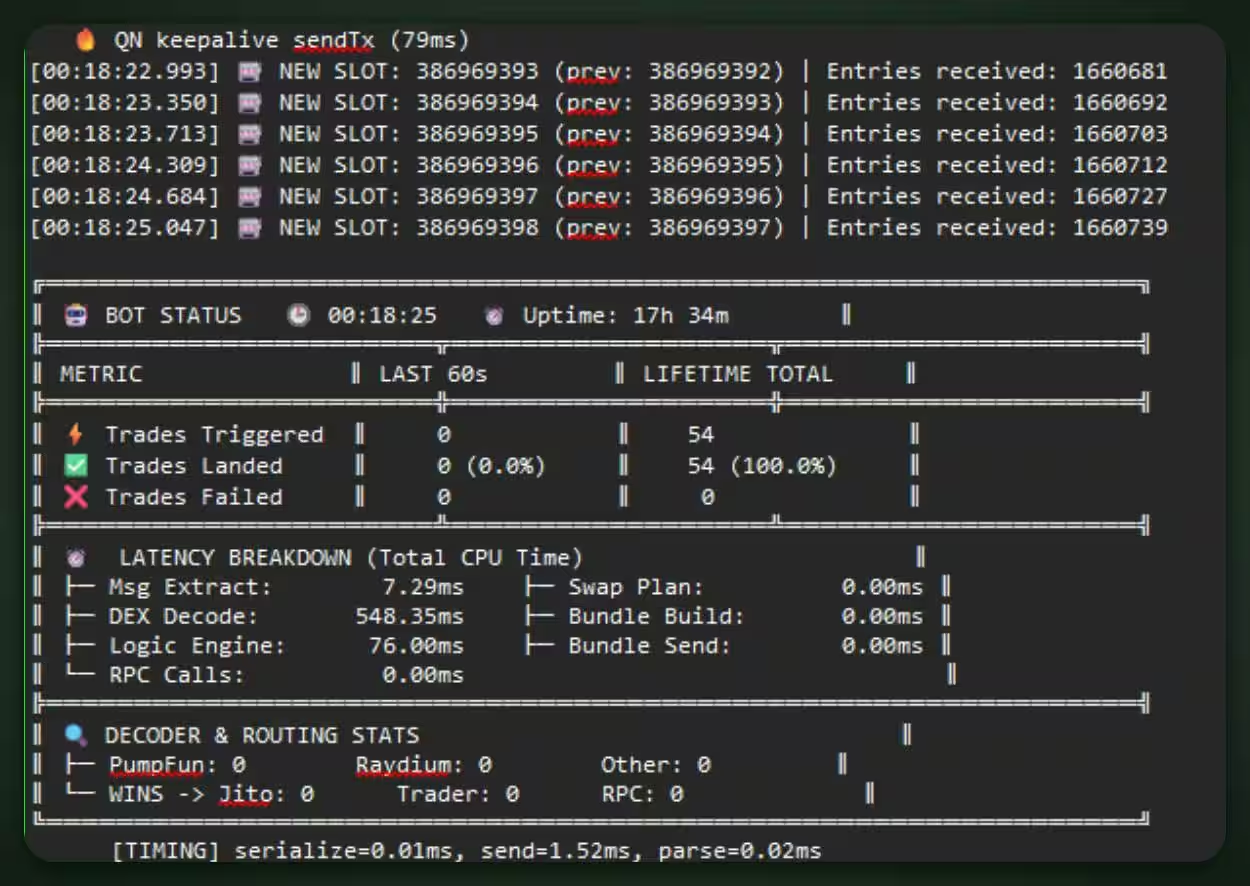
Key metrics from the case, see full details here:
- Node response under load: sub-1 ms during 100,000-call stress tests
- Landing latency: typical 200–300 ms, best around 15 ms
- Execution pattern: same-slot or +1-slot fills relative to the target wallet
- Uptime: only 2–3 short hiccups of a few seconds over three months, tracked via Telegram alerts
This is not a classic market-making engine, but the requirements are very similar: see keyflows first and react before the pack. The path that delivers same-slot or +1-slot copy trades is the same path that lands cancels on time in volatile markets.
Practical 2026 architecture for market makers
A realistic yet strong pattern for a 2026 Solana MM stack using the offers of the mentioned providers:
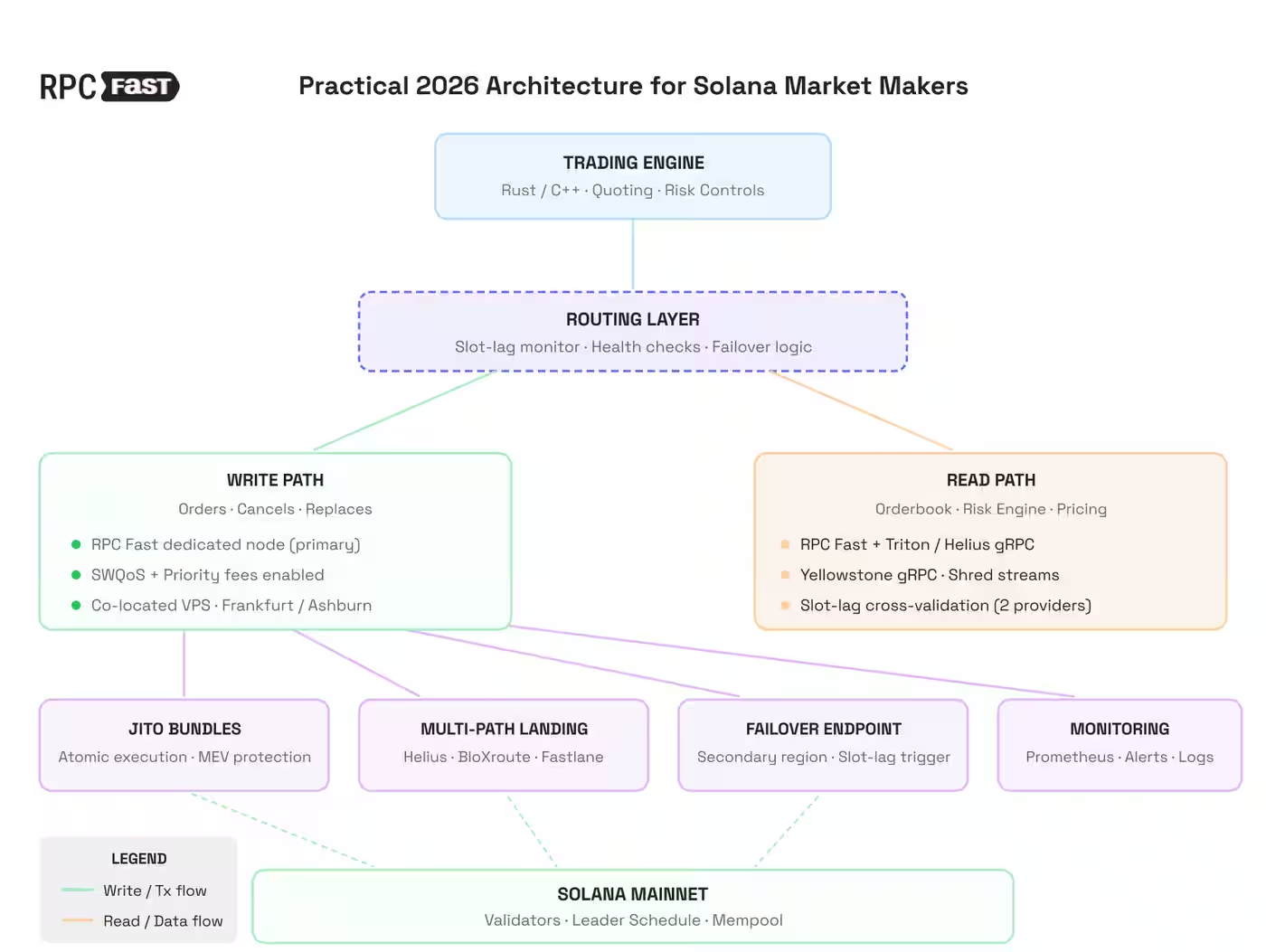
Separate reads and writes
- Reads: One or more providers with strong gRPC and indexing (e.g., Triton, Helius, plus RPC Fast read endpoints).
- Writes: Dedicated RPC Fast node in the same region as your trading engine, tuned for minimal jitter.
Multi-RPC routing and health checks
- Monitor: slot height, P95 latency, error rates per provider.
- Switch: if your primary write node lags by more than N slots or errors exceed a threshold, shift to an alternate endpoint.
- Cross-validate: use a second provider’s slot view to detect divergence.
Jito bundles and SWQoS
- For critical trades and cancels, submit through Jito bundles and stake-weighted QoS-enabled paths.
- Keep historical or research workloads off the live trading node; use separate archive endpoints or datasets.
RPC evaluation checklist for trading teams
When you evaluate or renegotiate your RPC setup, ask for:
- P50/P95/P99 latency for
sendTransactionandgetProgramAccountsfrom your exact region - Slot-lag guarantees and real-time metrics access
- Dedicated vs shared infrastructure, including noisy-neighbor isolation
- SWQoS support and any integration with Jito, Fastlane, or similar landing paths
- Clear rules for rate limits and congestion behavior
- Observability: per-client dashboards, webhook alerts, and logs
- Incident history and communication practices from 2022–2025
For a deeper checklist and example SLOs, see:
Where this leaves a market maker in 2026
In 2026, Solana market makers do not win on raw idea alone. They win on who sees the chain freshest, who gets cancels in first, and whose write-path tails stay flat when volatility hits.
Dedicated, co-located nodes like those used in the copy-trading case study show what “infrastructure as an edge” looks like in practice. You can apply the same pattern to quoting engines, arbitrage bots, and inventory risk systems.
Where RPC Fast fits: shared plans or a dedicated node
RPC Fast sells shared SaaS plans and dedicated Solana nodes, and a market-making desk can start on either.
Shared SaaS plans start at $0 with no credit card, so you can point a bot at an endpoint and measure your own P95 before committing to anything. Plans and limits are on the pricing page. On the top Aperture plan, Aperture TxStream also attaches a predicted execution result to each transaction while it is still in flight — roughly 95% accurate against actual execution, at a cost of +791 µs on median delivery — so a quoting engine can judge an order before it lands.
Dedicated nodes start at $2,200/month — bare-metal server, setup and maintenance included, delivered within 72 hours. That is the line the copy-trading case above ran on, and the one that carries co-location and no rate limits: dedicated Solana nodes.
Both lines run at 99.99% uptime. When shared capacity stops being the constraint, the top-end latency work happens on the dedicated side.
Questions about market-making infrastructure? RPC Fast engineers answer in the chat
Join the RPC Fast Solana chat.jpg)


.jpg)


