





.jpg)
RPC Fast is the strongest Helius alternative for Solana trading bots, HFT, MEV, and high-load backends that need direct RPC reads, Yellowstone gRPC, earlier transaction streams, multiple delivery routes, and managed dedicated infrastructure in one stack. OrbitFlare fits teams seeking no-credit RPC plans, Jetstream, raw shreds, and a Solana-specific landing product. Shyft fits teams prioritizing unmetered gRPC, RabbitStream, GraphQL, callbacks, and application APIs.
ERPC fits region-sensitive systems that want modular RPC, gRPC, direct shreds, SWQoS, and colocated compute. Triton One fits mature indexing and streaming pipelines built around Dragon's Mouth, Fumarole, and Cascade. Shreder fits teams buying the data feed itself: raw shreds, decoded shreds, Binary, preconfirmations, or Yellowstone-compatible Fastlane.
There is no universal Helius replacement. The right choice depends on whether your bottleneck is API breadth, stream completeness, pre-execution signal, transaction landing, network locality, dedicated-node control, or cost per successful outcome.
Why consider a Helius alternative?
Helius already covers most of the Solana infrastructure stack. Its current platform includes RPC and archival methods, Gatekeeper edge routing, LaserStream gRPC and WebSockets, 24-hour replay, raw shreds, decoded preprocessed transactions, scheduler-level preconfirmations, Sender, staked connections, enhanced APIs, and dedicated nodes.
Mainnet LaserStream gRPC starts with the $499 Business plan, raw shreds cost $1,000 per month per IP or $800 on Professional, and dedicated nodes start at $2,900 per month.

A different provider becomes relevant when your workload needs:
- A lower or simpler streaming billing model.
- A customer-facing raw or decoded shred feed in another region.
- A second network path independent of Helius.
- Dedicated bare metal below Helius's entry price.
- A separate SWQoS route for transaction failover.
- Stronger historical-stream persistence or consumer-group semantics.
- Full-stack infrastructure without Helius-specific APIs.
- A specialist data feed without bundled RPC or application APIs.
An alternative does not need to replace every Helius service. Production systems often split direct reads, structured streams, pre-execution data, transaction submission, and confirmation across independent providers. This reduces correlated failures and assigns each workload to infrastructure designed for it.
Methodology: How we compared Helius alternatives
This comparison uses current public documentation, pricing pages, and product specifications. No controlled cross-provider benchmark covers every vendor under identical client regions, filters, commitment levels, network paths, and traffic periods. Provider-published latency results are treated as vendor benchmarks, not universal rankings.
We evaluated six areas:
- JSON-RPC, WebSockets, heavy methods, and historical access;
- Yellowstone-compatible gRPC, replay, and stream recovery;
- Raw shreds, decoded shreds, and pre-execution signals;
- SWQoS, Jito, specialized senders, and route diversity;
- Shared, dedicated, and high-availability infrastructure;
- Pricing model and strongest production workload.
Four distinctions matter:
- Provider-side Shredstream acceleration is not the same as raw shreds delivered to your application.
- Pre-execution transaction data lacks runtime outputs such as logs, inner instructions, balance changes, and final status.
- A staked
sendTransactionendpoint is not equivalent to a multi-path sender that broadcasts through several networks. - Fast acknowledgment is not transaction success. Landing rate, confirmed slot, expiry rate, and total landed cost matter more.
.jpg)
Helius alternatives: Comprehensive comparison table
Helius baseline: Best self-service product breadth
Helius remains a strong default for Solana-native teams that want one account for RPC, enhanced data APIs, streaming, early transaction feeds, and sending. Gatekeeper shortens the request path through Helius's edge network. LaserStream supplies Yellowstone-compatible streaming with automatic recovery and 24-hour replay. Shred Delivery adds raw UDP shreds and preprocessed transactions, while Pre Confirmations exposes scheduler-level signals before shreds exist.
Sender broadcasts through Helius, Jito, Harmonic, Rakurai, and other routes. The SWQoS-only path starts at a 0.000005 SOL minimum tip, while Sender Max requires at least 0.001 SOL. Sender is available on every plan and does not consume API credits.
Best for:
- Wallets, explorers, exchanges, and token applications
- Teams using DAS, enhanced transactions, webhooks, and archives
- Trading systems that want self-service early data and multi-path sending
- Organizations preferring one Solana-specific vendor relationship
Trade-offs: Helius uses several billing dimensions: monthly credits, RPC limits, streaming data, shred seats, and transaction tips. Preconfirmations and preprocessed transactions are early signals, not execution outcomes. Raw-shred consumers still own packet handling, reconstruction, deduplication, and reconciliation.
Landing-cost micro-case
At 100,000 monthly submissions, the minimum route tip alone equals 0.5 SOL on the SWQoS-only path versus 100 SOL on Sender Max, before priority fees. That 200x spread makes cost per landed transaction a better metric than plan price or acknowledgment latency.
RPC Fast: Best for integrated Solana execution infrastructure
RPC Fast combines JSON-RPC, WebSockets, Yellowstone gRPC, Shredstream gRPC, Aperture, Beam, dedicated nodes, and HA clusters. The platform separates direct reads, structured streaming, pre-execution signals, transaction routes, and dedicated infrastructure instead of presenting them as interchangeable API features.
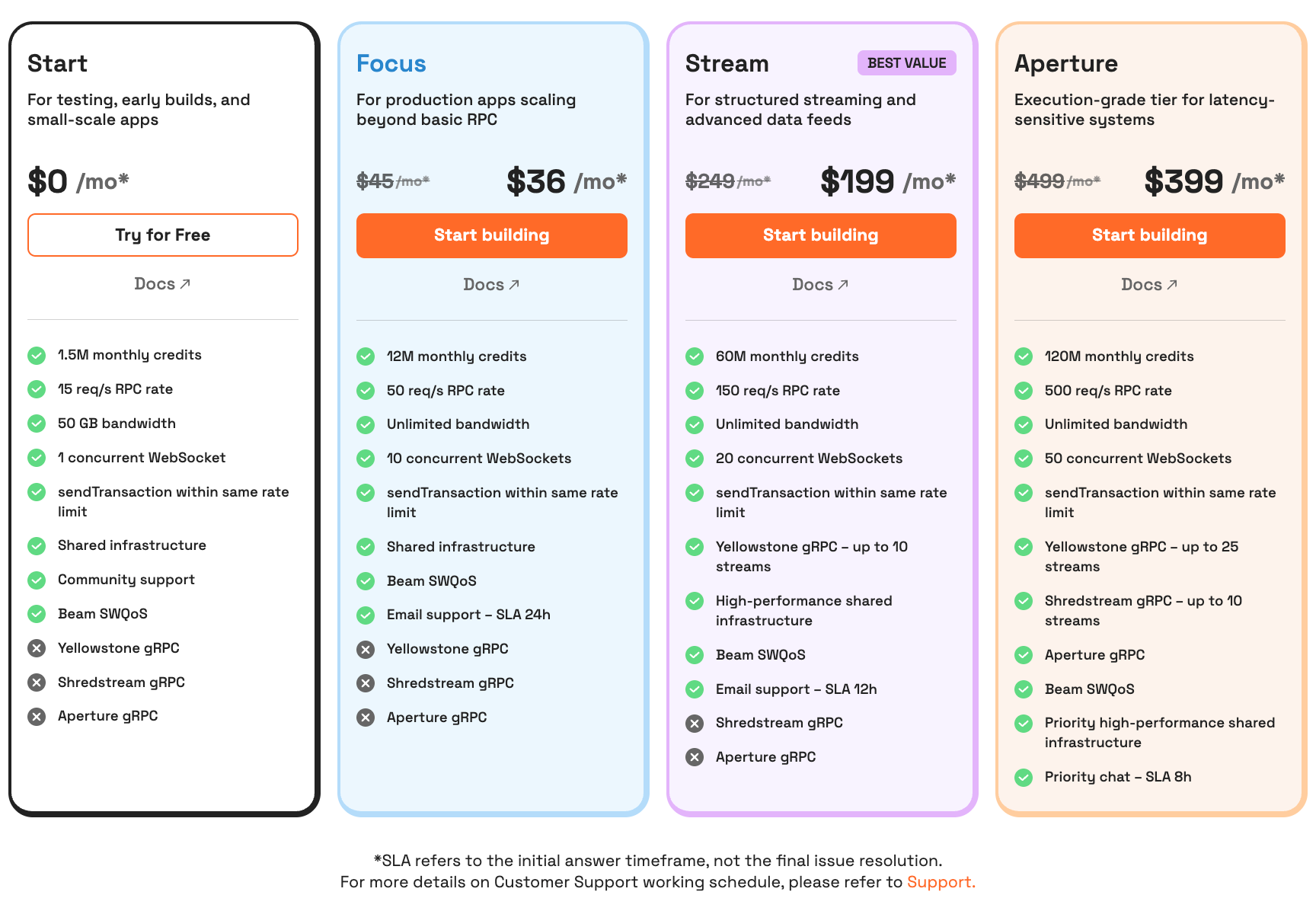
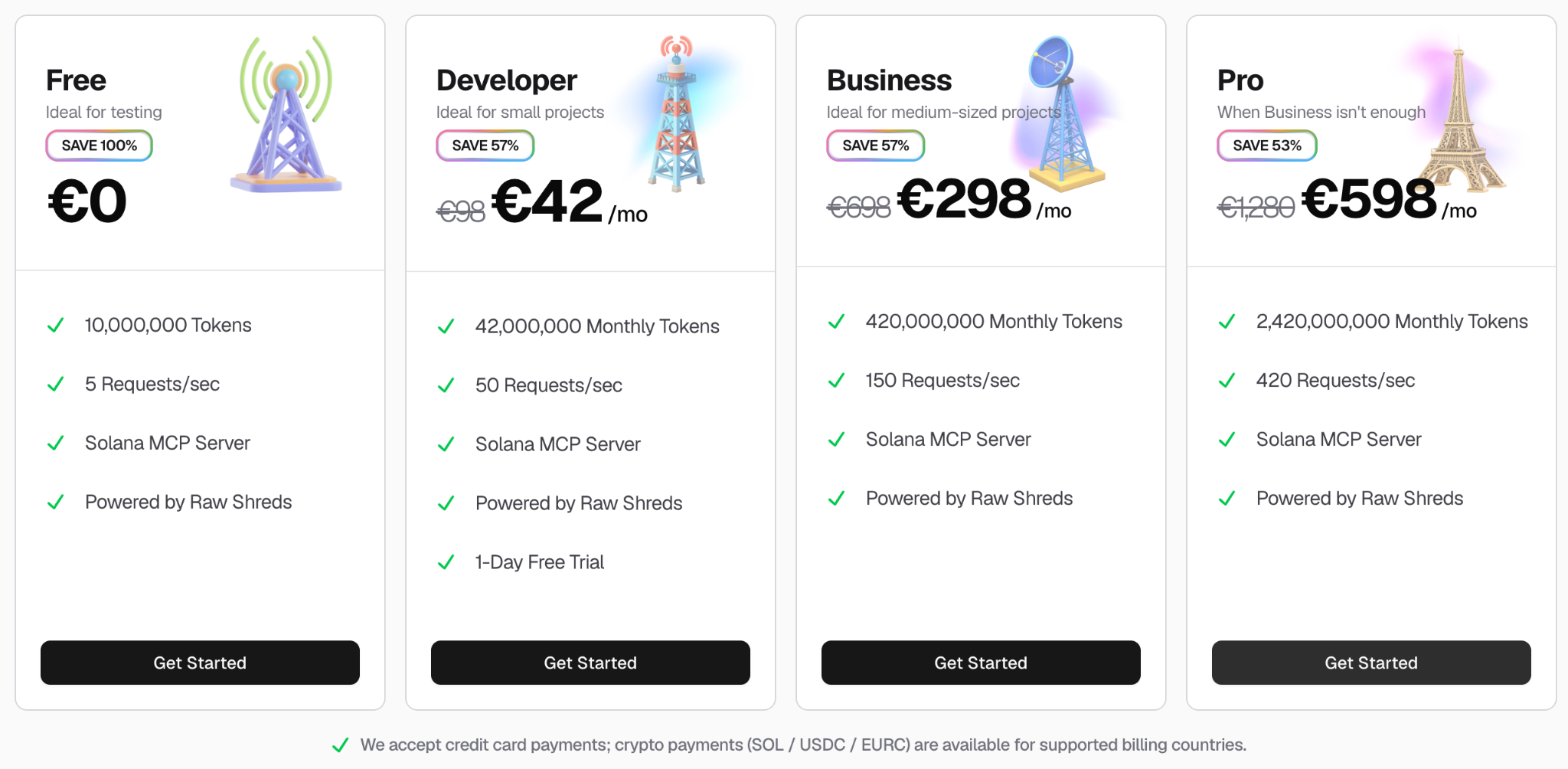
The shared tiers are: Start at $0, Focus at $45, Stream at $249, and Aperture at $499. Yellowstone starts with Stream. Shredstream and Aperture access sit in the Aperture tier. Paid plans include unlimited bandwidth, while usage is controlled through Compute Units and stream limits.
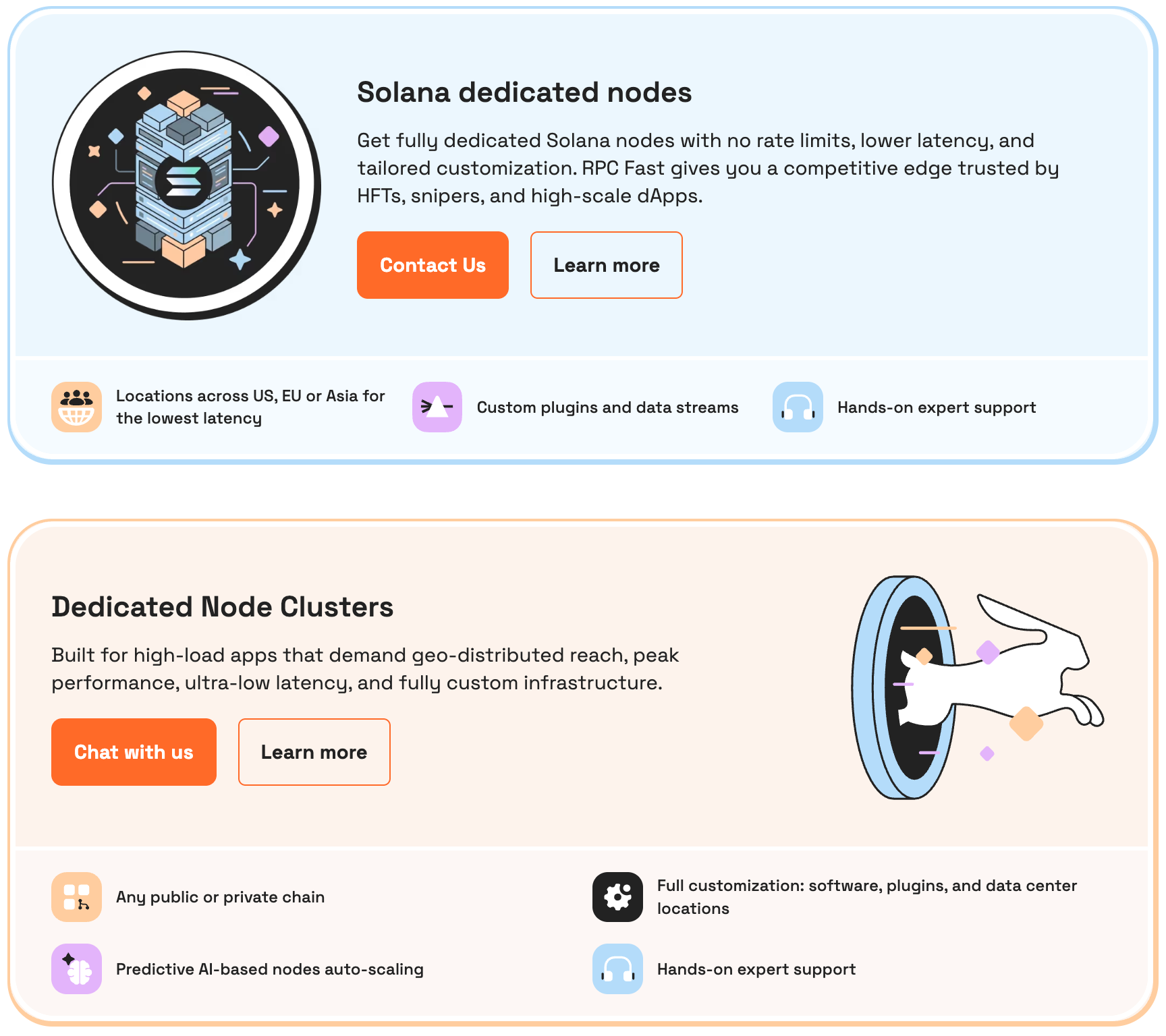
Dedicated Solana nodes start at $2,200 per month in the EU for 512 GB RAM and support Yellowstone, Jito ShredStream, custom tooling, and performance tuning. HA clusters add multiple bare-metal servers, load balancing, geo-distribution, and failover.
Best for:
- Arbitrage, liquidation, copy-trading, and market-making systems.
- HFT and MEV infrastructure.
- Teams joining data ingestion and transaction execution.
- Custom dedicated or HA Solana infrastructure.
- Independent Helius stream or landing failover.
Trade-offs: Beam carries separate route fees, and Aperture requires an active plan rather than short-term trial access. Dedicated Solana nodes do not include historical archive data.
OrbitFlare: A fit for flat-rate Solana trading infrastructure
OrbitFlare offers Solana RPC, Yellowstone gRPC, Jetstream, raw UDP Shredstream, dedicated nodes, and Apex transaction landing. Jetstream provides transaction-only data from a shred-optimized path with account include, exclude, and required filters. Yellowstone retains full metadata for indexing and state-driven systems.

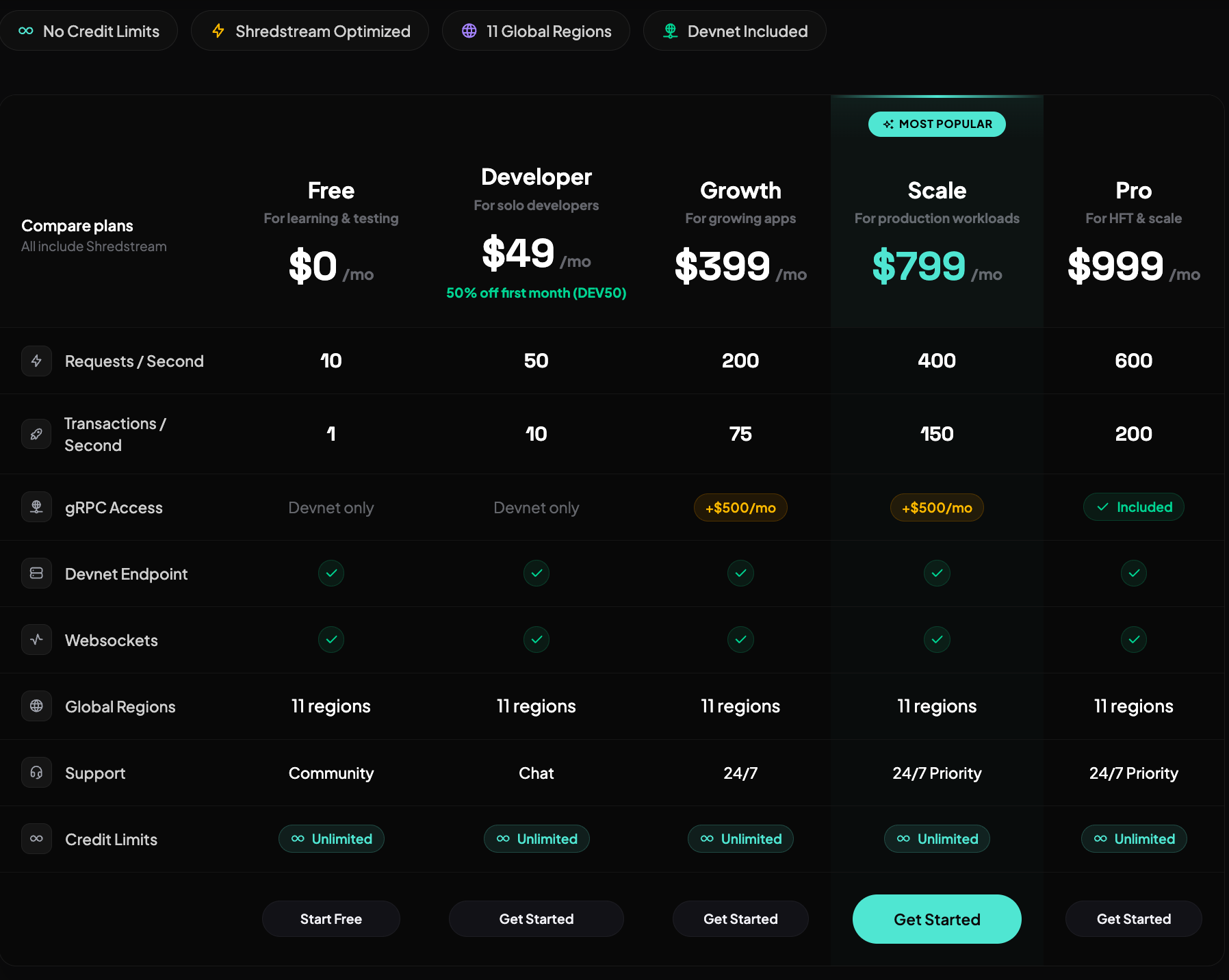
RPC plans run from free to $999 per month with unlimited requests inside the selected RPS limit. Shared Yellowstone or Jetstream costs $500 per month for one IP with unlimited streamed data. Standard raw-shred regions start at $500 per month; dedicated RPC starts at $2,500 and dedicated gRPC at $1,800.
Best for:
- Trading teams that prefer capacity limits over credit accounting.
- Bots needing decoded shred-level transactions and full Yellowstone in parallel.
- Teams seeking raw shreds across several regions.
- Solana-only infrastructure with a branded landing route.
Trade-offs: Jetstream omits execution metadata and inner instructions, so production systems still need Yellowstone or RPC for enrichment and final status. gRPC, raw shreds, RPC capacity, and dedicated infrastructure remain separate cost layers.
OrbitFlare's strongest latency claims come from its own benchmark material and require reproduction from the buyer's region.
Shyft: Good for unmetered gRPC plus application APIs
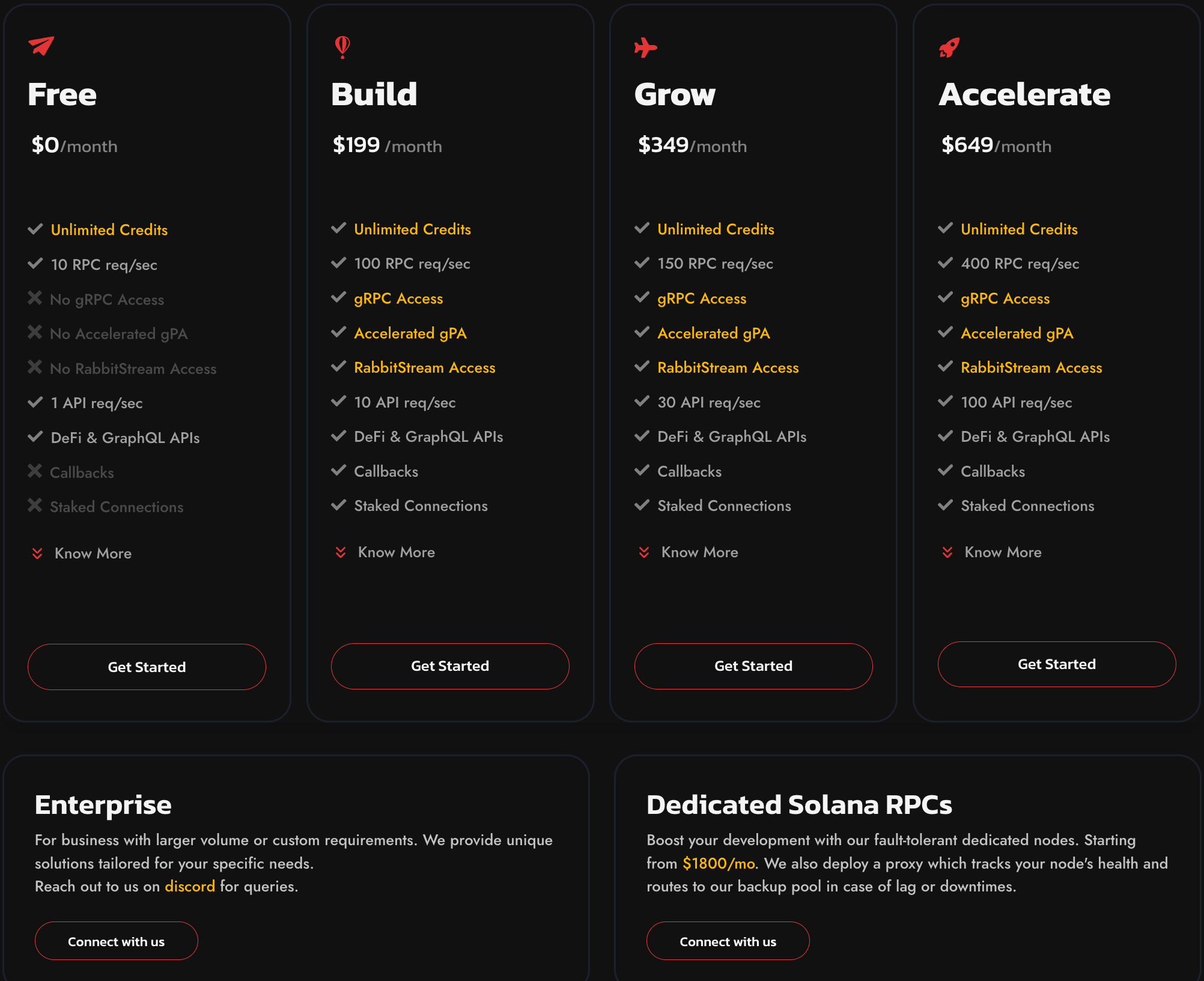
Shyft combines Solana RPC, Yellowstone gRPC, RabbitStream, DeFi and GraphQL APIs, callbacks, transaction history, and staked connections. Build costs $199 per month with 100 RPC requests per second; Grow costs $349 with 150 RPS; Accelerate costs $649 with 400 RPS. These plans list unlimited credits, gRPC access, RabbitStream, and staked connections.
Yellowstone supports transactions, accounts, and blocks with recent-slot recovery. RabbitStream listens to raw UDP shreds and emits pre-execution transactions. Its lighter payload trades completeness for earlier visibility: no runtime logs, inner instructions, errors, account streams, block streams, or slot filters.
Best for:
- Indexers and analytics backends using Yellowstone
- Application teams needing APIs, callbacks, and streaming together
- Trading bots that want an early transaction feed without a local decoder
- Teams seeking a no-credit streaming model
Trade-offs: Shyft does not document a specialized multi-path sender comparable to Helius Sender. RabbitStream needs Yellowstone or RPC reconciliation. Dedicated nodes start at $1,800, while higher-memory configurations raise the monthly cost.
ERPC: Best for locality and modular infrastructure
ERPC sells Solana RPC, Geyser gRPC, Direct Shreds, SWQoS, VPS, and bare-metal infrastructure as separate modules. Its model suits teams that want the subscriber, stream, and transaction route inside the same low-latency network rather than behind a general cloud edge.
Current monthly rates shown on the pricing page include shared gRPC from €198, Direct Shreds from €198, dedicated gRPC from €1,580, and dedicated RPC from €2,480. The page also lists discounted annual and hourly-equivalent figures, so buyers should compare the intended contract term rather than the largest discount badge.
ERPC's shared SWQoS allocation is tied to elSOL holdings, with one TPS per 4.2 elSOL within plan limits. Dedicated RPC customers add a 1,000 SOL staking allocation for €100 per month.
Best for:
- Latency-sensitive applications colocated near the provider edge.
- Teams assembling RPC, gRPC, shreds, compute, and SWQoS separately.
- Regional arbitrage and independent route diversity.
- Infrastructure teams comfortable with network-level tuning.
Trade-offs: The product catalog and discount model require careful normalization. SWQoS access depends on token allocation or a dedicated add-on, and no public Helius-style multi-path sender is documented.
Triton One: Fitting reliable and scalable streaming pipelines
Triton One maintains the Yellowstone gRPC project and operates Dragon's Mouth, a Geyser-fed service for accounts, transactions, entries, blocks, slots, and unary calls. It also exposes beta deshred transactions before validator execution. Replay from a recent slot supports short-disconnection recovery.
Fumarole targets a different requirement: persistence, multi-node stream merging, reconnect backfill, and horizontal scaling through consumer groups. It remains in limited beta. Cascade provides SWQoS-based transaction delivery through staked validators and is positioned for more predictable landing during congestion.
Best for:
- Full-fidelity indexers and data platforms
- Accounting, compliance, and analytics pipelines
- Teams needing replay, persistence, or consumer-group scaling
- Backend systems with dedicated infrastructure and direct support
- Solana teams that want the reference Yellowstone ecosystem
Trade-offs: Triton's shared RPC service targets frontend dApp traffic; backend scripts and bots require dedicated infrastructure. Public self-service pricing is limited, and Fumarole plus deshred subscriptions remain beta-stage products.
Shreder: Best for specialist Solana data feeds
Shreder focuses on streaming rather than broad RPC infrastructure. Its product line includes Raw Shreds over UDP, Decoded Shreds over gRPC, compact Binary transaction streams, validator-level preconfirmations, Regular Geyser, and shred-accelerated Fastlane. Five regions are listed for the main streaming products: Frankfurt, Amsterdam, New York, London, and Tokyo.

Pricing starts at 3 SOL per month for Regular Geyser, 8 SOL for Fastlane, 8 SOL for Decoded Shreds, and $1,000 for Binary. Raw Shreds use custom pricing. Plans include a trial and no credit accounting.
Best for:
- HFT, market making, searchers, and copy-trading signals
- Teams replacing only the Helius data layer
- Buyers comparing raw, decoded, compact binary, and Geyser formats
- Applications with a separate RPC and transaction-sending stack
Trade-offs: Shreder does not document a broad JSON-RPC platform, archive layer, dedicated application node, or transaction sender. Early feeds do not contain post-execution state, logs, balances, or final outcomes.
The provider publishes detailed head-to-head benchmarks, but those results still represent its selected locations, filters, and test windows.
Which Helius alternative fits your use case?
The selection changes with the bottleneck. A wallet values parsed data and reliable notifications. An indexer values complete streams and recovery. A liquidation bot values account freshness, blockhash age, and leader access. An HFT system values earlier signals, regional locality, and several independent submission routes.
.jpg)
Benchmark providers against your workload
Do not migrate based on an average latency number from a vendor page. Run each provider under identical conditions:
- Client host, region, and network interface
- RPC methods, concurrency, and payload sizes
- Yellowstone filters and commitment level
- Account lists for decoded or preconfirmation feeds
- TX construction and blockhash source
- Compute limit, priority fee, route tip, and retry policy
- Traffic window, including at least one congestion period
Metrics you’ll need to track
For RPC: record p50, p95, p99, error rate, slot distance, response size, and rate-limit events.
For Yellowstone: record first-seen timestamp, slot lag, reconnect time, replay behavior, missing events, duplicates, queue depth, and transaction coverage.
For raw shreds: record packet loss, out-of-order rate, FEC recovery, reconstruction time, deduplication cost, parse failures, and CPU per decoded transaction.
For early decoded feeds: record coverage against a complete post-execution source, filter accuracy, ALT resolution, missing metadata, and time-to-usable-signal.
For transaction delivery: record acknowledgment latency, confirmed slot, landing rate, blockhash expiry, failed simulation rate, priority fee, route tip, route identity, and total cost per landed transaction.
Subscriber capacity belongs in the benchmark. Triton reports full-chain stream spikes around 1.3–1.8 Gbps and recommends at least 5 Gbps network capacity for large subscriptions. A low-latency provider does not fix a consumer that falls behind, blocks on parsing, or drops updates under backpressure.
.jpg)
Recommended production architecture: Replace one Helius dependency at a time
A low-risk migration separates interfaces before moving traffic:
- Keep Helius RPC as the control path.
- Add the alternative Yellowstone endpoint with identical filters.
- Compare coverage, freshness, reconnects, and p99 variance.
- Add the alternative early feed and reconcile it against processed data.
- Add the alternative sender or SWQoS route in shadow mode.
- Split a small percentage of signed transactions across routes.
- Promote the new route only after landing rate and landed cost remain stable.
- Preserve an independent confirmation source.
This approach exposes compatibility gaps without combining data migration, transaction routing, and failover changes in one release.
To your to-do list: Build a provider portfolio, not a replacement
Stay with Helius when its enhanced APIs, Gatekeeper, LaserStream replay, early transaction feeds, Sender, and self-service billing already match your system. Helius remains one of the broadest Solana-native platforms.
- Choose RPC Fast when data ingestion, early transaction visibility, transaction delivery, and dedicated or HA infrastructure form one execution-sensitive production system.
- Choose OrbitFlare for flat-rate Solana capacity, Jetstream, raw shreds, and a branded landing layer.
- Choose Shyft for unmetered gRPC, RabbitStream, application APIs, and callbacks.
- Choose ERPC for modular network-local infrastructure and an independent SWQoS route.
- Choose Triton One for Dragon's Mouth, persistent streams, custom indexing, and Cascade.
- Choose Shreder when the purchasing decision centers on the earliest usable data feed rather than RPC breadth.
RPC Fast provides a 24-hour trial for Yellowstone and Shredstream evaluation. Run it beside Helius with identical filters, client placement, and transaction logic. Compare slot freshness, stream gaps, route variance, and landed cost before shifting production traffic. Aperture access requires an active Aperture plan.
.jpg)


.jpg)


