

October brought changes to stream handling, infrastructure costs, and transaction delivery for Solana production teams. RPC Fast handled the Alpenglow transition smoothly, introduced the Velocity pricing plan, published a seven-route Beam comparison against RPC, and launched a service status page.
So you’ll be busy updating streaming clients, matching your plan to actual demand, and evaluating transaction routes using inclusion alongside latency.
TL;DR
- Alpenglow activated on October 21. TxStream and Yellowstone gRPC users should update clients and review bank grouping, commitment subscriptions, and transaction-count alerts.
- Velocity adds decoded TxStream and unlimited monthly CU usage at $399/month. Aperture includes higher limits and exclusive access to TxStream real-time simulation among standard plans.
- Seven Beam routes recorded 30/30 inclusions each in our October 13 test. The RPC baseline recorded 27/30.
- Manka joins Beam’s routing options.
- Our status page is live. Hackathon sidetrack submissions are closed, with winners scheduled to be announced by November 11.
Alpenglow is live: Review your streaming assumptions
Solana activated Alpenglow on October 21, 2026. Votor replaced TowerBFT as the consensus protocol; Rotor, the proposed replacement for Turbine block propagation, remains a later phase. RPC Fast’s infrastructure handled the transition smoothly.
Our Alpenglow technical guide explains the consensus changes, commitment behavior, and implications for RPC and streaming consumers.


What TxStream and Yellowstone gRPC users should check
Upgrade to the latest TxStream and Yellowstone gRPC clients, then review these assumptions:
- Group candidate block data by (
slot,bank_id). Grouping by slot alone risks mixing different candidate banks. - Reconcile cross-provider streams by blockhash.
bank_idis local to a node. - Prefer
finalizedfor new commitment subscriptions. Under Alpenglow,confirmedandfinalizedrepresent the same consensus state. Both commitment values remain accepted by the API for now;confirmedwill be deprecated later. - Remove redundant commitment subscriptions where both now serve the same purpose.
- Re-baseline transaction-count alerts. Vote transactions disappear from blocks and streams.
- Review parsers that relied on PoH tick entries for block boundaries.
For example, an indexer subscribing to both confirmed and finalized should check whether it processes the same state twice before increasing worker capacity.
Velocity fills the gap between Stream and Aperture
The updated pricing model introduces Velocity for workloads that need decoded TxStream without real-time simulation.
Monthly billing prices, checked November 3, 2026.
- Velocity includes 20 Yellowstone and 10 TxStream subscriptions. Aperture includes 40 Yellowstone, 25 TxStream, 15 Shredstream subscriptions, and TxStream real-time simulation.
Both offer priority chat support with an 8-hour support SLA. - Unlimited CU removes the monthly usage allocation; request, submission, and subscription limits still apply.
- Enterprise arrangements cover custom limits, features, and fallback service for dedicated deployments.
Existing customers keep their current pricing through the end of 2026.
Beam benchmark: Seven routes against RPC submission
Our October 13 Beam report compares Apex by Orbit, Astralane, bloXroute, Falcon by Covus, Manka, Nozomi by Temporal, and Raiden Bolt with RPC submission.
Disclaimer: These results reflect 30 paired rounds per route in Frankfurt on October 13, 2026, before Alpenglow, using a memo workload and fixed fee settings. Latency measures submission to TxStream observation, not confirmation or finality, and excludes unobserved transactions.
This sample does not establish production reliability or a universal provider ranking; results vary with region, network conditions, transaction complexity, and fees.
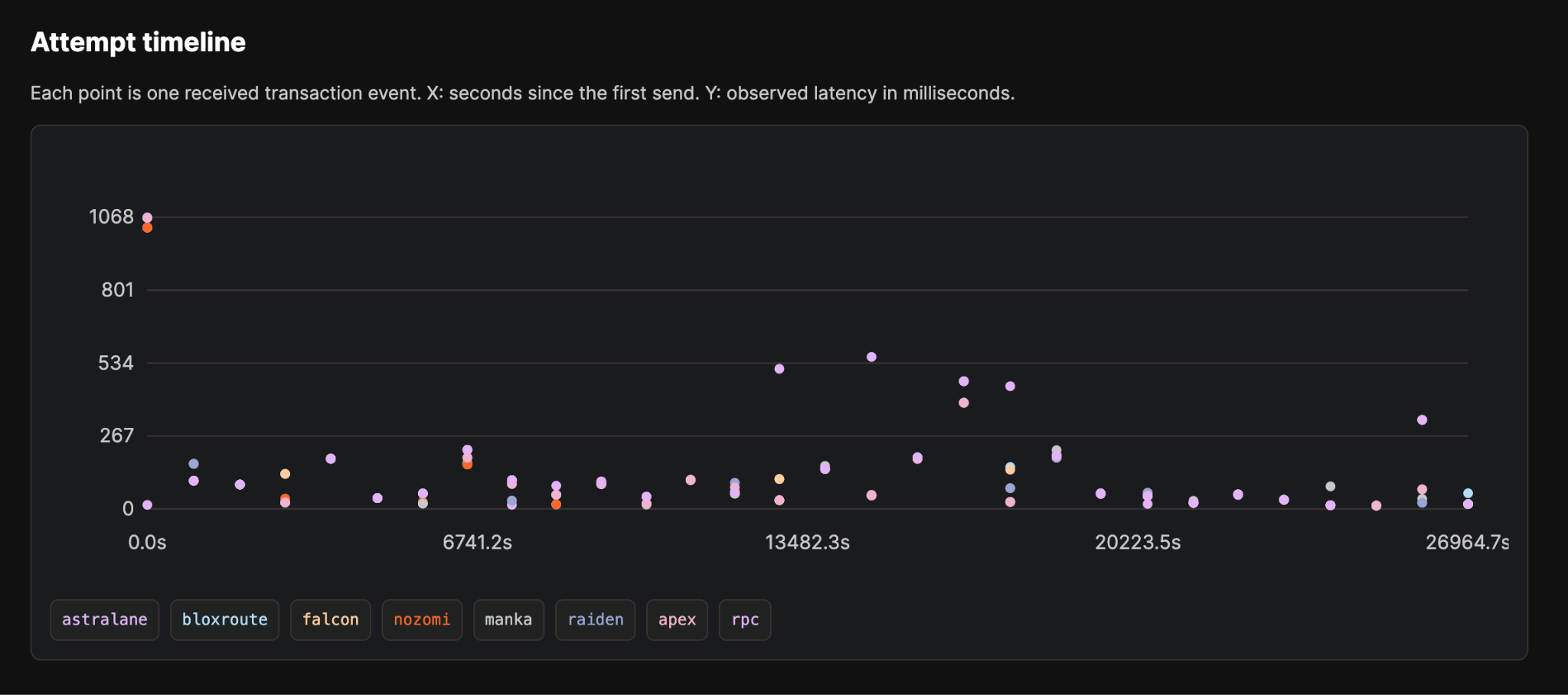
Every Beam route recorded 30/30 included transactions and successful executions. RPC recorded 27/30, with three expirations. Astralane had the lowest observed median at 44.6 ms; Manka recorded 54.2 ms.
The primary latency metric measures submission start to local TxStream observation. RPC confirmation is tracked separately through polling. These values describe different points in the transaction lifecycle.
Results from the October 13 test
Percentiles use observed transactions only: 30 per Beam route and 27 for RPC. Missing observations do not receive a latency value.
What the benchmark establishes—And what to retest
The test ran in Frankfurt on October 13, before Alpenglow, with 30 paired rounds over roughly 7.5 hours. It used warmed connections, Beam QUIC against HTTP RPC, and a compute-budget + tip-transfer + fixed-length memo workload. The metadata identifies a Beam staging endpoint.
Configuration included a 100,000 CU limit, a 100,000 micro-lamport/CU price, and a 1,000,000-lamport tip on every route, including RPC. Confirmation polling ran every 250 ms; TxStream used local monotonic receive timing.
Repeat the comparison from your deployment region, with your transaction shape, fees, and observation path.
Other news to mention
Manka → Beam integration
To start using Manka, please update beam-quic-client to v0.2.0.
With Manka and Beam, you get:
- SWQoS for optimized transaction landing;
- Direct routing to the current leader;
- Atomic bundles for coordinated execution and complex liquidations;
- MEV protection for private execution and defense against frontrunning and sandwich attacks.
RPC Fast availability page is live
The RPC Fast status page is now available for checking service availability.
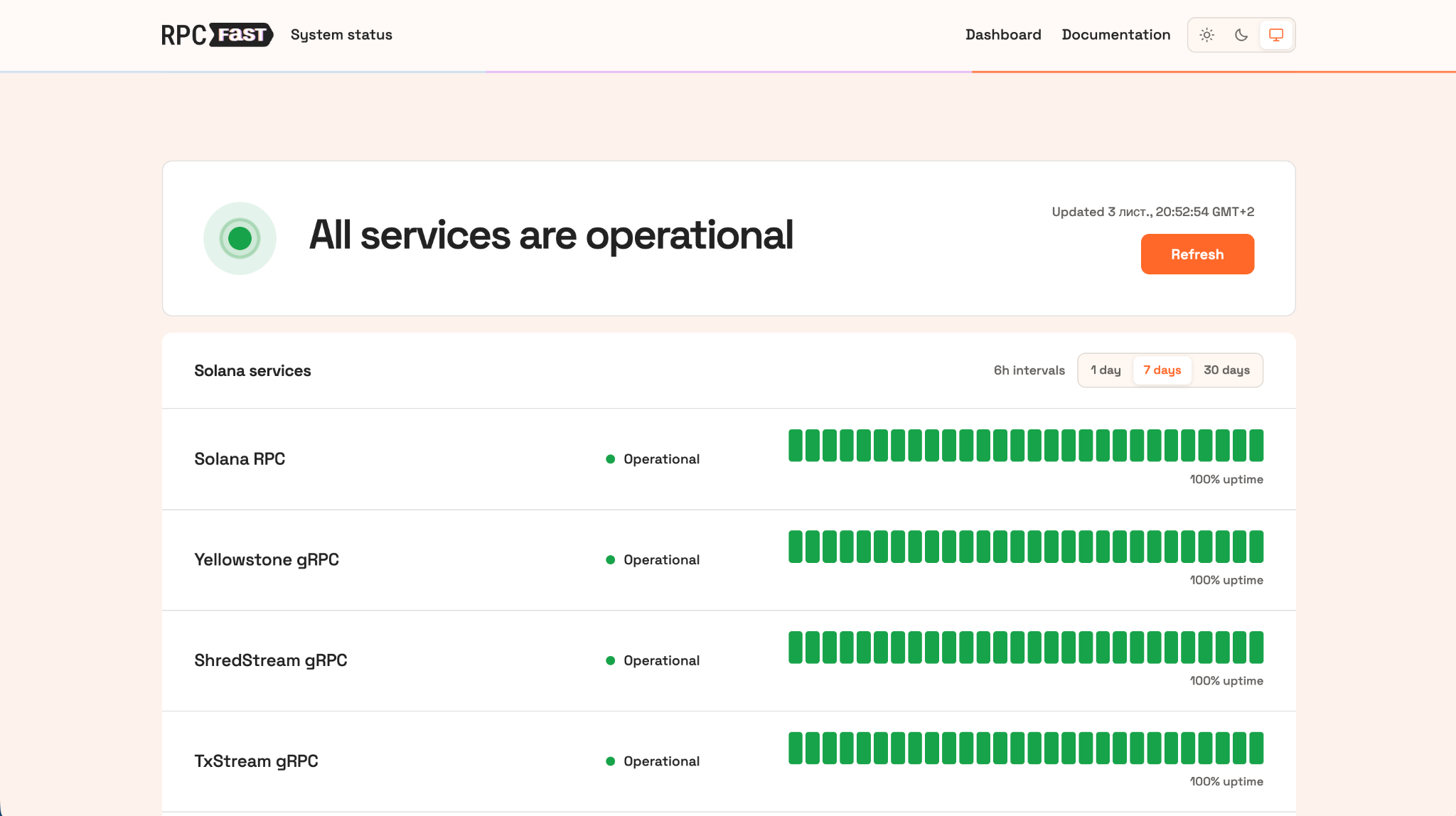
Use it alongside your own monitoring. When an application falls behind, compare provider status with reconnects, consumer lag, queue depth, and slot freshness.
A provider incident and a stalled consumer require different responses. An availability page provides context; your application metrics identify where processing stopped or slowed.
Colosseum’s Crypto World’s Fair hackathon ends—Expecting winners
Submissions to the RPC Fast Infrastructure Sidetrack at Colosseum’s Crypto World’s Fair closed on October 12.
The listing schedules the winners announcement by November 11, 2026. Follow RPC Fast on X and Telegram for the winners announcement, product updates, and promo codes.
Put the October changes to work
October’s updates bring more choice across RPC capacity, streaming, and transaction routing, with Velocity and Manka expanding the available options. Review the Alpenglow changes, compare the updated plans, and use the Beam benchmark to guide testing for your workload.