





.jpg)
June was a hot, productive month for the RPC Fast team, while the Solana market has become increasingly demanding on infrastructure despite the low season. Projects kept pressure on data freshness, transaction landing, and fee efficiency, while RPC Fast shipped updates focused on faster transaction delivery, cleaner gRPC data, broader shred coverage, and easier subscription payments.
For trading teams, indexers, wallets, and DeFi apps, the takeaway is direct: Solana performance work is shifting from “use an RPC endpoint” to a full execution stack. You need low-latency reads, reliable streams, priority transaction paths, ALT-aware parsing, and observability around slot lag, reconnects, and missed transactions.
What was happening in Solana in June?
June was a split month for Solana. SOL price action remained weak early in the month, but the network’s financial activity continued to broaden across stablecoins, RWAs, tokenized equities, perps, and payments.
For infrastructure teams, that is a useful signal: Solana demand is becoming less about a single memecoin cycle and more about high-frequency financial workloads that need fresh data, predictable transaction landing, and low variance under load.
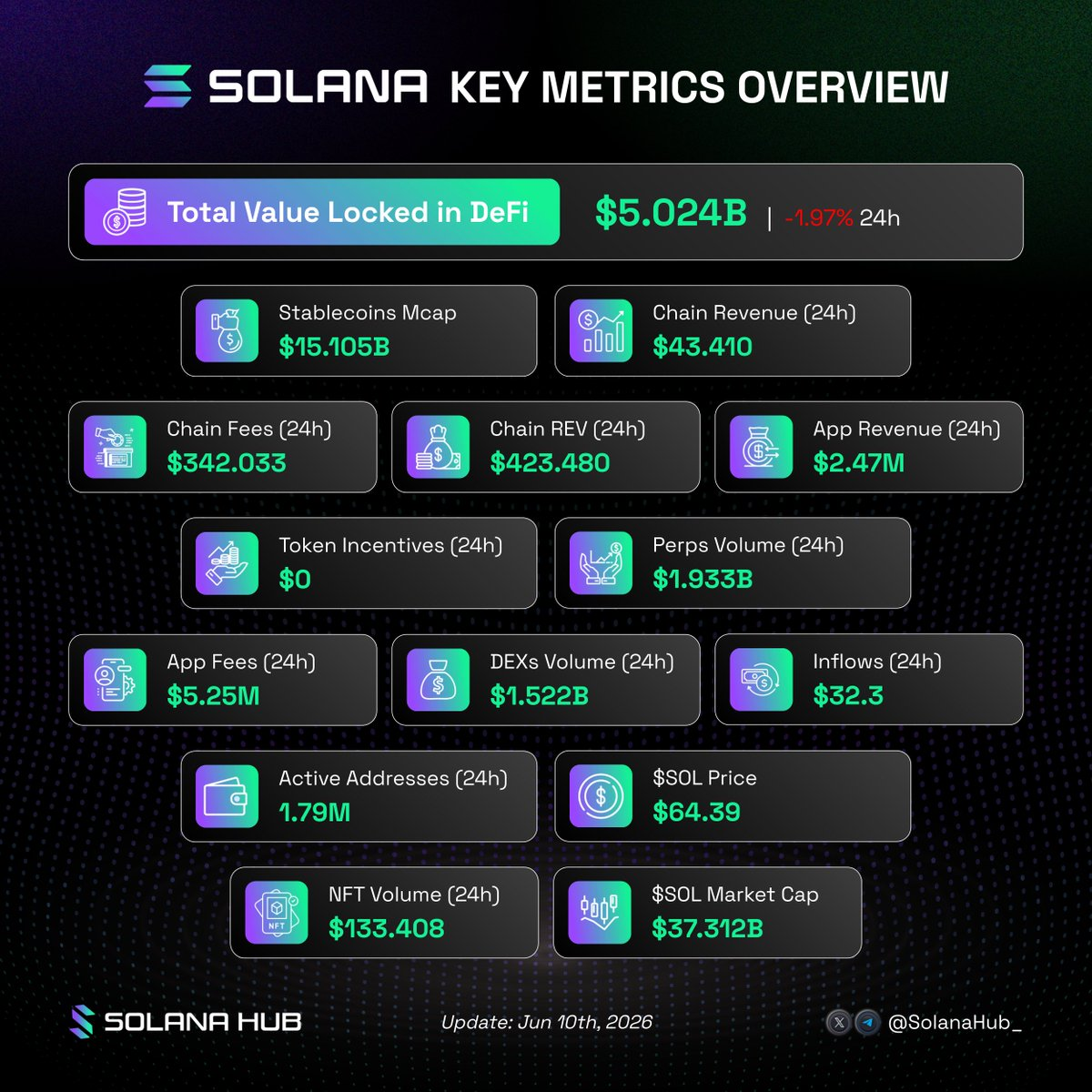
On June 8, SOL traded at $66.37, below the $70 level, with broader crypto risk-off conditions and ETF inflows not yet strong enough to offset selling pressure. That price weakness did not remove onchain usage. Around June 10, public ecosystem snapshots showed about $5.0B locked in DeFi, 1.79M active addresses in 24 hours, $1.52B in DEX volume, $1.93B in perps volume, $5.25M in app fees, and $15.1B in stablecoin market cap.
The bigger June story came from the May data published by Solana Foundation on June 5. Solana reported $2.8B+ in RWA value, 97% share of cumulative onchain tokenized-equity spot trading volume, $16.4B stablecoin supply, $64.6B in monthly perps volume, and $115.3M in U.S. spot Solana ETF inflows with zero outflow days. This gives June a clear operating context: the chain entered the month with stronger institutional and payment rails, even while token price sentiment was soft.
That matters for RPC and streaming infrastructure because the workload mix is changing.
Stablecoin payments and tokenized assets do not tolerate “eventually correct” UX. Perps, liquidation bots, CLOB-style markets, and DEX routing punish stale blockhashes, delayed account updates, weak fee estimation, and single-path transaction submission.
For builders, the practical conclusion is simple: Solana’s second-half 2026 opportunity depends on infrastructure that handles both retail bursts and institutional-grade flows.
RPC Fast updates and integrations
Crypto payments for RPC Fast subscriptions
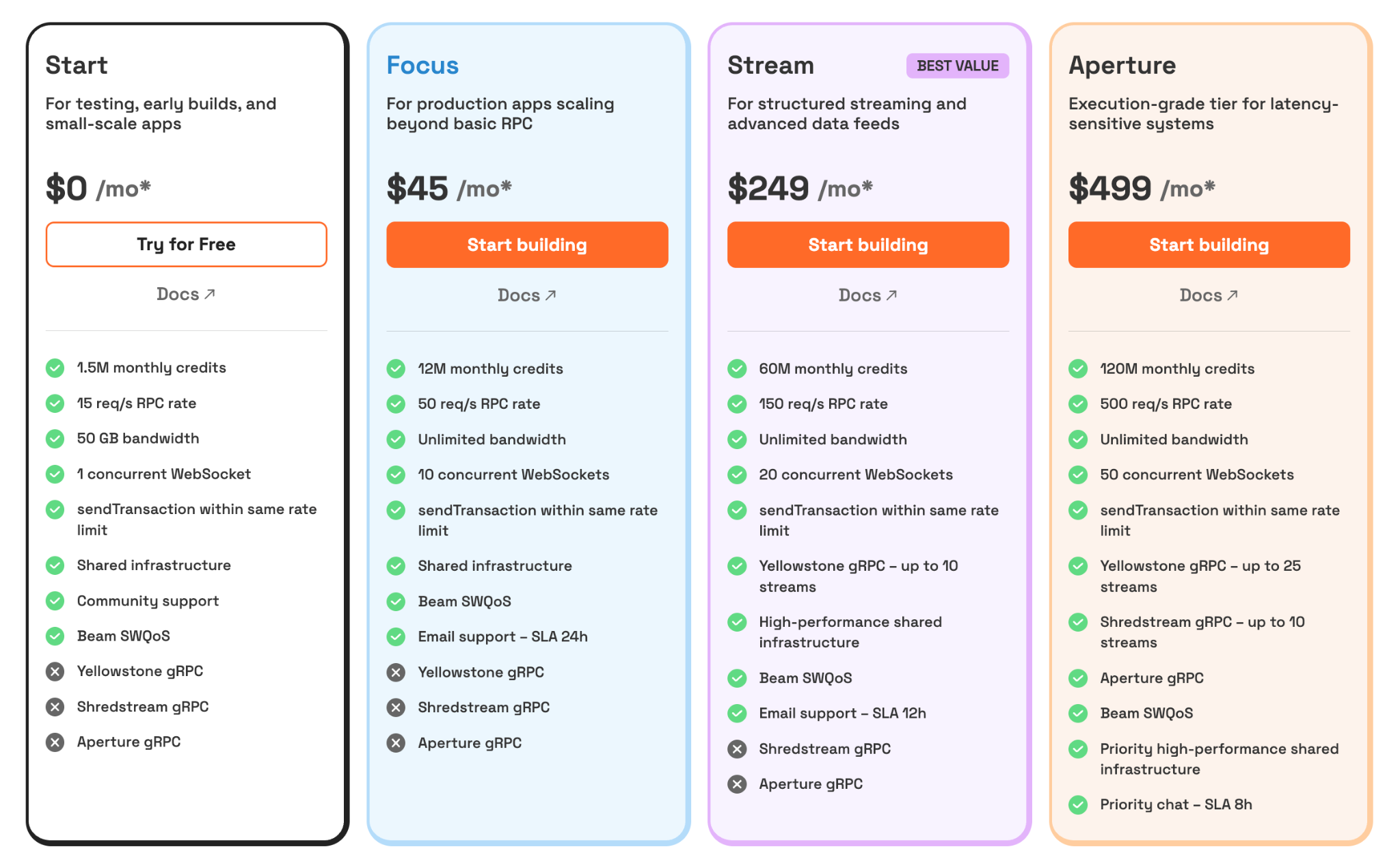
RPC Fast now supports crypto payments for Solana RPC subscriptions. Teams choose a plan and pay with USDC or SOL, reducing procurement friction for crypto-native builders that already operate treasury, payroll, and infrastructure budgets onchain.
For trading desks, bot operators, and Web3 startups, these crypto payments remove card and invoice friction, helping teams move from testing to production faster when infrastructure timing matters.
Beam added a QUIC submit endpoint
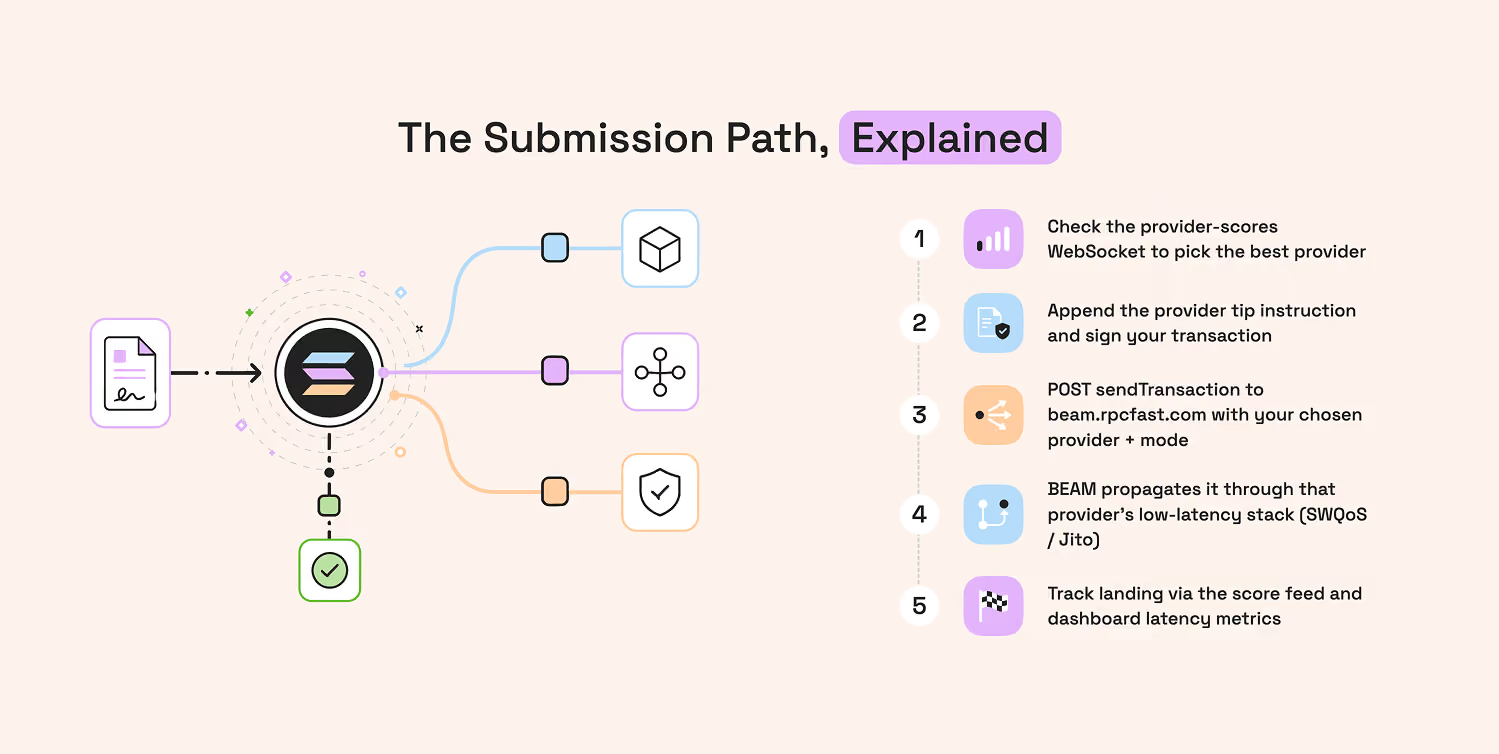
Beam, RPC Fast’s low-latency transaction delivery service, now has a QUIC submit endpoint for faster transaction delivery. Beam already routes signed transactions through provider paths such as SWQoS-backed validator routes, Jito Block Engine submission, and partner delivery infrastructure.
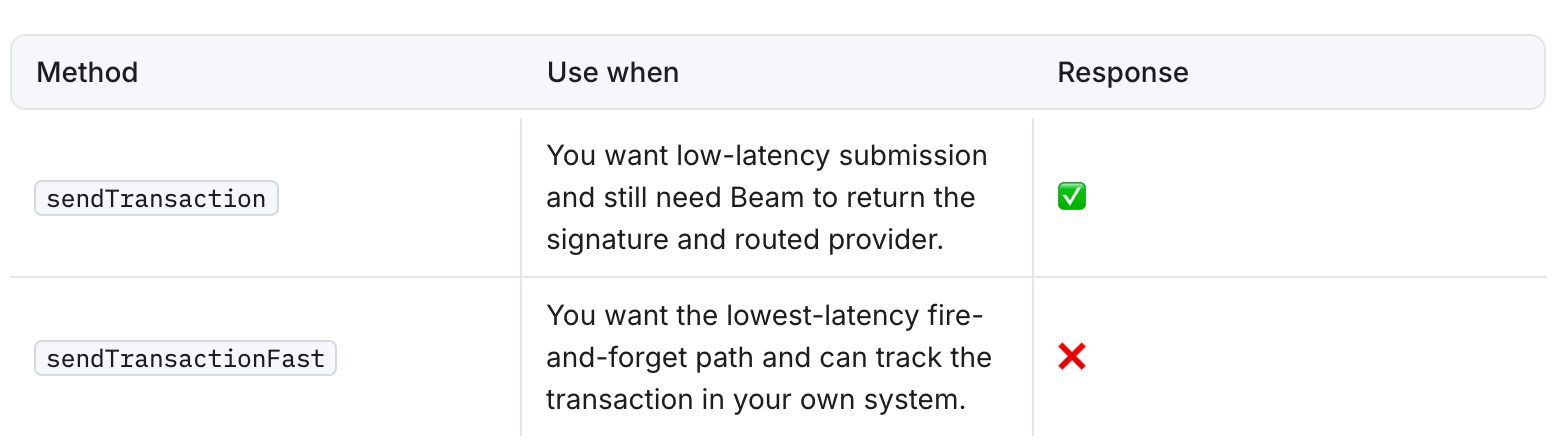
QUIC improves the send path where milliseconds and jitter matter. For HFT systems, MEV searchers, liquidation bots, and arbitrage engines, transaction delivery should not compete with normal RPC reads. Beam keeps submission focused on landing probability, while the app still uses RPC and gRPC for state, simulation, and confirmation.
gRPC performance tuned for speed and coverage
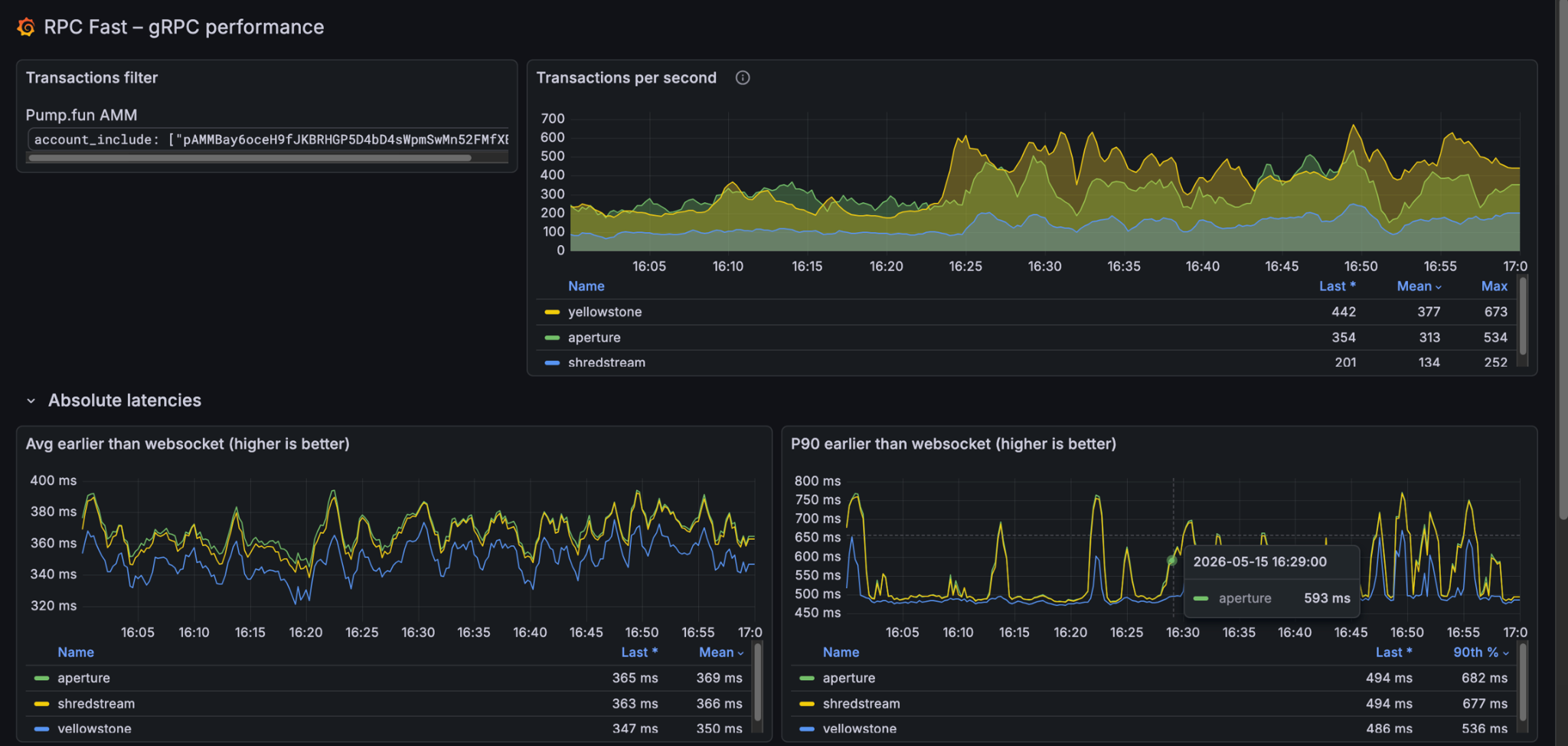
RPC Fast tuned gRPC performance in June, improving stream speed and transaction coverage. The update increased included transactions by roughly 10–15%, which matters for workloads that treat missing transactions as data loss rather than a minor delay.
Better coverage reduces the need to stitch together multiple partially complete feeds. Indexers, analytics tools, copy-trading systems, and bot pipelines get fewer blind spots, cleaner state transitions, and less recovery logic after gaps.
Aperture gRPC now resolves ALT for versioned transactions
Aperture gRPC now resolves Address Lookup Tables for versioned transactions. This gives consumers complete account context without forcing every parser to run extra lookup calls for ALT-backed transactions.
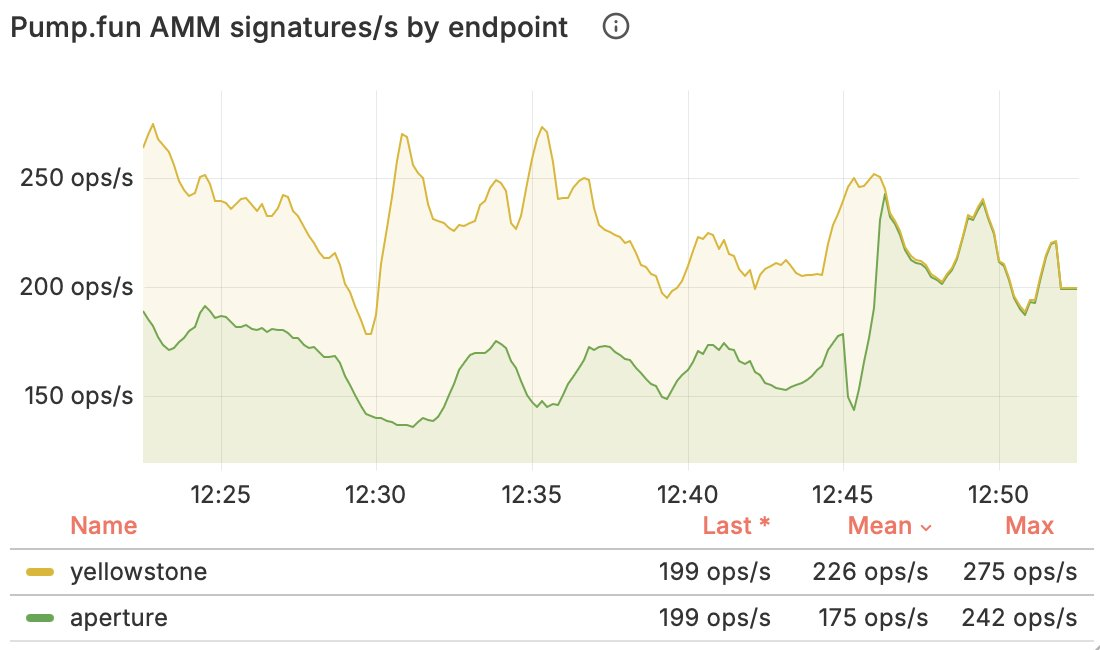
Versioned transactions are common in serious Solana workloads. ALT resolution shortens the path from “raw transaction observed” to “usable signal parsed.” For trading, monitoring, and indexing systems, this reduces parser complexity, RPC round trips, and latency variance.
Best June guides
How to build WebSocket pipelines capable under the load
Solana WebSocket subscriptions are useful for wallets, explorers, monitoring, and lightweight event systems, but production teams need reconnect handling, external state storage, slot-lag tracking, and a migration path to Yellowstone gRPC when event volume outgrows PubSub.
How to prevent sniper bot failures before submission
Many Solana sniper bots fail before their transactions reach the leader. The failure surfaces are slow data detection, slow blockhash/RPC reads, bad regional placement, weak submission paths, and poor priority strategy.
How to pay less for better landing on Solana
Solana fees are not Ethereum-style global gas. Teams need to size compute limits, compute unit price, and Jito tips around account-level contention and execution path, not broad “network congestion” headlines.
How to diagnose the dropped transactions on Solana
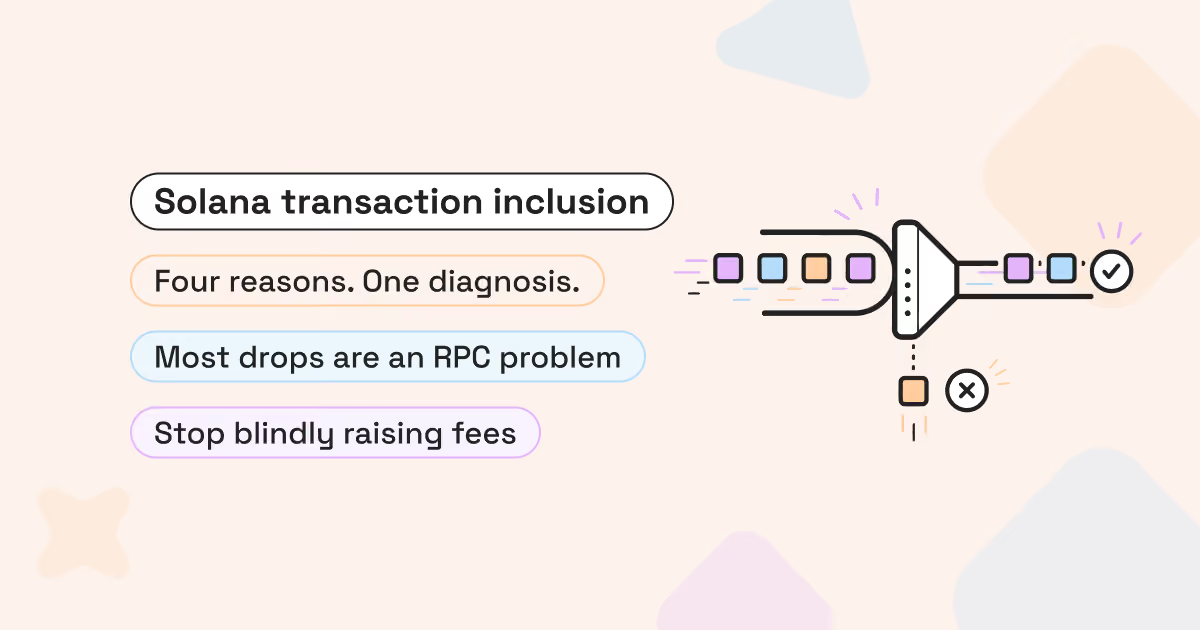
Dropped Solana transactions usually trace back to low-priority fees, incorrect compute settings, leader-path congestion, or stale blockhashes. The fix starts with diagnosis, not blindly raising fees.
Predictions for the rest of 2026
1. Shred-level data becomes normal for competitive trading
WebSockets and standard gRPC remain useful, but latency-sensitive teams will increasingly compare multiple shred sources. The winning architecture will use shreds for earliest detection and RPC/gRPC for correctness, state confirmation, and recovery.
2. Transaction delivery separates from normal RPC
The send path will continue to move away from generic RPC endpoints. Beam-style delivery, SWQoS routes, Jito paths, QUIC submit, and provider scoring will become standard for systems where one missed slot changes P&L.
3. ALT-aware parsing becomes a baseline requirement
As versioned transactions keep spreading, data streams that do not resolve Address Lookup Tables will create operational drag. Indexers and bots will favor feeds that return complete account context without extra lookup calls.
4. Fee optimization gets more local and more automated
Teams will stop treating Solana priority fees as a simple “pay more” lever. Expect more systems to combine getRecentPrioritizationFees, account-level fee history, compute simulation, Jito tip logic, and landing-rate feedback loops.
5. Stablecoins and RWA push infrastructure toward reliability metrics
If Solana’s stablecoin, payments, and RWA activity keeps expanding, buyers will care less about peak TPS claims and more about p95/p99 latency, slot freshness, replay gaps, confirmation consistency, and audited uptime.
Looking forward: Your July with RPC Fast
June showed where Solana infrastructure is heading: lower latency, richer data streams, better transaction delivery, and less tolerance for blind spots. RPC Fast’s June updates fit that direction: crypto-native billing, faster Beam submission, better gRPC coverage, ALT-aware Aperture streams.
If your application depends on fresh Solana data or same-slot execution, test the full path: data source, parser, blockhash read, fee logic, submit route, confirmation, and recovery. That is where the real latency budget lives.
.jpg)


.jpg)


