





.jpg)
RPC Fast is the strongest QuickNode alternative for Solana bots, HFT, MEV, and transaction-heavy systems that need real-time streams, early transaction signals, specialized sending routes, and managed dedicated infrastructure. Helius fits Solana-native products that need enriched APIs, shreds, and multi-path transaction delivery. Alchemy suits multi-chain application teams and large streaming workloads. Chainstack and GetBlock stand out for configurable nodes and advanced transaction routing. Tatum fits teams seeking RPC, gRPC, notifications, wallets, and application APIs on a single multi-chain platform.
There is no universal winner. The right provider depends on whether your bottleneck is RPC throughput, stream freshness, transaction coverage, landing rate, infrastructure isolation, or developer tooling.
Why consider a QuickNode alternative?
QuickNode already offers a substantial Solana stack. Its current platform includes standard RPC and WebSockets, Yellowstone-compatible gRPC, managed Streams, priority-fee estimation, Smart Transactions, SWQoS routing through QuickNode’s stake pool, and Jito bundle support through the Lil’ JIT add-on.
Solana gRPC is included with Scale and Business plans and remains an add-on for lower plans.

A different provider becomes relevant when your workload needs:
- Customer-facing raw or decoded shreds;
- A dedicated low-latency transaction sender;
- Several SWQoS, Jito, or partner routes in parallel;
- Solana-focused enriched APIs;
- Dedicated bare metal with custom Geyser plugins;
- A different gRPC billing model;
- Another region or an independent failover path.
An alternative does not always completely replace QuickNode. Production trading systems often separate read RPC, real-time streams, transaction submission, and confirmation across independent providers. This limits correlated failures and lets each component use infrastructure designed for its workload.
Methodology: How we compared QuickNode alternatives
This comparison uses public documentation, pricing pages, and product specifications. RPC Fast has not published a controlled cross-provider benchmark covering all vendors, so this article does not rank providers by their claimed latency.
We evaluated six areas:
- JSON-RPC, WebSockets, heavy methods, and historical data;
- Yellowstone-compatible gRPC and stream recovery;
- Raw shreds, decoded shreds, and other pre-execution signals;
- SWQoS, Jito, sender services, and priority-fee tooling;
- Shared, dedicated, and high-availability deployment models;
- The workload each platform serves most effectively.
One distinction matters: Jito ShredStream feeding a provider’s node is not the same product as raw shreds delivered to your application. The former improves node ingestion and downstream gRPC freshness. The latter gives your system pre-execution packets that require decoding or deshredding.
Helius documents direct customer-facing raw shreds, while Chainstack positions Jito ShredStream as an input to its Solana nodes. GetBlock’s StreamFirst uses shreds internally; its direct raw-shred access remains listed as a future addition.

Best QuickNode alternatives: Comparison table
RPC Fast: Best for real-time Solana execution infrastructure
RPC Fast combines the layers needed by execution-sensitive systems: JSON-RPC, WebSockets, Yellowstone gRPC, Shredstream gRPC, Aperture, transaction submission, and managed Solana nodes.

Yellowstone handles structured account, transaction, block, and slot updates. Shredstream and Aperture target earlier transaction visibility. Beam handles low-latency signed-transaction submission, while partner SWQoS routes provide stake-backed access to the leader pipeline. Dedicated deployments support Agave or Jito clients, custom indexing, Yellowstone, Jito ShredStream, Jupiter Swap API, and HA topology.
Best for:
- Arbitrage, liquidation, and copy-trading bots
- HFT and MEV infrastructure
- Real-time transaction monitoring
- Teams combining data ingestion and transaction execution
- Custom dedicated or HA Solana infrastructure
Trade-offs: Yellowstone starts on the $249 Stream tier, while Shredstream and Aperture require the $499 Aperture tier. Partner SWQoS carries separate fees. Dedicated nodes start at $2,200 per month in the EU, and RPC Fast does not provide historical archive data through its dedicated Solana nodes.

Data center: Equinix FR13, Frankfurt
Closer to major EU Solana validator routes for lower latency.




Methods not available:
-
getProgramAccounts
-
getTokenAccountsByOwner
-
getTokenAccountsByDelegate
-
getTokenLargestAccounts

Heavy methods available:
-
getProgramAccounts
-
getTokenAccountsByOwner
Heavy methods NOT available:
-
getTokenAccountsByDelegate
-
getTokenLargestAccounts
BEST VALUE
No method restrictions
Use any RPC method of your choice.
No method restrictions
Use any RPC method of your choice.
RPC Fast’s documentation also separates basic reads, structured streaming, pre-execution data, transaction routes, and dedicated infrastructure, rather than presenting them as a single interchangeable API layer.
Helius: Popular Solana-native APIs and multi-path sending
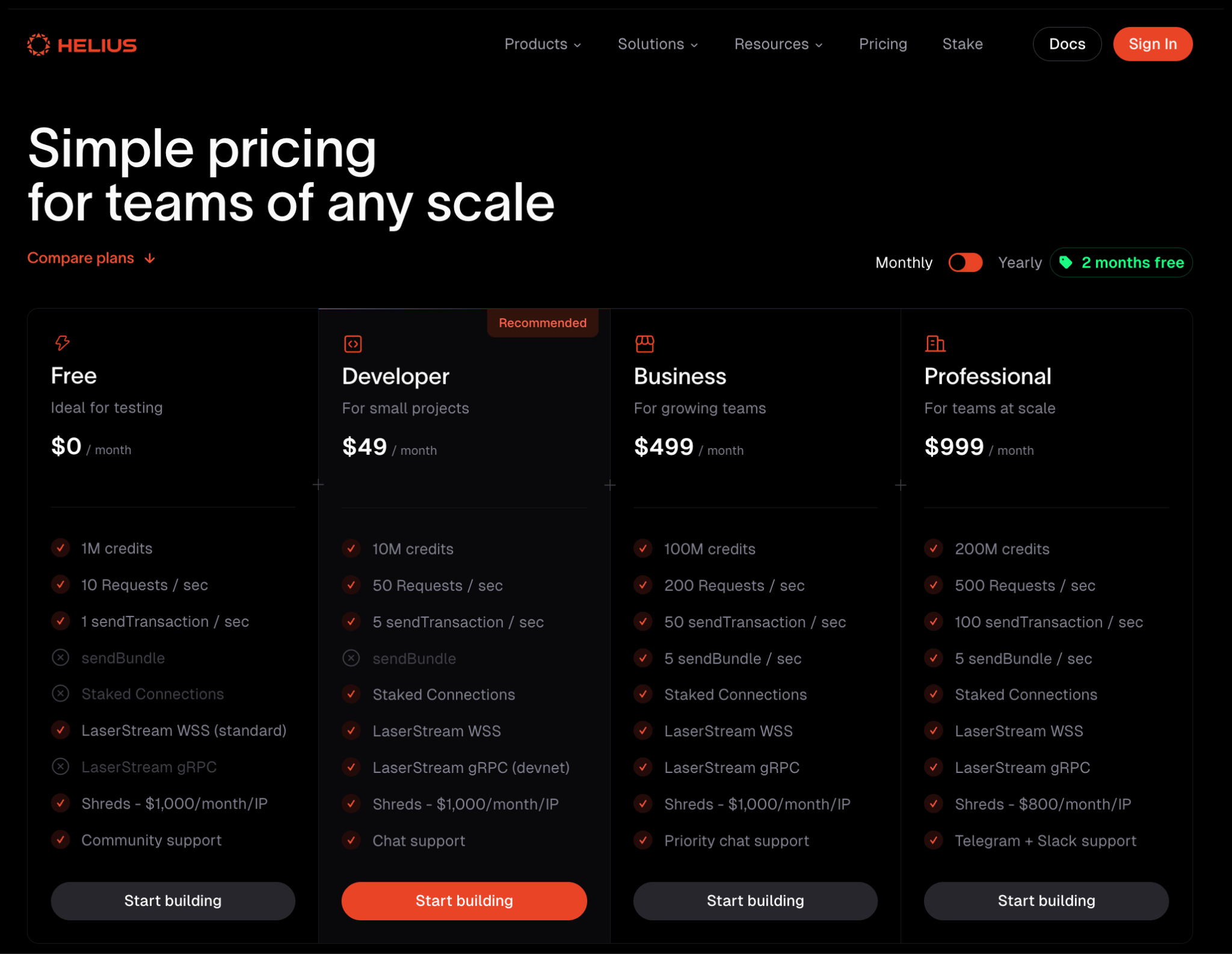
Helius offers one of the broadest Solana-specific product stacks. LaserStream provides Yellowstone-compatible gRPC and WebSockets with multi-node redundancy, automatic reconnection, and 24-hour replay. Its data products also include pre-confirmations, raw UDP shreds, and preprocessed transactions decoded from shreds before execution metadata exists.
Helius Sender broadcasts through Helius, Jito, Harmonic, Rakurai, and other paths. Sender Max requires a 0.001 SOL minimum tip for its priority buffer. The lower-cost SWQoS-only route starts at 0.000005 SOL. Sender is available across all plans and does not consume API credits.
Best for:
- Wallets, explorers, and token applications
- Enriched transaction and asset data
- Trading bots needing data and sending products
- Teams seeking self-service raw shreds
- Solana-only engineering organizations
Trade-offs: Mainnet LaserStream gRPC starts on the $499 Business plan. Raw shreds cost $1,000 per month per IP, or $800 on Professional. Streaming bandwidth, RPC credits, shred seats, and Sender tips use separate billing dimensions.
Alchemy: Created for multi-chain application infrastructure
Alchemy’s Solana offering now includes JSON-RPC, archival methods, WebSockets, Yellowstone-compatible gRPC, DAS APIs, priority-fee estimates, transaction simulation, and wallet infrastructure.
Its gRPC service uses multi-node shred ingestion and a rolling replay buffer. Consumers reconnect with from_slot to retrieve recent missed updates before resuming the live stream. Pricing is usage-based at $75 per streamed TB, prorated by data volume, with access through PAYG and Enterprise plans.

Alchemy states that Solana writes are broadcast through staked connections. It also exposes a priority-fee estimate method and Jito bundle simulation, though its public product structure focuses on reliable RPC and staked writes rather than a separately branded multi-route sender.
Best for:
- Existing Alchemy customers
- Multi-chain wallets and applications
- Indexers with variable gRPC volume
- Teams needing archive data and developer APIs
- Products using Alchemy Wallet APIs
Trade-offs: No separate customer-facing shred feed is publicly documented. Execution-focused teams still need to evaluate whether staked writes provide enough route diversity for their landing targets.
Chainstack: Best for configurable nodes and Warp routing
Chainstack offers Global, Unlimited, Trader, and Dedicated Solana nodes. Yellowstone gRPC is a paid add-on from the Growth plan and supports transactions, accounts, blocks, slots, filtering, and recent-slot recovery through from_slot. The service is Mainnet-only.
Jito ShredStream is enabled by default on Chainstack’s Solana nodes. It speeds shred arrival into the node, which improves gRPC consistency and tail latency. This is provider-side acceleration rather than a raw-shred feed delivered to customer infrastructure.
Warp routes transactions through staked SWQoS connections toward current leaders. Chainstack prices Warp at $0.15 per transaction across paid plans. Trader Nodes also send through large staked validators.

Best for:
- Trading systems needing a distinct submission route
- Teams choosing between shared and dedicated nodes
- Indexers using standard Yellowstone clients
- Multi-chain infrastructure organizations
Trade-offs: Yellowstone, node capacity, and Warp are separate cost layers. Warp’s fixed per-transaction charge becomes material for high-volume low-value strategies.
GetBlock: Useful for dedicated Solana trading stacks
GetBlock provides shared RPC alongside dedicated Solana nodes, Yellowstone gRPC, StreamFirst, LandFirst, TradeFirst, and an indexed archive product.
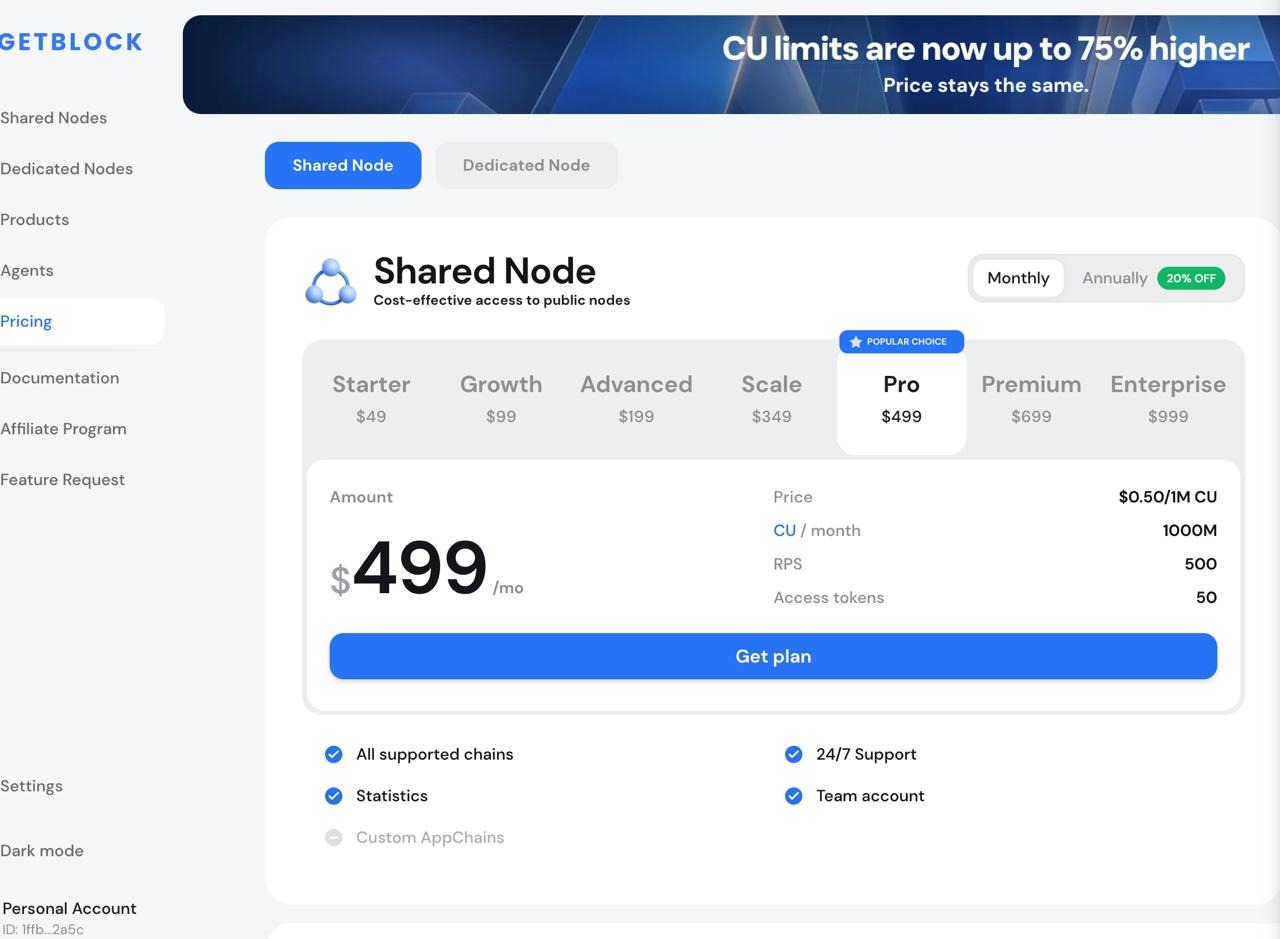
Yellowstone is tied to a dedicated Solana subscription. StreamFirst combines an accelerated Yellowstone implementation with provider-side shred reception and early state reconstruction. LandFirst submits through GetBlock and partner SWQoS connections while also sending to Jito.
This architecture addresses both sides of a trading loop: receive state updates through StreamFirst, then send through LandFirst. GetBlock’s public documentation also lists direct raw-shred delivery as a future TradeFirst addition, so it should not be treated as a currently delivered customer-facing feature.
Best for:
- Dedicated Solana node customers
- Trading and MEV systems
- Teams needing one custom deployment
- Historical analytics through the indexed archive
- Organizations using GetBlock across many networks
Trade-offs: Advanced gRPC and trading products center on dedicated or custom deployments. Vendor-reported latency figures lack a neutral cross-provider methodology, so buyers should reproduce measurements in their own region and application.
Tatum: Best for unified multi-chain product development
Tatum combines Solana JSON-RPC, Yellowstone gRPC, application APIs, wallets, webhooks, notifications, and multi-chain infrastructure.
Its Solana Mainnet gRPC endpoint streams accounts, transactions, slots, blocks, and block metadata through the standard Yellowstone client model. Dedicated API keys offer flat-fee throughput for RPC calls without consuming the base plan’s credit pool.

Tatum’s wider platform also provides indexed Data APIs and address-based notifications, which reduce the amount of custom ingestion and indexing required by wallets, payment products, and consumer applications.
Best for:
- Wallets and payment systems
- Multi-chain products
- Teams needing webhooks and indexed APIs
- Backends seeking one authentication and billing layer
- Products where development speed matters more than raw execution latency
Trade-offs: Tatum does not publicly document customer-facing Solana shreds, SWQoS routing, Jito submission, or a specialized low-latency sender. That makes it a weaker fit for HFT and competitive transaction landing.
Which QuickNode alternative fits your use case?
The selection changes when the bottleneck changes. A wallet usually values parsed data and reliable notifications. An indexer values complete streams and replay. A liquidation bot values account freshness, blockhash age, and leader access. An MEV system values pre-execution signals and several independent submission routes.
.jpg)
Benchmark providers against your workload
Do not migrate based on an average latency number from a vendor landing page.
Run every provider under the same conditions:
- Client machine and region
- RPC methods and request concurrency
- Yellowstone filters and commitment
- Transaction construction and blockhash source
- Priority fee and route tip
- Observation period
For RPC, record p50, p95, p99, error rate, and slot distance.
For streams, record slot lag, reconnect time, missing events, duplicate events, queue depth, and transaction coverage.
For transaction delivery, record acknowledgment latency, confirmed slot, landing rate, blockhash expiry, failed simulation rate, priority fee, tip, route, and total landed cost.
A sender that returns a signature quickly but produces a lower landing rate has not improved execution. A gRPC stream with low median latency but frequent gaps creates reconciliation work and hidden trading risk.
Final recommendation: Don't put all eggs in one basket
Stay with QuickNode when its gRPC, Streams, Smart Transactions, SWQoS routing, Marketplace add-ons, and multi-chain platform already match your operational requirements.
Choose RPC Fast when Solana data ingestion, early transaction visibility, transaction delivery, and dedicated infrastructure are part of a single latency-sensitive production system.
Choose Helius for the deepest Solana-specific API stack, customer-facing shreds, and a mature multi-path sender. Choose Alchemy for usage-based gRPC, archive access, and an established multi-chain platform. Choose Chainstack for flexible node types and a fixed-price Warp route. Choose GetBlock for dedicated trading deployments. Choose Tatum for unified product APIs, wallets, notifications, and multi-chain development.
The practical decision will follow from answering this question: Which architecture delivers the freshest, usable signal, the highest landing rate, the lowest p99 variance, and the lowest cost per successful outcome for your workload?
RPC Fast offers a 24-hour trial for Yellowstone and Shredstream evaluation. Run it beside your current QuickNode connection, preserve identical filters and transaction logic, and compare slot freshness, stream gaps, route variance, and landed cost before moving production traffic. Aperture requires an active Aperture plan rather than short-term trial access.
.jpg)


.jpg)


