





In December 2025, analyst Eekeyguy published data that stopped a lot of traders mid-scroll: approximately 50% of Solana's entire DEX trading volume is driven by arbitrage. On some days, that number climbs to 60–70%. The same data, backed by research from Wu Shuo Blockchain, shows that atomic arbitrage through Jupiter alone accounts for roughly 22% of all transaction volume, and that figure rises to nearly 50% when bundled arbitrage is included.
To put that in dollar terms: Solana's spot DEX volume hit $1.95 trillion in 2025, nearly double the $968.9 billion recorded in 2024. MEV revenue on the network reached $720.1 million for the year—more than priority fees for the first time ever. Arbitrage is not a niche anymore. It is a dominant force shaping how Solana's economy runs.
What does this mean for you? It means competition has never been tighter. Arbitrage windows on Solana open and close in milliseconds. Price gaps between Raydium, Orca, Meteora, and Jupiter close so fast that even a 200ms delay can be the difference between catching a spread and watching it vanish.
What is Solana arbitrage, and why does RPC matter so much?
Arbitrage on Solana means buying a token at a lower price on one DEX and selling it at a higher price on another, all within the same transaction. Because Solana allows you to combine multiple instructions into a single atomic transaction, both legs of the trade execute together—if either leg fails, the whole thing reverts.
The process sounds simple. In practice, it's a high-speed race. Here's how it works in basic terms:
A bot monitors prices across DEXs in real time. The moment it spots a price gap between, say, the SOL/USDC pool on Orca and the same pair on Phoenix, it calculates whether the gap is large enough to cover fees and slippage. If yes, it builds a transaction, signs it, and fires it off to an RPC node. The RPC node forwards the transaction to the Solana cluster. If the transaction lands before the gap closes, you profit.
Every step in that chain has latency. But the one most traders underestimate is the RPC node itself.
Why RPC speed matters for arbitrage:
- The RPC node is your direct connection to the Solana cluster. It receives your transaction and broadcasts it to validators.
- A slow or overloaded RPC adds dozens or hundreds of milliseconds before your transaction even reaches the network.
- RPC nodes also feed your bot real-time price data via WebSocket subscriptions. If your data feed is lagging by even one slot (400ms), you're working with stale prices—and you're competing against bots with fresh data.
- During high-volatility periods, shared RPC nodes get hammered with traffic. Rate limits kick in, latency spikes, and your transactions start failing.
Top arbitrageurs run on bare-metal infrastructure with dedicated RPC endpoints, Jito bundle support, and gRPC feeds (Yellowstone/Geyser) that push state changes in near-real time. If you're not there yet, choosing the right RPC provider is the fastest way to close the gap.
Top 7 Solana RPC providers for arbitrage

1. RPC Fast—Best for high-frequency trading and MEV

RPC Fast, built by Dysnix, is the most performance-focused option on this list for serious arbitrage work. It's not a generic infrastructure play—the team explicitly targets DeFi traders, MEV searchers, and high-frequency bots. That focus shows in every layer of the stack.
The infrastructure runs on bare-metal servers with dedicated compute clusters, not shared cloud VMs. This matters because shared nodes have "noisy neighbors"—other tenants competing for the same CPU and memory, adding unpredictable latency spikes at the worst moments. RPC Fast eliminates that problem by design.
The company publishes Grafana measurements from live dedicated nodes: light methods such as getSlot and getSignaturesForAddress return in 2–3 ms, while heavy account reads such as getAccountInfo run 25–35 ms. Overall latency improved by 40% from launch for trading bot setups. They've tuned 100+ bots on Solana and partner with both bloXroute and Jito—giving you access to stake-weighted quality of service (SWQoS) and bundle submission in one managed setup.
For arbitrageurs specifically, RPC Fast supports Yellowstone gRPC streams (Geyser plugin), which deliver account and slot updates faster than standard WebSocket subscriptions. They also handle the complexity of Jito ShredStream integration, which lets your bot catch transaction data before it's fully propagated—a meaningful edge in sub-second races. On the Aperture plan, Aperture TxStream goes further and attaches a predicted execution result to each transaction while it is still in flight, at roughly 95% accuracy against actual execution for about +791 µs of median delivery cost—useful when an arbitrage leg is about to revert.
There's a free Start plan at $0 with no credit card, and paid plans run $45 to $499. Teams that outgrow a shared endpoint move to dedicated Solana nodes from $2,200/month, with server, setup and maintenance included and delivery within 72 hours. For teams running production bots, the managed approach means you're not debugging infrastructure variance at midnight when Solana congestion spikes.
Pros:
- Bare-metal infrastructure with dedicated compute—no noisy neighbors
- Native bloXroute and Jito integration for SWQoS and bundle submission
- Yellowstone gRPC / Geyser support for ultra-fast state streaming
- Managed service: 24/7 monitoring, automated failover, proactive alerts
- Battle-tested with 100+ trading bots; 2–3 ms on light RPC methods, 25–35 ms on heavy account reads
- Deep DeFi and MEV expertise from the Dysnix team
Cons:
- More expensive than general-purpose providers
- Best value for teams running sophisticated bots; overkill for casual use
2. Helius—Best Solana-native infrastructure with rich APIs

Helius is probably the most well-known Solana-specific RPC provider and a strong choice for teams that combine arbitrage bots with broader on-chain data needs. Their RPC traffic runs through staked validator nodes, which get priority treatment during network congestion—a real advantage when blocks are full.
Average latency sits around 140ms according to Chainstack's 2025 benchmarks, which is competitive for most arbitrage strategies, though not best-in-class for ultra-HFT setups. The platform scales from 10 RPS on the free tier up to 500 RPS on paid plans, with dedicated validator access at enterprise level.
Where Helius really shines is the data layer. They offer parsed transactions, webhook triggers on on-chain events, DAS API for token/NFT metadata, and Geyser-powered streams. For bots that need to monitor specific programs, wallets, or pool states—not just submit transactions—Helius gives you a lot without building a custom indexer.
Pros:
- Staked validator nodes for better transaction landing during congestion
- Geyser/webhooks support for real-time account monitoring
- Rich APIs: parsed transactions, DAS, SPL token data
- Free tier available; paid plans start around $49/month
- Solana-native team—fast to support new network features
Cons:
- ~140ms average latency—solid but not the lowest available
- Not the cheapest for high-volume bots
- Less optimized for pure HFT compared to infrastructure-first providers
3. Triton One—Best for sub-50ms latency and validator-level access

Triton One is a provider that infrastructure-focused traders respect. Average response times stay under 50ms, which puts it in the same tier as dedicated bare-metal setups. They operate with direct validator connections and strategic geographic placement to minimize the distance between your request and the current slot leader.
Load balancing at Triton automatically routes requests to the fastest available node, which helps maintain consistent performance when individual nodes experience temporary issues. Their infrastructure is particularly strong for teams that need reliable transaction broadcasting and account monitoring at the same time.
Triton doesn't have the same marketing budget as Helius or QuickNode, so it's less visible to newer developers—but experienced Solana builders know the name well.
Pros:
- Sub-50ms average response times—among the fastest in the market
- Direct validator connections for lower slot lag
- Automatic load balancing across nodes
- Strong reputation among experienced Solana developers
Cons:
- Less documentation and community resources compared to larger providers
- Smaller ecosystem of integrations
- Pricing is not as transparent—requires direct contact for enterprise plans
4. QuickNode—Best for reliability at scale
QuickNode is one of the largest multi-chain RPC providers, and their Solana offering is backed by significant infrastructure investment. They published benchmarks in August 2025 claiming 2–3x lower latency than competing providers in some regions, though real-world performance varies by geography.
Their platform handles real-time data efficiently through WebSocket connections, offers archive node access, and comes with a detailed analytics dashboard that shows per-method latency, request tracing, and error tracking. For teams that run bots in multiple regions or need to monitor performance across many endpoints, QuickNode's tooling is genuinely useful.
On the pricing side: Free tier gives 10M credits and 15 RPS. The Starter plan is $10/month for 25M credits and 40 RPS. Growth is $39/month for 75M credits and 125 RPS. Enterprise pricing is custom.
Pros:
- Extensive global infrastructure—low latency from most regions
- Strong analytics dashboard with per-method performance tracking
- Archive node support and WebSocket connections
- Clear, tiered pricing with a usable free tier
- Multi-chain support if you run bots on other networks
Cons:
- MEV protection is an add-on, not included by default
- Standard tiers cap at 400 RPS
- Multi-chain focus means Solana isn't always the top priority for updates
- Free tier is limited for production bot workloads
5. Alchemy—Best for teams already building multi-chain

Alchemy brings its Supernode architecture—well-proven on Ethereum—to Solana. Their focus is correctness, high uptime, and consistent routing under load. They advertise 99.99% uptime, and their developer tooling is genuinely top-tier: per-method latency tracking, request tracing, and error analytics in a clean dashboard.
Average Solana latency sits around 170ms, which is a step behind Helius or Triton. The CU (compute unit) pricing model can be unpredictable on Solana specifically, because different query types consume very different amounts of compute—something to factor in if you're running high-volume bots with varied call patterns.
For teams already using Alchemy for Ethereum or L2s and looking to add Solana arbitrage, the unified workflow is a genuine time-saver.
Pros:
- 99.99% uptime target—one of the most reliable options
- Excellent developer tooling and monitoring dashboard
- Familiar workflow if you already use Alchemy on other chains
- Strong documentation and support
Cons:
- ~170ms average latency—slower than Solana-native competitors
- CU pricing model can be unpredictable for high-volume Solana bots
- Not optimized specifically for MEV or arbitrage use cases
- Less Solana-native feature depth than Helius
6. Chainstack—Best balance of price and performance

Chainstack offers a strong combination of reliable performance and transparent pricing that makes it attractive for teams scaling up from development to production. Their multi-cloud routing prioritizes proximity to the current slot leader, keeping Solana latency around 140ms on average—competitive without breaking the budget.
They support real-time data streaming, WebSocket connections, and their console gives you meaningful control without having to manage hardware. For teams that need predictable costs at scale, Chainstack's pricing structure (not compute-unit-based) is simpler to budget around than some competitors.
Pros:
- ~140ms average latency with slot-leader-aware routing
- Transparent, predictable pricing—easier to budget at scale
- Multi-cloud deployment for geographic flexibility
- Good documentation and developer experience
- Scales from free tier to production without workflow changes
Cons:
- Not the lowest latency available for pure arbitrage use
- Solana-specific features are less deep than Helius
- No native MEV/Jito bundle tooling built in
7. Ankr—Best budget option with decentralized redundancy
Ankr approaches RPC infrastructure differently from the rest of this list: their network is distributed across independent node operators, which reduces single-point-of-failure risk and can provide better geographic coverage at lower cost. They support 70+ chains, stake-weighted QoS, and MEV protection in premium tiers.
Throughput can reach up to 1,500 RPS on higher plans. The public endpoint is available for free, and pay-as-you-go pricing starts from around $6 per million requests. For bots that don't need sub-50ms latency but do need reliable, cost-efficient infrastructure across multiple regions, Ankr delivers strong value.
Pros:
- Decentralized node network—strong geographic coverage and redundancy
- Competitive pricing, especially for high-volume use
- Up to 1,500 RPS on premium tiers
- Stake-weighted QoS and MEV support available
- Good for multi-chain operations at reasonable cost
Cons:
- Advanced APIs may require add-ons
- Latency not optimized for ultra-low-latency arbitrage
- Monitoring and configuration require more hands-on management
- Decentralized model introduces some performance variability
How to choose the right provider for your arbitrage setup
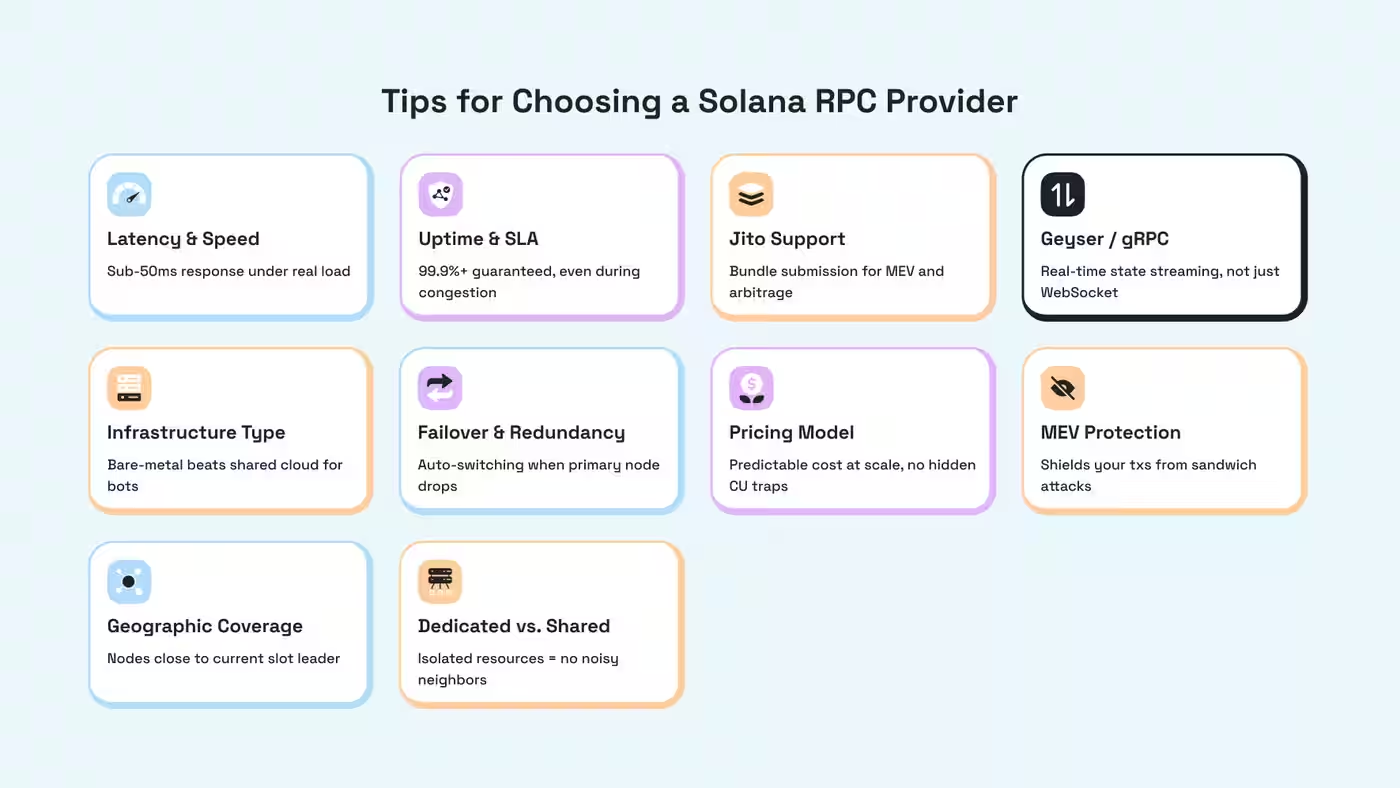
There's no single right answer—it depends on what type of arbitrage you're running and how serious you are about performance.
- If you're running a production HFT or MEV bot and every millisecond counts, the combination of dedicated bare-metal infrastructure, Jito bundle support, and Geyser gRPC feeds is non-negotiable. That points you toward RPC Fast or Triton One at the top end.
- If you need a strong mix of speed, data APIs, and Solana-native tooling without going full custom infrastructure, Helius is the most complete package for most teams.
- If you're scaling up and need predictable pricing with solid performance, Chainstack hits a good middle ground. If you're running multi-chain operations and want one provider that handles everything, QuickNode or Alchemy makes sense. And if budget is the primary constraint, Ankr gives you decent infrastructure without the premium price tag.
One thing applies across all scenarios: using a single RPC endpoint in production is a risk. The best setups run a primary provider with at least one fallback—especially during high-congestion periods when even the best nodes can experience temporary spikes. Building redundancy into your bot from the start is cheaper than debugging missed opportunities later.
Final word
In 2025, Solana arbitrage is a $720 million annual MEV market. The window to capture a profitable spread can be as short as 400ms—one slot on the network. In that environment, your RPC provider is not a commodity. It's a competitive advantage.
If you're serious about building or scaling an arbitrage operation on Solana, start with infrastructure designed for this purpose.
RPC Fast's combination of bare-metal compute, Jito and bloXroute integration, Geyser streaming, and a team that has actively tuned hundreds of trading bots makes it the most battle-tested choice for arbitrage workloads in 2026.
Contact us for more information →
.jpg)


.jpg)


