

Solana's 200ms slots are live on mainnet. For trading bots, the upgrade means more frequent block-production opportunities, shorter leader windows, and a smaller blockhash validity window. The immediate task is to review signal freshness, transaction timeouts, retry logic, execution costs, and landing performance. Alas, blindly dividing every existing timeout by two won’t bring you any profit.
The final stage of SIMD-0525 activated on October 9, 2026. Solana moved from a 400ms target to 200ms through four staged reductions. Its first full epoch at the new setting averaged 218.3ms per slot, according to Solana Compass.

So, every trading bot owner now understands that 200ms is just a target slot interval, not a guaranteed transaction landing time or finality SLA.
For arbitrage, MEV, sniping, and copy-trading systems, profitability still depends on obtaining an actionable signal, reaching a leader, landing before the opportunity disappears, and retaining enough margin after fees and adverse price movement.
TL;DR
- 200ms slots are already active. Start with production telemetry rather than treating the upgrade as a future scenario.
- Nominal block frequency doubled, not nominal compute throughput. The block compute limit scaled from 100M CU at 400ms to 50M CU at 200ms, preserving approximately 250M CU/s of theoretical budget.
- Blockhash lifetime is shorter. The nominal window is around 30 seconds, but expiration remains governed by block height, not a fixed timer.
- Arbitrage, MEV, sniping, and copy trading all need reassessment. The main difference is how quickly each strategy's information loses value.
- Event-driven feeds and route-level landing measurements matter more than aggressive polling. Faster block production does not compensate for delayed signals or weak transaction delivery.
- Other trading chains compete on different execution models. MegaETH offers ~10ms sequencer mini-blocks; Base offers 200ms Flashblocks; Robinhood Chain uses first-come, first-served sequencing; Hyperliquid optimizes committed order responses.
The network speed-up: Who wins, who loses
Shorter slots benefit systems whose reaction time is already close to the network's execution cadence. They do less for strategies bottlenecked by slow market data, inefficient transaction construction, or inadequate liquidity.
For a trading bot, the potential advantage is a shorter interval between opportunities for a leader to produce blocks. But inclusion still depends on transaction arrival, compute capacity, account contention, priority fees, and validator behavior.
Who is better positioned?
A bot polling prices every second previously sampled approximately once per 2.5 nominal slots. Under a 200ms target, the same polling interval spans five nominal slots.
That does not prove the bot loses money. It does mean its sampling frequency now covers more potential state transitions.
Decision rule: If your bot earns profits from information that becomes stale within one or two slots, prioritize feed architecture before changing trading parameters. If your strategy holds positions for minutes, focus on execution quality rather than raw slot cadence.
What changed and why
Timeline
Solana introduced shorter slots through staged mainnet activations rather than a single protocol switch.
Source: Solana Foundation — Reduced Slot Times.
The rollout is complete across mainnet, devnet, and testnet. This is no longer a proposal requiring speculative tuning. However, the target interval differs from realized network behavior. Epoch 1053 lasted approximately 26.2 hours, averaging 218.3ms per slot across 432,000 slots.

Thus, the operating assumption should be a nominal 200ms cadence with measured variation, not a perfectly periodic clock.
Impact by strategy
The upgrade changes three relevant timing relationships:
- Signal age relative to slot progression. A 100ms-old opportunity spans half a target slot instead of one-quarter.
- Submission relative to leader changes. Four consecutive leader slots now represent approximately 800ms rather than 1.6 seconds.
- Transaction validity relative to wall-clock time. The recent-blockhash processing window becomes shorter as blocks advance more frequently.
These effects differ across strategies.
A pool arbitrage bot may have one actionable price discrepancy remaining when a signal arrives. A liquidation bot may retain an opportunity until another liquidator executes. A market-making system may value rapid cancellations more than rapid new orders.
The relevant unit is the remaining economic life of the opportunity, measured against the bot's observed end-to-end execution time.
Why Solana made this change
According to SIMD-0525, faster validator networking, propagation, and replay enabled Solana to reduce the target slot interval without requiring an equivalent increase in work performed per second.
The upgrade also shortens the period during which a single leader controls consecutive block-production opportunities.
At four slots per leader:
- 400ms slots produced a nominal 1.6-second leader window.
- 200ms slots produce a nominal 0.8-second leader window.
For traders, this means leader-aware routing and fee strategy need more frequent attention. For validators, it means tighter execution, propagation, and handoff requirements.
Shorter leader tenure also matters for censorship resistance: a leader's uninterrupted opportunity to delay or exclude traffic shrinks.
The technical reason: Twice the slots does not mean twice the TPS
The key change is time slicing, not a free doubling of processing capacity.
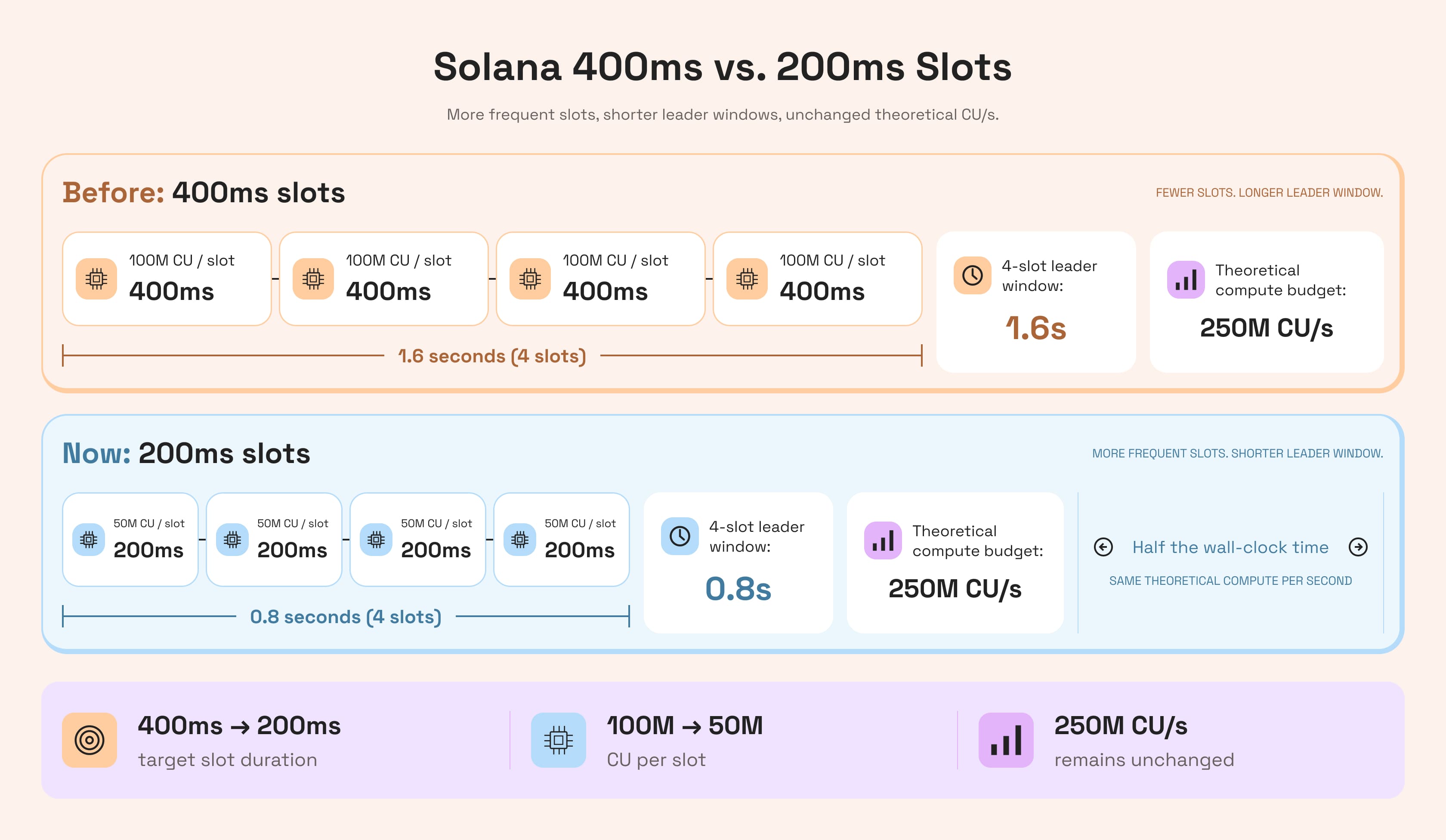
Solana activated 100M CU blocks on July 29, 2026. Under SIMD-0525, per-slot execution limits scale proportionally as slot duration decreases.
At the October 2026 configuration:
This is a protocol-limit calculation, not a measured transaction throughput result. Actual capacity depends on block production, compute usage, account contention, and other limits.
The 50M CU baseline is also documented in the October 10 discussion about raising block limits again. That increase was a proposal at the time, not part of the completed 200ms rollout.
Operational consequence: A trading bot should not assume twice as much compute capacity or twice as many successful trades. More frequent blocks offer more inclusion opportunities, while individual blocks accommodate less aggregate compute.
And another thing deserves our attention. Solana's separate Alpenglow consensus upgrade, targeting faster finality, is scheduled for epoch 1064 around October 21, 2026. As of October 15, its mainnet transition is still upcoming. Do not confuse the 200ms slot activation with Alpenglow's finality target or assume its future commitment behavior is already in production.
Impact analysis by bot type
The impact we’ve described below depends on signal decay, competition, infrastructure, and whether the bot submits transactions immediately or waits for confirmation.
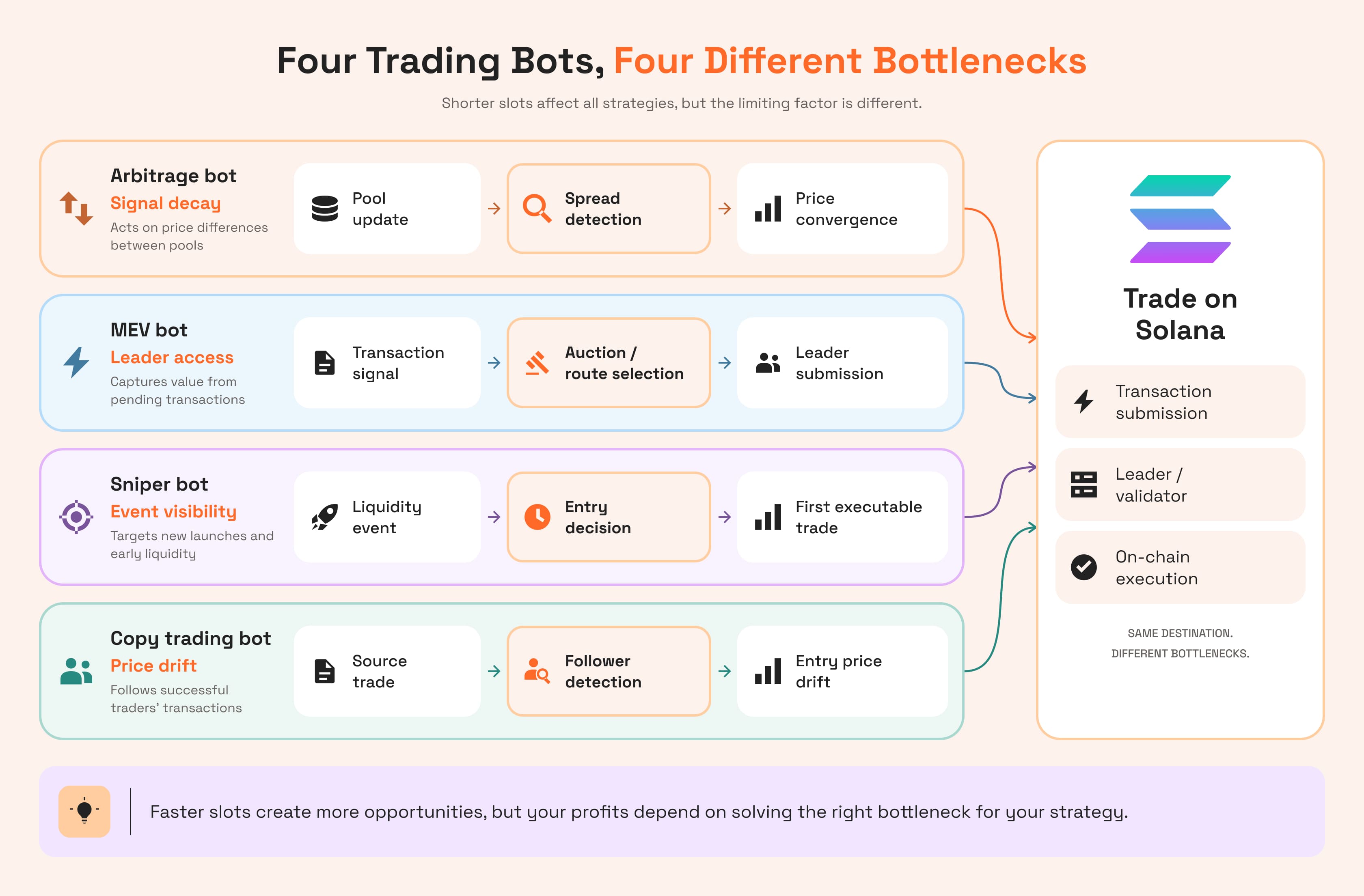
Type 1: Arbitrage bot—the most direct timing exposure
Arbitrage strategies are especially sensitive when the opportunity exists only until another trader corrects a price discrepancy. Consider a bot monitoring two Solana DEX pools. The relevant cycle is:
Pool update → detect price discrepancy → estimate net proceeds → build transaction → submit → land.
With 200ms slots, the network offers more frequent block-production opportunities. Competing bots also obtain those opportunities.
A faster network does not preserve the arbitrage spread. It may shorten the wall-clock time before another trade removes it.
Retune:
- Replace fixed-interval quote polling with filtered account or transaction streams.
- Keep pool state locally and update it as new data arrives.
- Reject signals using measured age and estimated execution cost.
- Track same-slot and next-slot landing rates separately.
- Recalculate expected proceeds when the relevant accounts change.
For atomic arbitrage, transaction failure is often preferable to completing only one leg. Where appropriate, keep the execution atomic within one Solana transaction, with on-chain minimum-output or profit checks.
Decision rule: Optimize the interval from the first usable market signal to transaction arrival at the leader, then test whether the reduced interval improves net realized profit.
Type 2: MEV bot—more frequent auctions, tighter competition
MEV searchers depend on a different combination of early transaction visibility, execution ordering, and leader access. Shorter slots reduce the time available to observe a signal and reach the relevant execution path before leadership advances.
Jito's low-latency transaction infrastructure remains relevant for bundles and auctions, as well as RPC Fast’s Shedstream. Jito’s auction cadence and bundle mechanics are separate from Solana's slot duration; a 200ms slot does not mean an arbitrary bundle automatically settles in 200ms.
Retune:
- Measure first-shred or first-transaction visibility against other feeds.
- Update leader schedules and route choices at the new cadence.
- Reprice tips using observed competition, not a fixed multiplier.
- Separate landing failures caused by timing from failures caused by auction competitiveness.
- Avoid building a fresh competing transaction before resolving the status of an earlier submission.
A strategy that lands more frequently but spends its additional margin on tips has not improved profitability.
Decision rule: Optimize expected profit per successful opportunity after tips, priority fees, and failed-attempt costs.
Type 3: Sniper bot—launch-event visibility becomes more important
Sniping is not automatically the least-affected category. For tokens or pools where the first executable liquidity event creates an opportunity, the decisive factor is the delay between that event becoming observable and a transaction reaching a leader.
A bot detecting pool creation through delayed confirmed data competes with systems processing earlier transaction or shred-level signals. The faster slot cadence makes event timing more important, particularly when competing transactions fill early liquidity at sharply changing prices.
Retune:
- Subscribe to the specific program activity relevant to the launch.
- Precompute static program accounts and transaction instructions.
- Validate mint, pool, authority, and risk constraints before submission.
- Cap slippage and transaction size for volatile, shallow pools.
- Measure the first tradable observation, not merely the first notification.
Shorter slots do not reduce rug-pull risk, toxic liquidity, or unexpected token-program behavior.
Decision rule: Treat faster execution as one component of a valid-entry strategy. A faster purchase at an unacceptable price remains a bad trade.
Type 4: Copy-trading bot—follower delay still determines execution quality
Copy trading tends to have less direct slot-level sensitivity when it follows strategies with longer holding periods. But the source trade creates price impact. A follower entering several slots later might face a materially worse price even if the original trader remains profitable.
A typical copy-trading path includes detection of the leader's transaction, asset and risk filtering, position sizing, quote construction, and submission. Every synchronous RPC call in that path adds time.
Retune:
- Use transaction streams rather than repeated signature-history polling.
- Filter leader wallets and transaction types before intensive decoding.
- Maintain local balances and token metadata.
- Set a maximum follower delay based on the source strategy.
- Reject trades where the follower's achievable entry price destroys the expected edge.
For a strategy holding assets for hours, the difference between 200ms and 400ms is unlikely to dominate expected returns. For immediate momentum copying, it may matter substantially.
Decision rule: Measure follower entry-price deviation and realized follower P&L, not just the delay between two signatures.
Bot parameter tuning
The safest adjustment is to separate different time budgets instead of applying one “200ms timeout” throughout the system.
1. Execution timeout: Distinguish three independent clocks
A common implementation mistake is treating RPC request timeouts, signal expirations, and transaction blockhash expirations as the same constraint.
The Solana transaction confirmation guide recommends tracking lastValidBlockHeight rather than relying on a fixed expiration timer.

Under the 200ms setting, the commonly cited nominal blockhash lifetime is approximately 30 seconds instead of 60 seconds. Actual wall-clock expiration varies with produced blocks and network conditions.
A 30-second-valid transaction is not necessarily a 30-second-valid arbitrage opportunity.
Practical example: Suppose replay analysis shows that an opportunity usually becomes unprofitable after 180ms. A reasonable first experiment is to reject signals older than a measured threshold below that boundary, while keeping transport and transaction-status tracking independent. The value must come from your data, not the network's slot target.
2. Price refresh rate: Switch from polling to event-driven updates
Price refresh logic should respond to relevant state changes rather than waking once per slot. For most active Solana trading systems, the more effective pattern is:
Filtered stream → update local account state → recalculate quote → evaluate opportunity.
Yellowstone gRPC provides structured account and transaction subscriptions. Earlier-data products such as Shredstream and Aperture TxStream target strategies where the additional detection lead matters.
Do not poll RPC every 10ms to compensate for 200ms slots. That approach increases request volume, duplicated responses, and rate-limit exposure without guaranteeing fresher information.
Track stream lag, sequence gaps, reconnects, and stale account state. A fast notification service with an overloaded consumer still produces delayed trading decisions.
3. Retry logic timeout: Separate delivery retries from trade retries
Retrying a signed transaction and constructing a new transaction are not equivalent.
A sendTransaction response confirms RPC acceptance, not on-chain inclusion. Solana's sendTransaction documentation distinguishes submission from subsequent status.
For the same trading attempt:
- Track the existing signature with
getSignatureStatuses. - Retry or distribute the same signed bytes according to the route's policy.
- Stop retrying when the trade is no longer desirable, even if the blockhash remains valid.
- Avoid signing an economically equivalent transaction with a new blockhash until you handle duplicate-execution risk.
Parallel submission over distinct routes can improve delivery resilience, but it adds operational cost and requires deduplication-aware state management.
Decision rule: Use an explicit opportunity state machine: detected → built → submitted → observed → confirmed/failed/expired. Never equate an HTTP timeout with a transaction failure.
4. Minimum spread threshold: Make the threshold net of execution costs
Faster slots do not justify a universal increase or decrease in the minimum arbitrage spread.
The correct threshold is strategy-specific:
Expected net edge = Gross price advantage − DEX fees − expected adverse price movement − network fees − relay tips − failure-risk allowance.
Consider an illustrative $10,000 arbitrage attempt.
This is an illustrative calculation, not a measured trading result.
If another 4 bps of adverse movement occurs before execution, the $4 estimated profit disappears. The goal is therefore to model how execution delay changes the distribution of realized edge.
Decision rule: Set the minimum spread using observed costs and opportunity survival probabilities, then validate it against completed and failed trades.
5. Maximum slippage allowed: Tighter execution is not permission for looser limits
Slippage tolerance is an economic risk control, not a latency optimization. The shorter slot interval might reduce some stale-state exposure, but it does not eliminate price impact, competing swaps, sandwiches, or sudden liquidity withdrawals.
Set maximum slippage according to available edge, pool depth, trade size, and market risk. Enforce executable price boundaries on-chain wherever the protocol supports them. A wider slippage setting might improve landing or swap completion while materially reducing profitability.
Decision rule: Compare the incremental completion rate against the incremental cost of worse fills. Optimize realized P&L, not transaction success rate in isolation.
Summary: What to change first
Code optimization strategies
The often-repeated savings of 50ms from pre-simulation, 30ms from batching, and 20ms from caching are not universal Solana performance figures. Savings depend on the original architecture, account state, infrastructure, and network round trips.
The key optimization principle is to remove work from the critical path only when you preserve correctness.
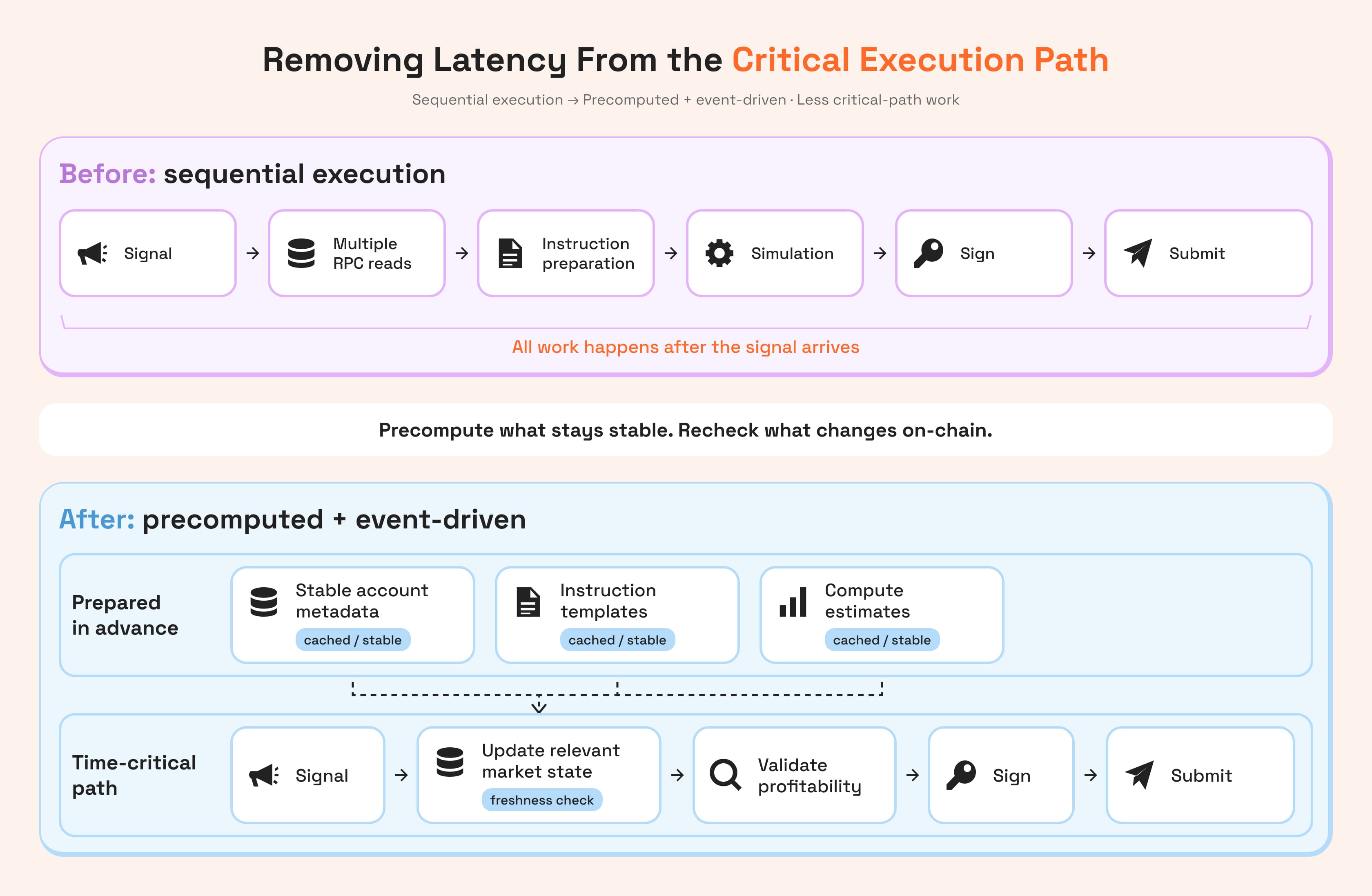
Strategy 1: Pre-simulate reusable transaction templates
Pre-simulate stable transaction structures rather than stale market conditions. Solana's simulateTransaction returns execution results, errors, and resource-use information. It helps validate instruction composition and estimate compute budgets. For repeatable strategies, move deterministic work earlier:
- Prepare account metas and instruction layouts.
- Validate known program behavior.
- Cache compute-budget estimates for relevant execution variants.
- Resolve address lookup tables and stable metadata before a signal arrives.
However, a pre-simulation against an earlier bank does not guarantee success against live pool reserves, token balances, or account locks.
For a time-sensitive trade, decide whether to perform final simulation based on the trade's risk profile. Skipping preflight reduces one source of waiting but transfers more responsibility to the bot's own validation.
Measure: signal-to-signature latency, simulation error rate, execution failure rate, and lost profit from rejected or stale transactions.
Strategy 2: Batch related operations
Batch reads when they need a coherent view of state. For example, getMultipleAccounts supports up to 100 addresses in one request and returns a shared response context.
This is often cleaner than making several sequential account queries to build an arbitrage quote.
A typical optimization is:
Before: fetch pool A → fetch pool B → fetch vault balances → calculate.
After: fetch the required accounts together → validate context → calculate.
The second pattern avoids avoidable sequential network waits, although the exact latency improvement varies.
For writes, atomic multi-instruction transactions are useful when all legs must succeed together. Jito bundles address a related but different requirement: coordinating multiple transactions under bundle execution rules.
Batching unrelated operations without respecting writable-account contention might increase failures or compute costs.
Measure: RPC round trips, context consistency, payload size, transaction CU usage, and successful atomic execution.
Strategy 3: Cache stable on-chain data and enforce freshness
Caching helps when the cached value remains valid for the decision being made. Safe candidates include token decimals, established program IDs, instruction templates, and address lookup metadata that is refreshed on change.
Dynamic values—pool reserves, concentrated liquidity state, oracle observations, account balances, and recent blockhashes—require explicit freshness checks.
Maintain the last observed slot for each mutable account. Reject or refresh quotes that mix incompatible state versions. A minimal TypeScript-style opportunity filter might look like this:
function shouldTrade(
  ageMs: number,
  expectedGrossBps: number,
  costsBps: number,
  maxSignalAgeMs: number,
  minNetEdgeBps: number
): boolean {
  const netEdgeBps = expectedGrossBps - costsBps;

  return ageMs <= maxSignalAgeMs
      && netEdgeBps >= minNetEdgeBps;
}
Here, calculate ageMs using timestamps from the same clock domain. The function is only an off-chain admission check; on-chain price bounds, account validation, and transaction-state handling remain mandatory.
Measure: cache-hit rate, stale-state rejections, inconsistent-slot reads, and resulting execution failures.
Solana vs. Emerging trading chains: What 200ms slots change
Solana's upgrade strengthens its latency position, but alternative chains compete through different execution architectures and market structures.
For trading bots, raw block intervals are a poor standalone comparison. A decentralized L1 slot, an L2 sequencer preconfirmation, a streamed mini-block, and a committed orderbook response are different events.
The relevant comparison is time to an actionable and economically useful execution result, together with liquidity, sequencing policy, operational dependencies, and settlement guarantees.
Decision matrix
Sources: Solana Foundation, MegaETH mini-block docs, Base Flashblocks engineering, ArbitrumDAO's Robinhood Chain factsheet, and Hyperliquid's latency docs.
These numbers deliberately describe their original measurement stages. A 10ms sequencer mini-block is not evidence of a 10ms Ethereum-settled trade, just as a 200ms Solana slot is not evidence of 200ms confirmed execution.
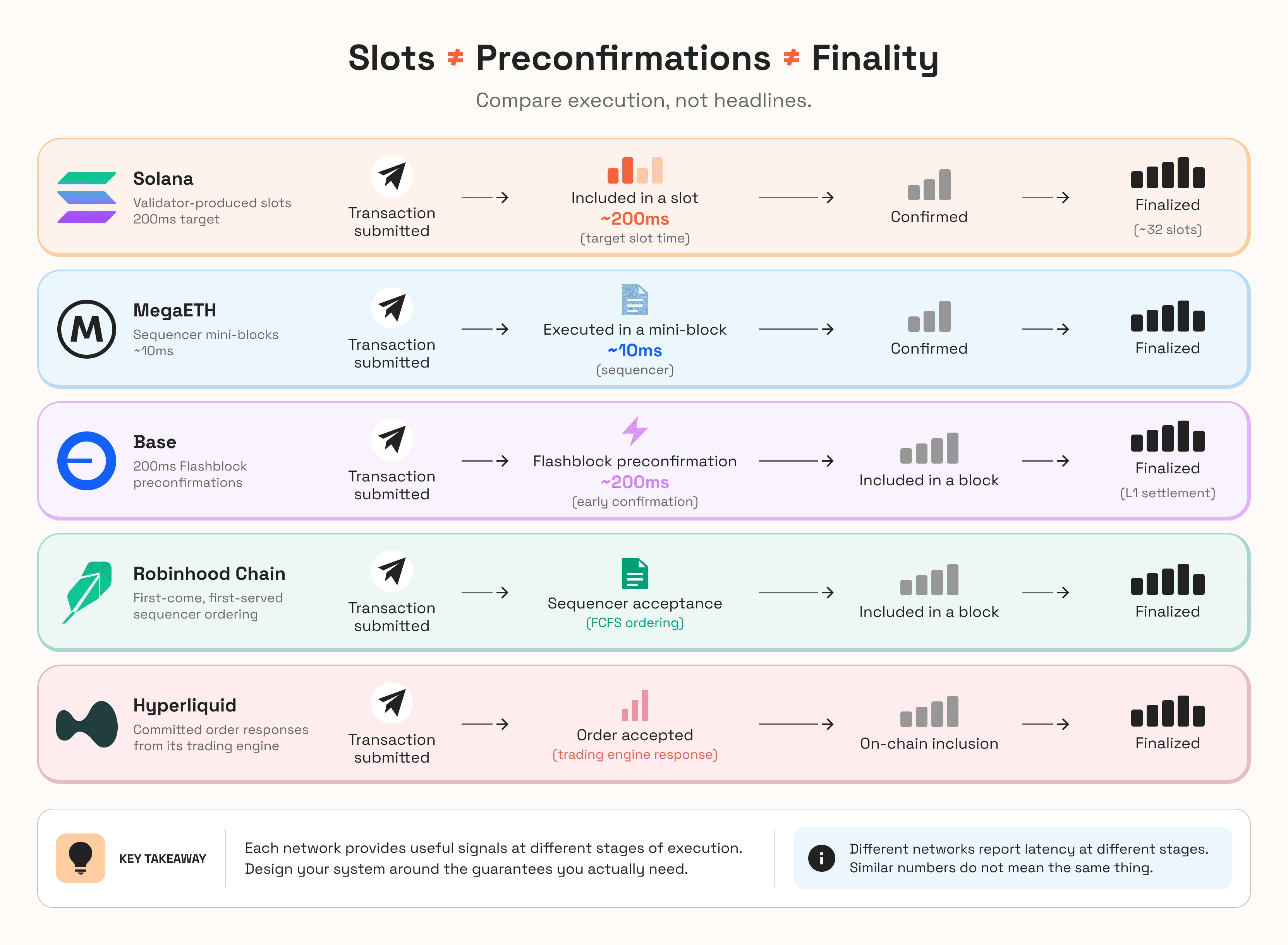
Robinhood Chain is a fair production comparison: its public mainnet launched July 1, 2026. Its documentation describes first-come, first-served sequencing based on arrival time, where higher priority fees do not move a transaction ahead in the queue.
That creates a different optimization problem from Solana's leader and fee-market behavior.
Stay on Solana if
Solana remains the natural execution environment when your opportunity depends on assets, pools, lending markets, or transaction flow native to Solana.
Its advantages for a trading operator include a developed DeFi execution ecosystem, specialized low-latency data feeds, direct leader-oriented submission infrastructure, and strategies built around atomic on-chain transactions. The new slot cadence strengthens that case for teams already measuring and optimizing their execution path.
Retuning is likely more economical than migration when your primary bottleneck is stale data, inefficient transaction construction, or poor landing routes rather than a lack of tradable opportunities.
Consider other chains if
A different network becomes attractive when it changes the available market, not merely the advertised timing figure.
- MegaETH: relevant for EVM-native applications needing high-frequency sequencer feedback and real-time state access.
- Base: relevant when deeper EVM ecosystem access and Flashblock preconfirmations matter to the strategy.
- Robinhood Chain: relevant for strategies targeting tokenized assets and the applications developing around that chain.
- Hyperliquid: relevant when the bot's core activity is orderbook trading, including placing and canceling spot or perpetual orders.
Migration requires a new execution model, account and transaction infrastructure, liquidity assessment, data pipeline, risk controls, and historical testing.
A strategy profitable on Solana AMMs does not become profitable on Hyperliquid's orderbook merely because one execution metric looks competitive.
Example: Choosing between a faster chain and a better trading opportunity
Consider two hypothetical venues.
- Venue A offers a 200ms target block interval and enough liquidity for a $20,000 trade with limited price impact.
- Venue B offers 10ms sequencer preconfirmations, but the executable pool is much shallower, producing an additional 30 bps of price impact.
On $20,000, 30 bps represents $60 of additional execution cost.
The faster preconfirmation only compensates for that cost if it enables sufficient additional profit, improves fill probability, or prevents losses exceeding $60.
For the bot operator, the relevant metric is:
Expected net profit per opportunity = probability of profitable execution × conditional trading proceeds − expected execution and failure costs.
The decision should come from comparable real order sizes, market conditions, and end-to-end measurements—not a block-time leaderboard.
Testing and monitoring
Step 1: Backtest with measured 200ms behavior
Backtesting needs to model the actual ordering and aging of opportunities. Simply dividing historical timestamps by two produces misleading results.
Use mainnet observations from the completed 200ms rollout where available, including the recorded slot cadence rather than assuming a perfect 200ms interval. Replay:
- Account and transaction updates in observed order.
- Delays between signal arrival and strategy evaluation.
- Quote changes before execution.
- Transaction inclusion and failure outcomes.
- Priority fees, tips, compute costs, and realized slippage.
Compare the existing configuration with proposed tuning changes using the same opportunity dataset.
The evaluation should report both profit and risk: net P&L, profit per opportunity, drawdown, successful execution percentage, and losses attributable to stale signals. A parameter set that maximizes same-slot landing but increases unprofitable fills is not an improvement.
Step 2: Test on devnet/testnet for one week, then shadow mainnet
Solana devnet and testnet have already activated the shorter-slot configuration, making them useful for verifying integration behavior. Run at least a week of automated integration tests as a practical observation window, covering:
- Transaction signing and blockhash expiration.
- Slot-based scheduling and leader updates.
- Stream reconnects and event gaps.
- Retry-state transitions.
- Simulation, compute budgets, and instruction validation.
- Queue growth when update frequency increases.
Do not treat a week on testnet as proof of trading profitability. It does not reproduce mainnet liquidity, searcher competition, auction behavior, or production fee conditions.
After integration testing, run a shadow strategy against mainnet feeds. Record signals and hypothetical transactions without submitting live trades, then progress to controlled, risk-limited mainnet execution.
Step 3: Build a live monitoring dashboard
A useful dashboard separates detection, execution, landing, and economics.
Measure from the same client host and clock domain wherever possible. Network timestamps, local receipt timestamps, and chain block timestamps do not offer interchangeable millisecond precision.
Use getSignatureStatuses and block-height-aware tracking for transaction outcomes. Track latency distributions by provider, region, strategy, and congestion period.
For reference, RPC Fast's published Beam benchmark reported average submit-to-landed latency of 330ms through Beam versus 457ms through standard RPC, with 20 runs per route. The p90 results were 589ms and 1,066ms, respectively.
The important limitation: these runs preceded the 200ms-slot rollout. Both paths recorded 12 of 20 same-slot inclusions. They show why you must evaluate average landing latency, tail latency, and same-slot success separately; they do not establish a post-upgrade performance gain.
To measure the October change, rerun the experiment under the current network configuration using your own trade patterns, account contention, fee policies, and geographic deployment.
An actionable checklist for retuning your Solana bot for 200ms slots
Use this checklist to audit your existing configuration, test changes against production data, and deploy without introducing unnecessary execution risk.

1. Measure your current performance
- Establish a baseline. Record at least 24–72 hours of signal-to-decision, build/sign, submission, and landing latency at p50, p95, and p99.
- Measure signal freshness. Record the source slot, local receipt time, and signal age when each trading decision occurs.
- Identify the bottleneck. Determine whether market data delivery, bot processing, network forwarding, or leader inclusion consumes the largest share of execution time.
- Calculate profitability by latency bucket. Compare realized net P&L for trades grouped by signal age and submission-to-landing delay.
2. Retune execution parameters
- Separate your three timeouts. Configure signal expiration, RPC response timeout, and transaction validity independently. Do not automatically halve existing values.
- Update blockhash handling. Track
lastValidBlockHeight, refresh blockhashes before signing, and stop retries when transactions expire or opportunities lose profitability. - Replace critical-path polling. Use Yellowstone gRPC or earlier transaction streams where measured signal freshness justifies the integration.
- Reduce synchronous RPC calls. Cache stable metadata, prebuild instruction templates, and batch related account reads where appropriate.
- Recalculate spread and slippage limits. Include DEX fees, priority fees, tips, expected price impact, and failed-attempt costs.
- Review transaction delivery. Benchmark standard RPC, Beam, and eligible leader-oriented routes using the same transaction workload and client region.
- Prevent duplicate execution. Track pending signatures and transaction state before rebuilding or re-signing an economically equivalent trade.
3. Validate before increasing trading volume
- Replay historical opportunities. Compare the existing and proposed configuration using recorded market events, realistic latency, and execution costs.
- Test failure scenarios. Include stream disconnections, delayed slots, stale blockhashes, RPC timeouts, congestion, and duplicate notifications.
- Deploy incrementally. Start with shadow-mode decisions, then limited-capital mainnet trading before expanding exposure.
- Set rollback conditions. Revert changes if realized net P&L, landing rate, execution failure rate, or tail latency deteriorates beyond predefined limits.
Production acceptance criteria
Final decision: Keep a tuning change only when it improves risk-adjusted realized profitability or a defined reliability objective. Lower latency alone is not sufficient evidence of better trading performance.
Retune the details of the execution pipeline using the right tools
RPC Fast provides Yellowstone gRPC and low-latency streaming, Aperture TxStream, and Beam transaction delivery for different stages of that pipeline.
Solana's 200ms slots improve the frequency of potential execution windows, while making stale signals, poorly designed retries, and slow transaction routes more consequential.
The upgrade does not double compute throughput, eliminate congestion, guarantee same-slot landing, or make every strategy more profitable.
For most production bots, the highest-value sequence is to measure signal freshness, remove unnecessary work from the hot path, use a route matched to the strategy, and evaluate the full distribution of executed trade outcomes.