
SOLANA RPC COMMUNITY
Built for Solana builders.Run by operators.
Join builders running HFT bots, DEX tools, and AI agents on Solana.
Join Discord

Special offers

Live support

No spam

SOLANA RPC COMMUNITY
Built for Solana builders.Run by operators.
Join builders running HFT bots, DEX tools, and AI agents on Solana.
Join DiscordSpecial offers
Live support
No spam
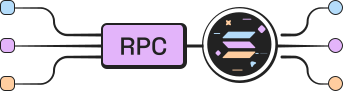
RPC req/s
Concurrent WebSockets
Bandwidth on paid plans
Infrastructure at Equinix FR13
Start with a free endpoint, load balances, and token accounts; track signatures in real time, simulate transactions, and submit signed transactions.
Move to heavier RPC methods, more WebSocket connections, Yellowstone gRPC, or dedicated infrastructure as wallet traffic grows.


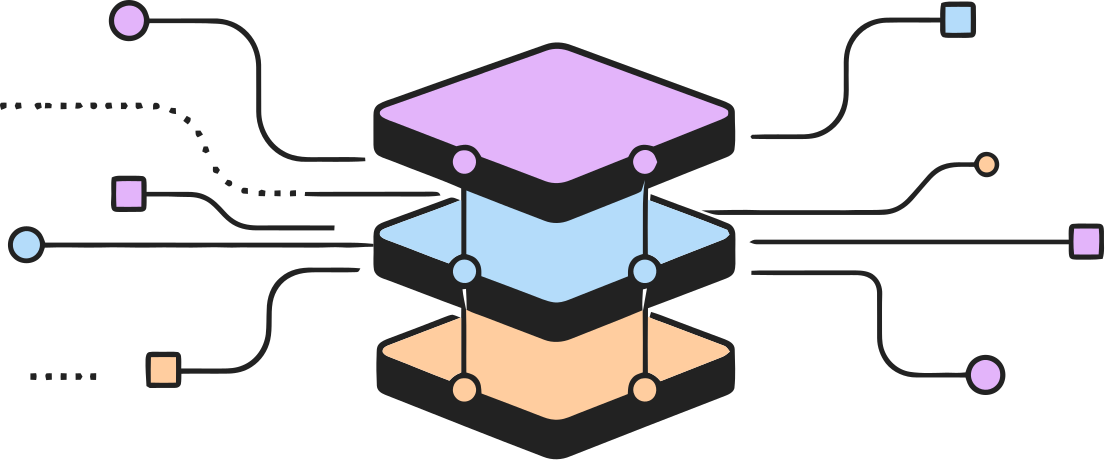
RPC Fast gives wallet teams JSON-RPC for direct reads and writes, WebSockets for live state changes, and higher-throughput streaming when backend event ingestion outgrows standard subscriptions.

Fast wallet reads

Real-time updates

Reliable transactions

Fresh blockhashes

Transaction simulation

Confirmation tracking

Balances, token accounts, transaction history

Structured accounts, transactions, slots, and blocks

Best for development, SOL balance reads, basic transactions, and early wallet UI work.

Production entry
Best for SPL wallet backends that need token account discovery and more request capacity.
10 WebSockets

Best for larger wallet products moving from repeated RPC reads to centralized real-time ingestion.
20 WebSockets

Best for wallet products with advanced trading or execution workflows.
50 WebSockets
Shredstream + Aperture data products
ALL-IN-ONE WALLET RPC
Build your Solana wallet on RPC infrastructure that scales with the workload
Access JSON-RPC and WebSockets, add heavier RPC methods, and move backend event ingestion to Yellowstone when token portfolios enter production.
FAQ
Wallets are just interfaces—they need RPC endpoints to connect to the blockchain. RPC fetches your balance, verifies transactions, broadcasts swaps, and confirms receipt of funds. Without RPC, wallets can't function. Faster RPC = faster balance updates and transaction confirmations.
Entire process takes 2-5 seconds with fast RPC.
Yes. Most wallets (Phantom, Magic Eden, Solflare) allow custom RPC in settings. You can point to RPC Fast for better performance than default public RPC. Settings → Network → Custom RPC → enter RPC Fast endpoint.
During high traffic:
During calm periods:
Fast RPC shines during congestion when everyone else is waiting.
Hardware wallet (Ledger) stores private keys, computer's wallet software connects to RPC. Hardware wallet signs transaction locally, wallet broadcasts via RPC. Private key never touches computer. Fast RPC speeds up broadcasts but doesn't improve security.
Fast RPC = faster reward tracking, quicker unstaking.
Transaction is in mempool, waiting for validator to include in block. Takes 1-3 seconds normally. With slow RPC, wallet might show "pending" for 5-10 seconds after already confirmed. Fast RPC detects confirmation faster.
User opens wallet → wallet connects to RPC endpoint → RPC fetches balance and transaction history → user can send/receive funds. Most wallets use default RPC (Solana public) but users can switch to custom RPC like RPC Fast for better speed.
Best practice: Every 10-30 seconds for active users. Slow RPC might take 1-2 minutes for balance update, causing confusion. Fast RPC updates instantly, improving user experience dramatically.
All use same RPC concept, but Phantom is industry standard for Solana.
Premium RPC improves user experience significantly.
Security risk: Minimal difference. Both public and custom RPC can't see private keys (signing happens locally). Risk is if RPC is compromised, it could show fake balances or fail to broadcast transactions.
Mitigate: Use trusted RPC providers (RPC Fast, Alchemy, QuickNode).
Yes. Phantom Mobile, Magic Eden Mobile, and Solflare Mobile all support custom RPC. Settings → Network → Add Custom Network → enter RPC endpoint URL. Same benefits as desktop (faster confirmations, better UX).
Faster RPC = faster NFT transfers, quicker metadata loading.


.jpg)


.jpg)

