





.jpg)
RPC Fast is the best-fit GetBlock alternative in this comparison for Solana HFT, MEV, arbitrage, and transaction-heavy systems where pre-execution data and transaction delivery belong in one latency-sensitive pipeline. Aperture TxStream delivers reconstructed transactions with ALT resolution and optional execution prediction, while Beam routes signed transactions through Astralane, bloXroute, Nozomi, and Falcon.
TL;DR
- RPC Fast: Best fit for HFT and MEV teams that want decoded pre-execution transactions, ALT resolution, optional execution prediction, multi-provider Beam submission, and a path from shared SaaS to dedicated or HA infrastructure.
- Helius: Strongest Solana-native application stack. LaserStream offers 24-hour replay; Helius also exposes raw shreds, preprocessed TXs, Preconfirmations, and Sender.
- QuickNode: Strong choice for multi-chain teams. Since June 2026, Blazar also exposes beta pre-execution transactions through shredTransactionSubscribe, including ALT-aware filtering.
- Triton One: Strong fit for low-level Solana streaming. Riptide is live on Mainnet, raw Triton Shred Streaming is in beta in five cities, Deshred reconstructs transactions before replay, and Fumarole provides four days of resumable stream retention.
- Chainstack: Practical option for standard Yellowstone consumers and teams that want a distinct bloXroute-backed transaction route. Yellowstone starts at $49/month for two streams; Warp costs $0.15 per submitted transaction.
- GetBlock already covers raw/deserialized shreds. Older comparisons that describe direct shred delivery as a future GetBlock feature are now stale. The current product costs $300/month, with a $20 24-hour test.
Why consider a GetBlock alternative?
GetBlock has moved beyond standard RPC. Its current Solana page lists shared infrastructure from $49/month, dedicated bare-metal nodes from $3,200/month, and Yellowstone gRPC as a $400/month dedicated-node plugin. StreamFirst combines provider-side shred ingestion with accelerated Yellowstone, while LandFirst combines SWQoS, BDN, and block-engine routes.
Its standalone Shred Streams product fills a historical gap. GetBlock delivers raw or deserialized shreds via UDP or gRPC, offering a $20 24-hour test, a $300 monthly subscription, and a Frankfurt ingest point. Its 1.38M-shred comparison is an internal benchmark, so latency results shouldn't be seen as independent evidence.
Meanwhile, its accelerated Yellowstone/StreamFirst stack is centered on dedicated Solana nodes, rather than being the same self-service product as standalone Shred Streams.
So GetBlock now has strong early-data primitives, but the public architecture is split between a self-service Frankfurt shred product and a more dedicated-node-centric accelerated trading stack.
That makes the geographic deployment model and how much infrastructure you want bundled into a dedicated setup more relevant differentiators than "does GetBlock have shreds?"
Workload causes for alternatives
A different provider becomes relevant when your workload needs: execution prediction with pre-execution transactions, longer replay after outages, multiple providers behind one interface, validator-scheduler preconfirmations, Solana-native APIs and data, usage-based streaming, different node regions or HA topology, or an independent failover domain.
An alternative need not replace GetBlock completely; trading systems often split tasks among providers to reduce failure risk and enhance performance.
How we compared GetBlock alternatives
This comparison uses provider documentation, current pricing pages, release announcements, and technical product pages checked on August 18, 2026. We do not rank providers using headline latency figures because their measurement boundaries differ.
We evaluated six areas:
- JSON-RPC, WebSockets, heavy methods, and historical access;
- Yellowstone-compatible gRPC, reconnect behavior, and replay;
- Raw shreds, reconstructed transactions, and other pre-execution signals;
- SWQoS, Jito, specialized transaction senders, and routing;
- Shared, dedicated, and high-availability infrastructure;
- The workload and cost model each platform serves most effectively.
One distinction matters: provider-side ShredStream, customer-facing raw shreds, reconstructed transactions, and scheduler Preconfirmations are not interchangeable.
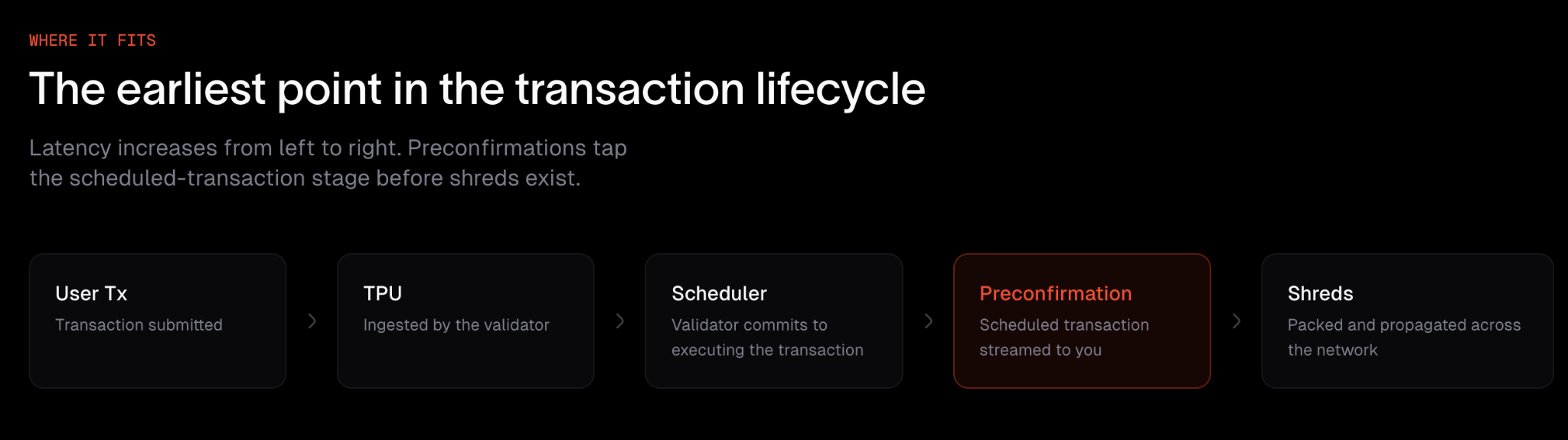
Chainstack uses Jito ShredStream inside its Solana nodes to improve Geyser freshness. GetBlock, Helius, and Triton expose raw shreds directly to customer infrastructure. RPC Fast TxStream, Triton Deshred, Helius preprocessed TXs, GetBlock deserialized shreds, and QuickNode shredTransactionSubscribe perform reconstruction before delivery. Helius Preconfirmations tap an even earlier scheduler stage, before shreds exist, but coverage depends on participating validator stake.
.jpg)
Best GetBlock alternatives in comparison
RPC Fast: Best for real-time Solana execution infrastructure
RPC Fast fits teams where receiving a signal and landing the response mean one performance problem. Its SaaS stack separates JSON-RPC, WebSockets, Yellowstone gRPC, shred-derived feeds, Aperture TxStream, and Beam transaction delivery; dedicated infrastructure adds isolated hardware and HA deployment options.
.avif)
TxStream is the main differentiation against GetBlock's deserialized Shred Streams. It reconstructs transactions from deshredded data and, on Aperture, attaches a predicted execution result before the transaction lands.
RPC Fast reports roughly 95% agreement with subsequent execution at approximately +791 µs median delivery overhead for the prediction layer. Those numbers are RPC Fast's own product measurements, not a controlled GetBlock comparison.
Beam addresses the other half of the loop. It routes through Astralane, bloXroute, Nozomi, and Falcon in fastest mode and charges 5 CU per submission. Current limits are 60 transactions/minute on Start, 200 on Focus, and 500 on Stream/Aperture.
.jpg)
Best for:
- Arbitrage and liquidation bots;
- HFT and MEV infrastructure;
- Copy-trading systems;
- ALT-heavy early transaction monitoring;
- Teams measuring signal-to-landed latency;
- Dedicated or HA Solana deployments.
Pricing: Regular list pricing is $45 for Focus, $249 for Stream, and $499 for Aperture; the pricing page currently displays summer-sale prices of $36, $199, and $399. Yellowstone starts on Stream.

Methods not available:
-
getProgramAccounts
-
getTokenAccountsByOwner
-
getTokenAccountsByDelegate
-
getTokenLargestAccounts

Heavy methods available:
-
getProgramAccounts
-
getTokenAccountsByOwner
Heavy methods NOT available:
-
getTokenAccountsByDelegate
-
getTokenLargestAccounts
BEST VALUE
No limitations. No rate limits
Use any RPC method of your choice.
No limitations. No rate limits
Use any RPC method of your choice.
Aperture provides up to 10 Shredstream streams and the full execution-oriented TxStream path. RPC Fast states that limited Stream-tier TxStream access becomes Aperture-exclusive from September 1, 2026. Dedicated Solana nodes start at $2,200/month in the EU.
Trade-offs: RPC Fast fits teams willing to adopt a specialized pre-execution interface to remove decode, ALT, and optional simulation work from the critical path. TxStream predictions still require post-execution reconciliation, partial ALT resolution, and handling unavailable simulation states. Dedicated nodes do not cover archival workloads.
Helius: Best for Solana-native APIs plus trading infrastructure
Helius has the broadest Solana-specific product layer among these alternatives. LaserStream provides Yellowstone-compatible gRPC and WebSockets, multi-node redundancy, automatic reconnects, and 24-hour historical replay. Its preprocessed TX stream reconstructs data from shreds, and Helius reports delivery up to 8 ms ahead of its processed stream.
Helius offers two earlier options: Raw Shred Delivery provides unprocessed shred data, and Preconfirmations stream a validator's scheduled transaction before shreds exist. Preconfirmations are an early signal, not a guarantee; coverage depends on validator stake, and gaps are the consumer's responsibility. They cost 10 credits per transaction and are available on Professional plans.
Sender provides the write path. Sender Max starts at a 0.001 SOL minimum tip, while SWQoS-only starts at 0.000005 SOL. Helius lists seven regional endpoints, a 50 TPS default, and zero API-credit consumption for Sender.
Best for:
- Wallets, explorers, and token applications;
- Enriched transaction and asset data;
- HFT teams evaluating Preconfirmations;
- Bots needing raw or preprocessed shreds plus a sender;
- Solana-only engineering organizations.
Pricing: Mainnet LaserStream is included from the $499 Business plan. Raw shreds cost $1,000/month per IP, reduced to $800 on Professional. Dedicated nodes start at $2,900/month. Streaming data, RPC credits, raw-shred seats, Preconfirmation credits, and transaction tips remain distinct billing dimensions.
Trade-offs: Helius offers unusually broad Solana coverage, but its fastest signals have different reliability and coverage properties. Preconfirmations depend on participating validator stake, preprocessed transactions are best-effort and lack execution metadata, and production trading systems still need a post-execution stream for reconciliation.
QuickNode: Best for multi-chain application infrastructure
QuickNode is no longer a processed-data-only comparison. On June 30, 2026, it introduced Blazar shredTransactionSubscribe, a beta WebSocket method that exposes transactions observed from shred/entry ingestion before execution. Blazar resolves ALT-loaded addresses for account filtering and emits the transaction body, slot, signature, version, and resolved addresses when available.
The feed is best-effort. QuickNode notes possible duplicates, no strict order, and no execution metadata like logs, errors, balances, instructions, or compute units. WebSocket on Blazar endpoints costs 15 API credits per 0.1 MB.
QuickNode also offers Yellowstone-compatible Solana gRPC, managed Streams, Smart Transactions, priority-fee tooling, and Lil' JIT for Jito bundles. Solana gRPC is included on Scale and Business; lower plans use the paid add-on. Replay through fromSlot reaches up to 3,000 recent slots, roughly 20 minutes.
Best for:
- Multi-chain wallets and applications;
- Teams already standardized on QuickNode;
- Solana products combining gRPC and managed Streams;
- Pre-execution account monitoring through a WebSocket interface;
- Systems using Smart Transactions and Jito bundles.
Pricing: Standard monthly list prices remain $49 Build, $249 Accelerate, $499 Scale, and $999 Business, with current annual discounts shown separately. The pre-execution Blazar method is still beta and does not expose raw shreds themselves. Teams requiring UDP-level shred control should compare GetBlock, Helius, or Triton instead.
Trade-offs: Blazar removes much of the integration burden of consuming pre-execution Solana data, but shredTransactionSubscribe remains beta and best-effort. Applications must deduplicate messages, tolerate non-strict ordering and unresolved ALTs, and correlate every early observation against a post-execution source.
Triton One: Best for low-level Solana streaming and replay
Triton One changed materially in August 2026. Riptide is now generally available on Mainnet as a lower-latency delivery path for the existing Dragon's Mouth gRPC service. Triton Shred Streaming is also live in beta from New York, London, Amsterdam, Frankfurt, and Tokyo, delivering raw shreds directly to customer servers.
Deshred reconstructs transactions before validator Replay with server-side filtering and ALT resolution, providing an earlier signal without owning shred reconstruction. Triton's benchmark reports ~6.3 ms p50 and ~20 ms p90 for internal processing from shred arrival at its node, not client-to-provider latency.
Fumarole addresses completeness rather than first-byte speed. It tracks server-side cursors and provides four days of rolling retention with resume/backfill after disconnects. Fumarole exited beta on June 1, 2026.
For transaction delivery, Triton retired the Cascade marketplace and made staked routing the default for customers. sendTransaction traffic is transitioning through Jet, which tracks the leader schedule and pre-connects to upcoming leaders over QUIC.
Best for:
- Solana-native indexers and analytics;
- HFT systems needing raw or reconstructed pre-execution data;
- Workloads requiring multi-day replay;
- Engineering teams that value open Solana infrastructure;
- Teams controlling their own shred-processing pipeline.
Pricing: Triton's streaming costs $0.08/GB with a $125 minimum deposit. Raw Triton Shred Streaming is $1,500/month per IP per data center, more costly than GetBlock's $300/month Shred Stream, so the value depends on network path and strategy justification.
Trade-offs: Triton gives teams unusually deep control over where they tap the Solana pipeline, but low latency and guaranteed completeness are separate concerns. Deshred lacks execution context, while Fumarole uses at-least-once semantics, so systems needing both earliest intent and authoritative state usually operate and reconcile multiple streams.
Chainstack: Best for configurable nodes and Warp routing
Chainstack offers a conventional Yellowstone deployment model with clear concurrency tiers. The Solana Yellowstone add-on is Mainnet-only, starts from the Growth plan, and costs $49/month for two concurrent streams, $149 for seven, or $449 for 25. Each tier includes unlimited stream events and up to 50 Solana accounts per stream.
From-slot ring buffer offers reconnect recovery, not backfill. Global Nodes keep about 100 recent slots (~1 min), while dedicated nodes support larger buffers. Chainstack enables Jito ShredStream on Solana nodes by default, speeding shred arrival before Yellowstone updates. This is provider-side acceleration, not a raw-shred service for customers.
Warp changes only the transaction-submission path. Chainstack routes sendTransaction through bloXroute's Trader API toward the slot leader and charges $0.15 per transaction.
Best for:
- Standard Yellowstone consumers;
- Teams choosing between shared and dedicated nodes;
- Trading systems needing a separate bloXroute-backed sender;
- Multi-chain infrastructure teams;
- Workloads with predictable, moderate submission volume.
Pricing: Chainstack separates the base RPC plan, Yellowstone streaming, and accelerated transaction delivery into different billing layers. Yellowstone gRPC starts at $49/month, with higher tiers at $149 and $449/month as stream concurrency increases; Warp is billed separately at $0.15 per submitted transaction.
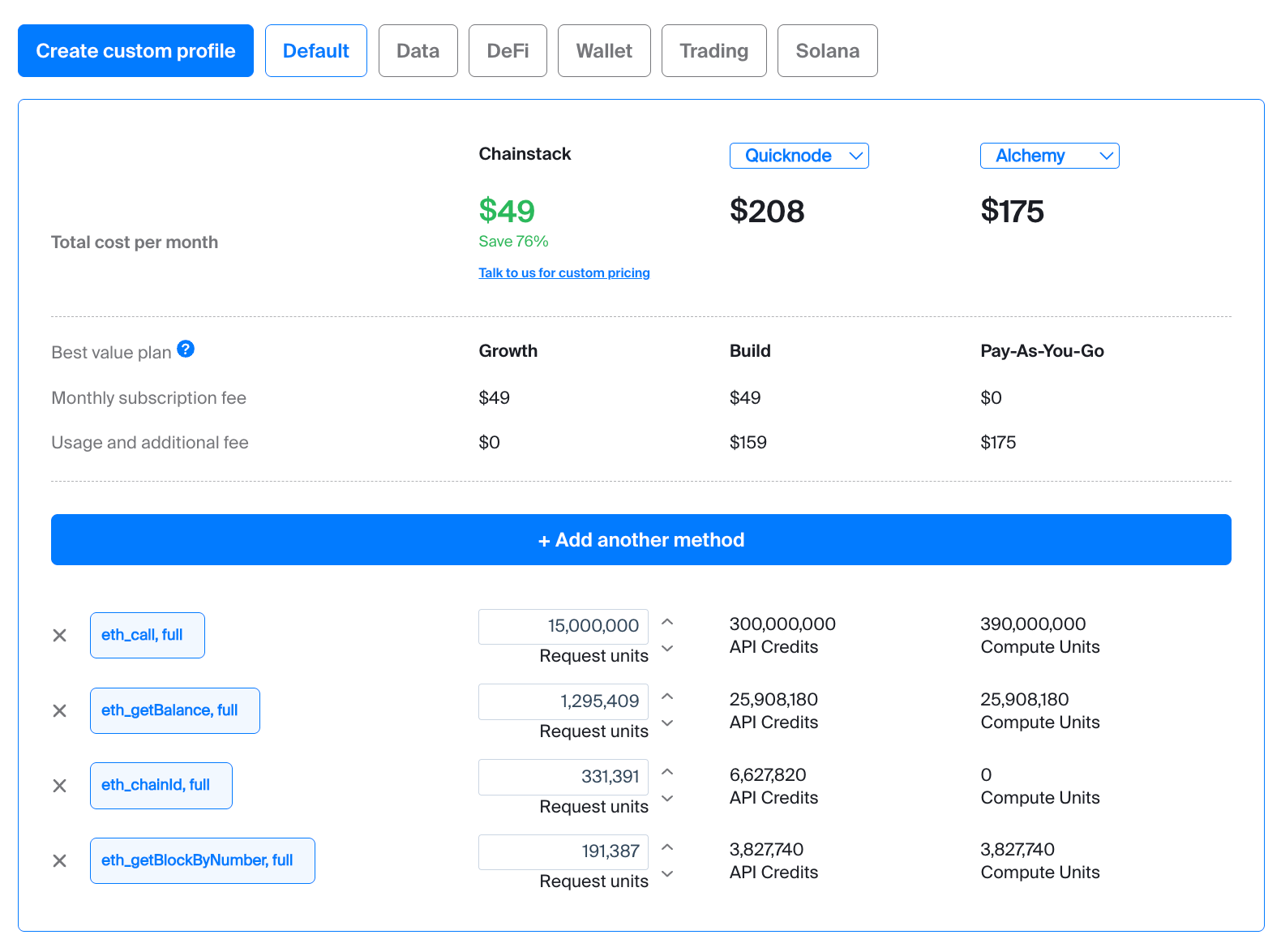
This structure is easy for moderate workloads, but transaction-heavy strategies should calculate cost per landed transaction, not per RPC call: 100,000 Warp submissions add $15,000 in routing charges. Base RPC usage is metered through Chainstack Request Units, so the total bill depends on RPC volume, Yellowstone concurrency, and Warp submissions.
Trade-offs: Chainstack is easy to adopt with standard Solana interfaces, but its Global Yellowstone replay window is designed only for short disconnects; ShredStream acceleration stays inside Chainstack's nodes; and Warp is a single bloXroute-oriented HTTP submission path that prioritizes speed over built-in front-running protection.
Which GetBlock alternative fits your use case?
The distinction between HFT choices now matters more than a generic “supports shreds” check. Helius Preconfirmations start before shreds but have participating-stake coverage constraints. Raw shreds maximize client control. TxStream, Deshred, Blazar, and other reconstructed feeds trade a small amount of provider-side processing for less work inside your critical path.
Benchmark providers against your workload
Do not migrate because one provider publishes a lower average latency.
Run every candidate under identical conditions:
- Client host and region;
- RPC methods and request concurrency;
- Yellowstone filters and commitment;
- Pre-execution filters and payload type;
- Transaction construction and blockhash source;
- Priority fee and route tip;
- Same observation period and congestion window.
For RPC, record p50, p95, p99, error rate, and distance from the network tip.
For streams, record first-byte and complete-message latency, slot gap count, duplicates, reconnect time, consumer lag, and transaction coverage.
For pre-execution feeds, also record the work remaining after receipt: shred reconstruction, deserialization, ALT resolution, simulation or prediction, strategy filtering, and reconciliation against the executed transaction.
For transaction delivery, record submit acknowledgment, confirmed slot, same-slot landing rate, dropped/expired transactions, priority fee, route tip, selected route, and total cost per landed transaction.
A sender that acknowledges in 20 ms but lands fewer transactions has not improved execution. A feed with excellent median latency but frequent gaps creates reconciliation work and trading risk.
Practical GetBlock vs RPC Fast test
For an ALT-heavy trading strategy, compare the two complete paths:
GetBlock now performs deserialization server-side when that feed mode is selected, so it is inaccurate to describe its customer path as raw-shred-only. RPC Fast's remaining distinction is execution-oriented enrichment and its integrated Beam route layer
Measure the timestamp from the first usable strategy signal to confirmed landing. That answers the business question better than comparing isolated feed latency.
.jpg)
Choose by bottleneck and keep failure domains independent
Providers aren't mainly distinguished by how many boxes they tick. They make different choices about where responsibility sits between provider and client:
.jpg)


.jpg)


